
Why do we watch films? For entertainment? To learn? To critique? Whenever there is criticism on how certain movies in their depiction or narratives are oppressive to a certain group of people or could have negative connotations, there is always a group that dismisses these claims with responses such as “It’s just a film!”. Because many times the movies that glorify hatred or are blatantly problematic also have a template that caters to people that appreciate peppy music, cinematography, direction, background score, etc. and like to ignore the subtext. When ideology fails, ‘art’ takes it upon itself to ensure that covert or overt propaganda reaches the audience. Whether we like it or not, films have been shaping society in many ways. Even if the audience consumes a film for its sake, the ideology seeps in, causing real world impact.
A few years ago we saw an influx of films that adopted the ‘Good Muslim vs. Bad Muslim’ trope, a type of storytelling involves two types of Muslims, the first one is shown to be very liberal, patriotic, someone who is ready to go against the bad Muslims who are always extremists. This is Islamophobic in itself as it puts the burden on Muslims to ‘prove’ their goodness to fit into this binary narrative.
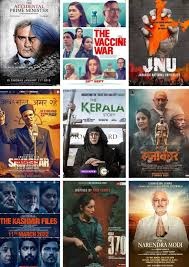
Coming to the plot of these films, use of relatability and ascribed attributes that people like to identify with, has become the implied blueprint used to attract the audience. These identities are used successfully to convince people into believing these narratives by employing half-truths and by conveniently omitting important contexts and perspectives. This manipulation tactic has worked very well, for example if I were to say that the film ‘Kashmir Files’ is propaganda, someone who has watched the film will ask me to prove that the exodus of the Kashmiri pandits is fake. The film whitewashes the fact that during the exodus, there was a BJP-supported government at the centre and uses the plight caused by the exodus to trump up Islamophobia.
The makers of movies like The Kerala story, Udaipur files, The Bengal files, The Sabarmati Report, Chhaava, Article 370, Bastar: The Naxal Story, often resort to the same defence of how the incidents shown in these films are based on true events. However, the scenes depicting these so-called true events are visually exaggerated and more often than not rely on false facts and narratives to sharpen the conflict. These films contain graphic scenes that act as emotional triggers to such an extent that any person watching these films even if slightly misinformed would resort to collective jingoism, anger, and even fear. So an average Hindu watching such films will relate to the Hindu identifiers the film uses and self-victimise.
What is concerning is that these films have given a pass to many closeted Sanghis to use these plots and stories to openly peddle the BJP narrative. These films only reinforce their ideologies and discussions that follow in support of these films later become echo chambers of hate that resort to targeting, stereotyping, and justifying exclusion of minorities and the marginalized.
Despite the court stays on the release of some of these films, they are always saved and have the government backing them up. Some of these films are promoted by the Prime Minister himself and screened at the Parliament. Recently the film ‘The Kerala Story-2’ was released in over 2,600 screens across India despite having a 15-day ban on release and ‘The Kerala Story’ was quoted by the Prime Minister in 2023 in one of his election campaigns.
While on one side the government loves promoting Hindutva agenda on the silver screen, the censor board that favours the ruling party is constantly censoring films that talk about social or economic injustice. The filmmakers that want to portray the truth often face serious censorship to make the truth palatable for the regime. Films like ‘Punjab ‘95’, ’Da’lit Kids’, and ’Santosh’ were not even allowed in film festivals. Even in a state like Tamil Nadu where the DMK is in power, the film Santosh was stopped from being screened at a film festival. Recently, the Indian release of ‘The Voice of Hind Rajab’, the Oscar-nominated Tunisian film about the death of a five-year-old girl during the genocide in Gaza, has been blocked by the censor board to avoid angering Modi’s fatherland, Israel.
During the time of Hitler, the radio was the most effective means of propaganda. Right now, film or any medium is not just a tool for entertainment, it is a propaganda machine, dictated by the needs of the ruling classes, alienated from the interests of the masses. Before we pay to watch a film, we need to understand the politics behind the film, who benefits from the narrative and who the film vilifies. We have to think of why films that clearly aim to whitewash the state get a free pass from the censor board while we barely hear about the rest that hold a mirror to society.