

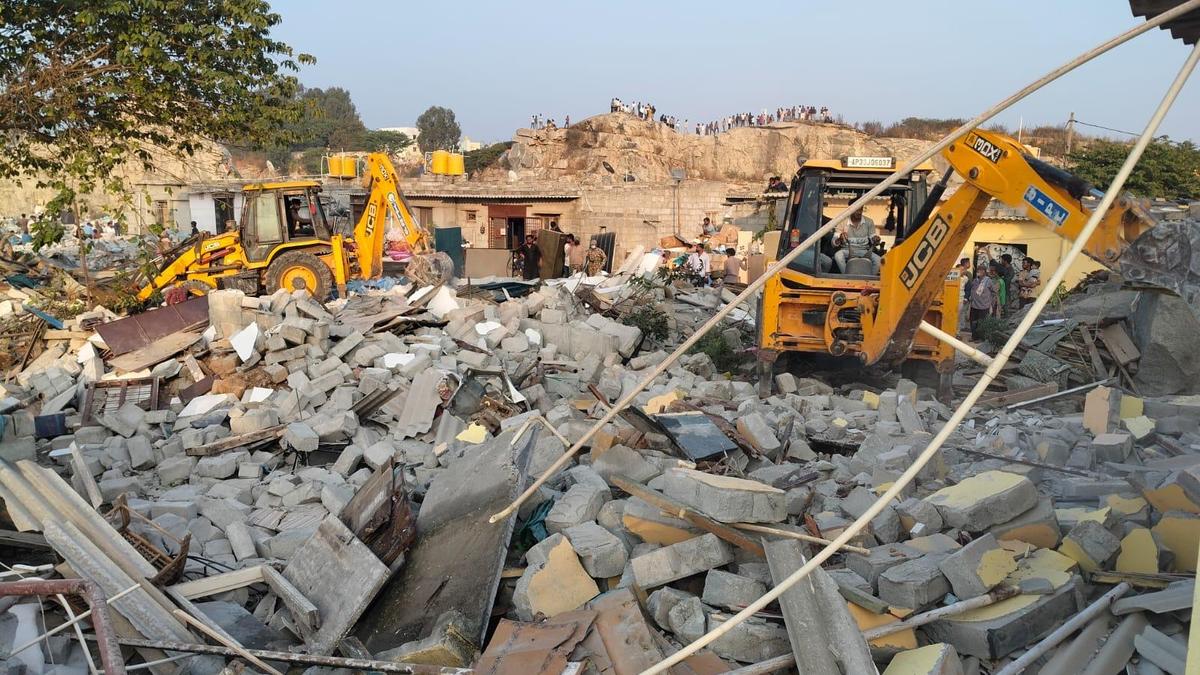
Bengaluru recently saw a spate of three demolitions in almost consecutive months in KG Halli, Kogilu layout, and Thanisandra. In all three places, demolitions were done without due process and zero compensation or rehabilitation. The use of force was also common to all these places. AISA comrades paid visits to KG Halli and Thanisandra demolition sites to understand the situation on the ground. The following observations are based on the visits and in case of Kogilu layout, the information has been taken from news articles.
KG Halli:
In the early hours of October 31, 2025, bulldozers rolled into a densely populated settlement called Suna Line 1, near the Kadugondanahalli (KG Halli) Railway Gate, leaving more than 100 families homeless in a matter of hours. The demolition drive, carried out by the Railway Protection Force (RPF) with the assistance of local police, was part of preparations to clear alleged encroachments for the Bengaluru Suburban Rail Project (BSRP), an initiative to expand and double railway lines in the region.
Residents from the affected area, many of whom belong to a largely Tamil-speaking Dalit community with some Muslim families, said they were taken completely by surprise. They were not given proper notice or sufficient time to vacate, with bulldozers arriving abruptly and starting demolition while many families were still inside their homes. Some people reported that officials had visited earlier under the pretext of a “survey” and collected personal details, leading them to believe no immediate displacement would occur.
The drive reduced significant parts of 29 multi-storey houses to rubble, displacing around 150 residents who were left to fend for themselves along the railway tracks with their salvaged belongings. Several families, including daily-wage labourers, domestic workers, and garment factory employees, described spending nights in makeshift tents with no shelter, sanitation, or basic facilities. Videos and firsthand accounts from residents show that police used force, including lathi charges, when people tried to secure their belongings or seek answers from officials. They were arranging for food through crowdfunding, however it was inadequate.
Residents shared that they had longstanding ties to the area, some families said they had lived there for multiple generations and even had documents showing approvals for house construction under government schemes. They argued that they had been paying for electricity and water for years and had no indication that their homes would be demolished.
Officials from the South Western Railway (SWR) defended the action, stating that the eviction followed due process and that multiple warnings had been issued to clear the encroachments. Police personnel present during the operation said that they were there only to assist the railways and denied responsibility for planning or executing the demolition. Residents said they planned to approach the High Court to seek legal remedies as proper notice and rehabilitation were not provided.
Kogilu Layout:
The demolition drive carried out in Kogilu, on the northern periphery of Bengaluru, has emerged as a stark illustration of the human cost of the city’s aggressive urban expansion. In late December, authorities razed large sections of informal settlements in areas such as Fakir Colony and Waseem Layout, displacing hundreds of families, many of them migrant workers who have lived and worked in the city for years. The demolitions were officially justified as the removal of “illegal encroachments” on government land earmarked for a solid waste management project.
Families reported that they were given no advance notice, with bulldozers arriving early in the morning under heavy police presence. Houses built incrementally over years were flattened within hours, leaving behind piles of debris and people scrambling to salvage belongings. The displaced included daily-wage labourers, domestic workers, street vendors and sanitation workers who form the invisible backbone of Bengaluru’s economy. With no immediate rehabilitation or alternative accommodation in place, families were forced to spend nights in the open, relying on community support and temporary relief arranged by activists. Children’s schooling was disrupted, and access to food, water and toilets became an immediate crisis.
The Kogilu demolitions quickly escalated into a political flashpoint. Opposition parties accused the Congress-led Karnataka government of engaging in ‘bulldozer justice’, drawing parallels with demolitions carried out in other states and alleging selective targeting of Muslim and migrant communities. The controversy spilled beyond Karnataka, with leaders from Kerala, including the CPI(M), strongly condemning the demolitions and questioning how a government that claims to be progressive could carry out such an action without ensuring rehabilitation. The BJP joined the fray banking on the identities of the evicted families and accused Congress of appeasement for promising the bare minimum of alternative shelters.
In the days following the demolitions, reports began to surface of groups affiliated to Hindutva groups targeting other migrant settlements around Bengaluru, emboldened by the Kogilu drive. Activists warned that the demolitions had sent a signal that informal housing, particularly that inhabited by migrants and minorities—could be removed with impunity. This intensified fear among thousands of families living in similar settlements across the city, many of whom possess identity documents, voter IDs and Aadhaar cards but lack formal land titles.
Public anger within Bengaluru also grew. Residents and activists staged protests, including a demonstration outside the residence of Revenue Minister Krishna Byre Gowda, demanding immediate relief, housing alternatives and accountability for the manner in which the demolitions were conducted. Protesters challenged attempts by some political actors to label the displaced residents as ‘illegal’ or ‘foreigners’, arguing that such narratives were being used to dehumanise people and shift attention away from the state’s failure to provide affordable housing and follow due process.
The Karnataka State Human Rights Commission took cognisance of the situation, raising concerns about whether the demolitions violated basic human rights and whether authorities had followed established norms requiring notice, consultation and rehabilitation before eviction. Legal experts and civil society groups pointed out that even when settlements are deemed unauthorised, the state has a constitutional obligation to protect the right to life and dignity, which includes access to shelter.
The Kogilu demolitions have reopened long-standing questions about Bengaluru’s model of urban development. The city’s rapid growth has depended heavily on migrant labour, yet housing policies have consistently failed to accommodate low-income workers. Informal settlements have proliferated not out of choice, but necessity, filling the gap left by the absence of affordable rental housing and inclusive urban planning.
Ashwath Nagar (Thanisandra):
The demolitions commenced at 6 AM on January 8, 2026, and continued until 2 PM. Authorities returned at 4 PM to resume operations, indicating a rushed and aggressive approach. No prior notices were issued to the residents, violating basic legal procedures for evictions. This sudden action left families unprepared and in distress. Although the BBMP, now Greater Bengaluru Authority, had issued e-Khata (electronic property records) to some residents, the land falls under the jurisdiction of the Bangalore Development Authority (BDA). BDA officials claimed the area is part of the Arkavathy Layout Project notified in 2004 and alleged that the land was illegally sold and subdivided over the years. Out of approximately 64 houses in the area, more than 30 were demolished. Primarily kuccha structures were targeted, while pucca (permanent) houses received notices prior to any action, revealing inconsistencies in enforcement. A local Congress leader claimed that the property belongs to D.K. Shivakumar, a prominent real estate giant and the Deputy Chief Minister, raising questions about conflicts of interest and selective enforcement.
Residents reported being manhandled and dragged from their homes while still asleep. This included vulnerable groups such as women and children, and disabled people across ages (including heart and stroke patients), exacerbating the trauma of the event. Some residents protested by threatening self-harm, such as drinking acid, in a desperate bid to halt the demolitions. Police vans were deployed at the site, and officers, along with Congress leaders, allegedly threatened evicted families to vacate using brute force by the morning of January 12, 2026. Women were specifically instructed to stay with relatives, and police warned that any protest would be dispersed within 30 minutes. Just two days before the demolitions, Cauvery water was supplied to the area for the first time, creating a false sense of security among residents.
Affected families have erected makeshift tents without adequate protection from the elements. Toilets in the area are in abysmal condition, posing health risks. Some residents had built and rented out temporary structures, which were also demolished, leading to a loss of rental income. An elderly man shared that his three sons had not gone to work for three days following the demolitions due to the chaos and need to salvage belongings. The area is home to daily wage earners and low-income families, many of whom now face homelessness. School-going children have been unable to attend classes, with their books and study materials stuck under the rubble or destroyed. The neighbourhood is predominantly Muslim, with a significant number of Tamil Dalits, making this eviction particularly impactful on marginalised communities already facing socio-economic challenges.
Local Congress leaders distributed ₹25,000 to some affected families, an amount insufficient for finding alternative housing in Bengaluru’s expensive real estate market. Additionally, Congress and the Social Democratic Party of India (SDPI) workers provided biscuits and packaged drinking water as immediate relief. The local MLA and Minister Krishna Byre Gowda, who has won elections in the constituency for the past four terms, has reportedly never visited the area, showing a lack of interest. Some residents had previously challenged the government in the Karnataka High Court six years ago and won their case. They now express intent to approach the Supreme Court to seek justice and prevent further encroachments on their rights.
The minimal relief provided fails to address the long-term needs of displaced families, who are now living in precarious conditions amid ongoing threats from law enforcement. We demand immediate halt to further demolitions and rebuilding of the destroyed property, provision of adequate temporary shelter, sanitation, and basic amenities for affected families; a transparent investigation into the ownership claims and the decision-making process behind the evictions; fair compensation and rehabilitation packages that enable families to rebuild their lives, including support for education and livelihoods; accountability for police and officials involved in manhandling residents and issuing threats; and engagement from elected representatives to address the grievances of marginalised communities in the area. This report calls for solidarity with the affected residents in all these areas spending sleepless nights in an uncertain present and future. The civil society, activists, and political organisations must strive to amplify their voices against such injustices.
These demolition drives exemplify a pattern of state-sponsored evictions targeting the urban poor without adequate rehabilitation or legal safeguards. It must be seen in conjunction with the broader agenda of city expansion for the benefit of real estate giants and multinational corporations setting up shop in Bengaluru, one of the biggest hubs of foreign investment. The absence of notices, combined with allegations of political ownership, shows that Congress, despite its slogans of social justice, will stoop to any level to appease its corporate masters. It must be noted that this ‘bulldozer raj’ is not confined to the city limits, it is connected with the displacement of farmers from their land in the outskirts too. With the pushing out of industries from the cities, the newer ones, be it godowns serving the service sector or factories, are coming up on the peripheries. Thus, demolitions in KG Halli, Kogilu layout and Ashwath Nagar, and land grab in Devanahalli, Anekal, Bidadi, are all part of the same neoliberal agenda.