
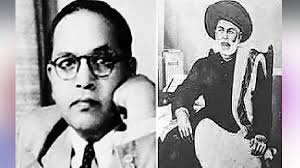
April 11th and 14th respectively mark the birth anniversaries of two of India’s most radical anti-caste thinkers: Jyotirao Phule and B.R. Ambedkar. Remembering them now is a necessity for all of us. Both challenged the foundations of caste society and dedicated their lives to the liberation of the oppressed. At a time when their legacies are often diluted or appropriated, revisiting their ideas becomes essential to reclaim their vision of equality, dignity, and justice.
Phule and Ambedkar were not merely social reformers; they were architects of a radical anti-caste politics rooted in material realities. Phule’s Satyashodhak Samaj mobilised peasants, workers, and oppressed castes against Brahmanism and the exploitative “Shetji-Bhatji” nexus, linking caste oppression with economic exploitation. His politics was democratic, anti-feudal, and grounded in mass mobilisation.
Ambedkar carried this forward by organising Dalits into a political force. Through struggles like the Mahad Satyagraha and his leadership of the ‘Depressed Classes’, he transformed caste from a social issue into a political question. He identified Brahmanism and capitalism as twin enemies and argued that independence without social transformation would reproduce oppression. While engaging with constitutionalism, he remained committed to annihilating caste and securing rights for workers, women, and oppressed communities. Both saw liberation as a collective, structural process of resistance, not mere reform, which is how their thoughts have been diluted, by many.
On education:
For both Phule and Ambedkar, education was not a neutral institution; it was a site of power. Denied historically by Brahmanism to the oppressed, education functioned as a mechanism to sustain caste hierarchy. Their intervention lay in transforming it into a weapon of resistance.
Phule was among the first to recognise that caste domination was sustained not only through economic control but through ideological control: through religion, customs, and the monopoly over knowledge. He argued that oppressed communities were kept in ‘mental slavery’ by being denied access to education. For him, education was liberation: it enabled individuals to question authority, understand exploitation, and assert their rights. This is why he prioritised opening schools for girls and oppressed caste children, directly challenging Brahmanical restrictions on learning.
Importantly, Phule rejected the elitist notion that education would ‘trickle down’ from upper castes. He demanded universal and compulsory primary education, insisting that knowledge must reach the masses. He also emphasised practical education (skills, agriculture, and everyday knowledge) so that learning would directly improve material conditions. His advocacy for education in vernacular languages further reflected his commitment to accessibility. Representation, too, was central: he believed teachers must come from all castes so that marginalized communities could see themselves within educational spaces.
Ambedkar deepened this vision by placing education at the centre of political struggle. His slogan “Educate, Agitate, Organise” was not rhetorical, it was a strategic framework. Education, for him, created the consciousness necessary for agitation, which in turn enabled organisation. Without education, he argued, oppressed communities could neither understand their rights nor build collective power.
Ambedkar’s own life embodied this belief. Despite severe caste discrimination, he pursued higher education and used it to analyse the caste system and expose its structural nature. He saw education as a means to develop rationality, scientific temper, and critical thinking which are qualities necessary to dismantle oppressive traditions. He consistently opposed blind adherence to scriptures like the Manusmriti and instead promoted logical inquiry.
Institutionally, Ambedkar worked to expand access to education through hostels, scholarships, and organisations like the Bahishkrit Hitkarini Sabha and the Depressed Classes Educational Society. These initiatives addressed structural barriers such as poverty, exclusion, and lack of infrastructure that prevented Dalits from accessing education. He also fought for reservations, recognising that formal equality was insufficient in a deeply unequal society. For Ambedkar, education was also tied to dignity and self-respect. The struggles he led were as much about asserting equality as they were about access to resources. Education enabled oppressed communities to challenge humiliation and claim their place in society.
Both thinkers also linked education with broader social transformation. They understood that caste was intertwined with patriarchy and economic exploitation. Phule’s emphasis on women’s education and Ambedkar’s advocacy for women’s rights highlight their recognition of gender as central to caste oppression. Education, therefore, had to be inclusive and transformative, not merely technical.
Crucially, both opposed the commodification of education. Ambedkar argued that the state must invest in public education, ensuring that resources are redistributed to benefit the oppressed. Education, in their vision, was a public good, essential for democracy itself. Phule and Ambedkar redefined education as a radical, emancipatory force. It was not just about individual upliftment but about collective liberation. It was about creating a society based on equality, liberty, and fraternity.
Relevance today:
In the present moment, remembering Phule and Ambedkar requires moving from reflection to action. Students must organise because the structures they fought continue in today’s society significantly. Identifying the primary enemies is crucial: feudal social relations, imperialism, and its Indian lackeys that promote privatisation and saffronisation of education.
Ambedkar’s insight that imperialism cannot be fought without confronting its internal allies, landlords, capitalists, and dominant castes, remains relevant in today’s neo-colonial context . While Ambedkar strategically engaged with colonial rule to secure rights for the oppressed, he remained critical of national elites who represented landlord and capitalist interests.
Today’s ruling parties continue to collaborate with dominant caste and class forces to maintain status-quo. At the same time, figures like Ambedkar are appropriated by organisations such as the RSS to saffronise their radical legacy. Students must resist this appropriation and reclaim their ideas. Integrating the visions of Phule, Ambedkar, and Bhagat Singh points towards a broader struggle for both social and political justice, one that confronts caste and class together. The youth of today need to take up this task and march towards this goal.