
On 24th of February members of Akhil Bharatiya Vidhyarthi Parishad (ABVP), the student-wing of the RSS, forced their way into Azim Premji University (APU) Sarjapura campus to disrupt a discussion organised by the Spark Reading Circle marking 35 years of the Kunan-Poshpora atrocities. A discussion was escalated into vandalism, assault, police intervention, and finally an FIR filed by the university against its own students for a ‘breach of university protocols’.
The ABVP members forced entry, blackened the university name, scrawled ‘Ban Spark’ and ‘Ban AISA’ on campus walls, vandalised property, and raised slogans. The security guards resisting their entry were assaulted. A student wearing skullcap was targeted and beaten up. Despite the Sarjapura police station being in close vicinity of the university campus, an effective police intervention took nearly two hours. The police largely remained passive as vandalism and intimidation continued before roughly 20 detentions were finally made. This delayed response allowed the attackers to proceed deep inside the campus and continue their rampage uninterrupted. The vandals even threw chappals at students.
In response, hundreds of students mobilised in resistance. They refused to disperse despite attempts by security, admin, and police to clear gatherings. By 8 pm, students began a peaceful counter demonstration inside the campus condemning the organised assault on academic freedom and ABVP. On February 25th, many students boycotted classes in protest.
A formal FIR against the ABVP members involved in the attack was filed by the security manager at 8:10 pm on 24th February. The FIR registered included charges under Sections 191, 189, 351, 115 and 329 of the Bharatiya Nyaya Sanhita. The FIR named the affected security personnel and the targeted student as the victims.
The second FIR filed at 11:30 pm on 24th February, however, targeted the Spark Reading Circle Instagram account handlers. The Registrar filed this complaint against a “specific social media handle that used the University’s name without authorisation”. He also stated that ‘on the Instagram page …several defamatory posts unrelated to our university have previously been made, damaging the reputation of our institution’, indicating the retaliatory nature of the FIR. Sections 299 of the Bharatiya Nyaya Sanhita (hurting religious sentiments), 66E (intentional, non-consensual capture, publication, or transmission of a person’s private intimate images), and 67 (publishing, transmitting, or causing to be published/transmitted of obscene material in electronic form) of the Information Technology Act (2008) have been absurdly invoked.
The decision to file an FIR against students is alarming, it equates those who organised a discussion with those who carried out violence and allows confusions in accountability. Supporting students does not mean endorsing every idea they express. It means affirming their right to express and examine ideas without fear of violence or legal intimidation. When external goons enter a campus and disrupt an event, the institution must clearly stand with its students and draw a firm line against such interference.
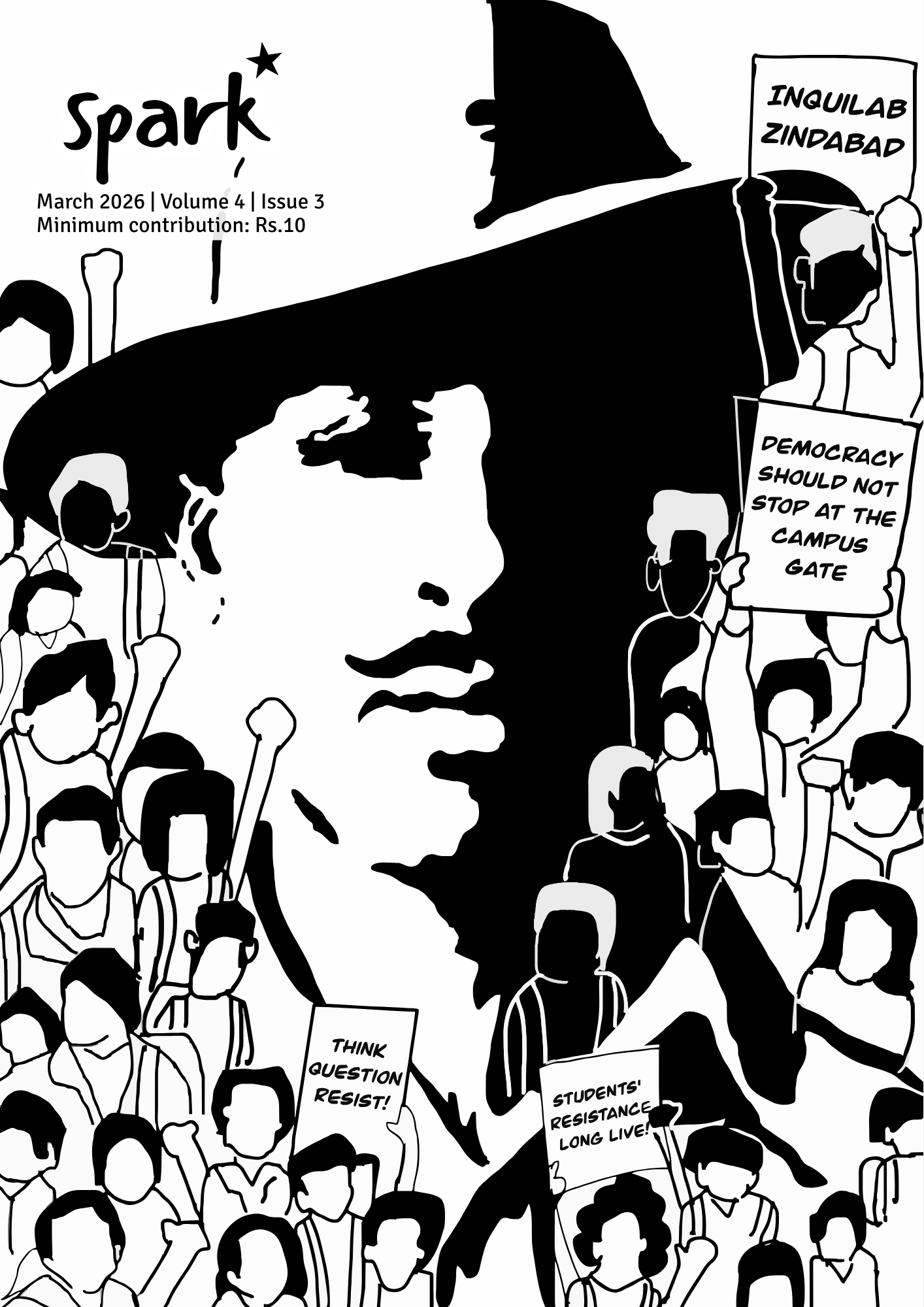
For more than three years, Spark magazine has organised discussions, published writings and engaged students on social and political questions within campus spaces. No call to violence or disruption was initiated by organisers on that day as opposed to the open threats and labeling of ‘anti-national’ by ABVP.
Solidarity has emerged across academic and civil society circles. Starting from APU alumni, Bahutva Karnataka, left student groups, and numerous human rights groups unequivocally denounced the vandalism and the FIR lodged by the university. The Democratic Teachers Initiative warned that criminalising students while granting bail to attackers reflects a troubling institutional imbalance. PUCL Karnataka described the incident as vigilantism, citing the Supreme Court’s observations in Tehseen Poonawalla v. Union of India and demanded withdrawal of the FIR against students. The All India Forum for Right to Education condemned the delayed police response and the non-bailable charges on the students. The APU Student Council highlighted the ‘asymmetry’ between the treatment of vandals and student organisers. NAJAR backed the students and called for protection of democratic dissent. AILAJ stated that the FIR is part of a larger trend where victims of mob attacks themselves face punitive charges.
ABVP is on a rampage across the country to crush all spaces of democratic dissent. From JNU, Jamia, DU, to APU, the troubling pattern continues with tacit state support. Attempts to silence through mob force and criminal law are attacks not only on students but on the future of education itself. In this alarming situation, we demand the following:
- Immediate withdrawal of the FIR against Spark Reading Circle Instagram handlers.
- Universities must protect a space for democratic discussions, not crush it with an iron fist.
Lastly, Spark stands in solidarity with the resistance put up by the Azim Premji University students in the face of communal assault and institutional backlash.