

In India, we have often come across success stories of how several recognised restaurant chains first started as humble roadside stalls or as street food carts. These stories celebrate individuals who supposedly started from ‘nothing’ or ‘the bottom’ and eventually built culinary empires. However, the reality of most hawkers is far removed from these celebrated tales of ‘self-made’ entrepreneurs.
For millions of street vendors across the country, selling vegetables, fruits, tea, snacks, clothes, or household goods is simply a means of survival. They work long hours in the informal economy, earning just enough to feed their families while receiving little recognition, protection, or security from the state. Yet when governments decide to ‘beautify’ or ‘sanitise’ cities or reclaim public spaces, these same vendors are often the first to lose everything.
In India where ‘bulldozer justice’ is seen as something to be celebrated by the ones that support these pro-establishment or anti-poor drives, for the helpless the selective ways of the bulldozers spell the end. This has been evident in different parts of India, most recently after BJP coming to power in West Bengal, where hawkers near major railway stations were suddenly met with arbitrary eviction from their livelihoods using bulldozers. Demolitions and evictions like these are often justified by claiming they are necessary to remove encroachments, improve pedestrian movement, and enhance public convenience.
Phrases like ‘anti-encroachment drive’ have become a powerful political tool, it conveniently portrays the poor as illegal occupants while rarely questioning how or why there is a structural failure in implementing laws such as the Street Vendors Act, 2014. While the act clearly states that no vendor can be evicted until a local Town Vending Committee conducts a comprehensive survey and issues a Certificate of Vending, what is often missed is how these surveys are delayed on purpose to treat the vendors as ‘illegal encroachers’ and order a clean-up drive.
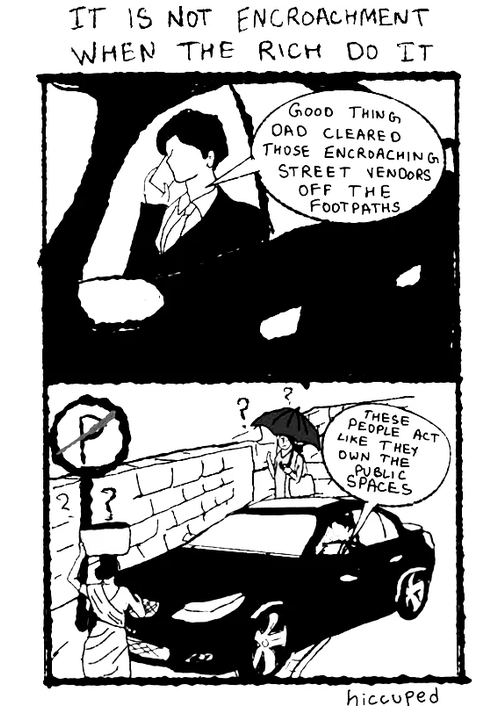
Who really benefits from this redevelopment? Why are informal workers denied a place in the cities they help sustain? The irony is difficult to ignore. Time and again we have seen how capitalist-owned large commercial establishments routinely occupy public land through parking encroachments, illegal pavement extensions, and advertising structures. We have seen rich neighbourhoods or housing complexes occupying footpaths with hundreds of fancy cars. Yet it is the small tea stall, fruit cart, vegetable or fish vendor that becomes the visible symbol of ‘illegal occupation’. The idea of urban development is blatantly selective, targeting those with the least economic and political power while leaving larger violations untouched.
In Bengaluru and Mumbai, too, hawkers have repeatedly faced eviction drives citing traffic congestion, road widening, and city beautification. Instead of recognising and planning street vending as an essential part of the city’s economy, authorities frequently treat vendors as obstacles to development. The aim is to redirect their customer base to bigger capitalist establishments. Recently, the Greater Bengaluru Authority (GBA) has taken up demolition drives and has notified around 1,500 km of arterial, sub-arterial and major roads across the city as non-vending zones. There has been an expression of public outrage against this plan.
While eviction drives are officially presented as neutral administrative actions, they come with communal narratives where Muslim vendors are at the receiving end of harassment, intimidation, and organised economic boycotts by Hindutva forces. Across several cities, Muslim slums, Muslim-owned roadside stalls, vendors, butcher shops, etc., have often found themselves disproportionately targeted during demolition drives.
When the state disregards its own laws, bulldozes livelihoods, and pushes the poorest further into destitution in the name of development, it is not only reclaiming land. It is also encroaching upon people’s constitutional right to life and livelihood. Public spaces are not meant to be ‘beautified’ to appease upper-class aestheticism but to serve the people. In this regard the rights of the vast majority of working class street vendors who maintain the economic life of the city, must be protected. A government that snatches away these rights is the true encroacher.