
A Struggle That Began with Jobs
The recent struggle of agricultural science students and graduates in Karnataka was triggered by a government decision to open Agricultural Officer (AO) and Assistant Agricultural Officer (AAO) posts to graduates from non-agricultural disciplines. As frontline positions for taking agricultural knowledge and technology to farmers, students saw the move not merely as a threat to employment, but to the professional and farmer-oriented character of agricultural extension.
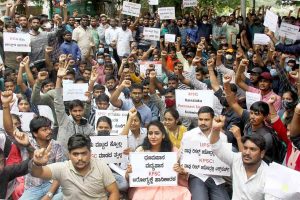
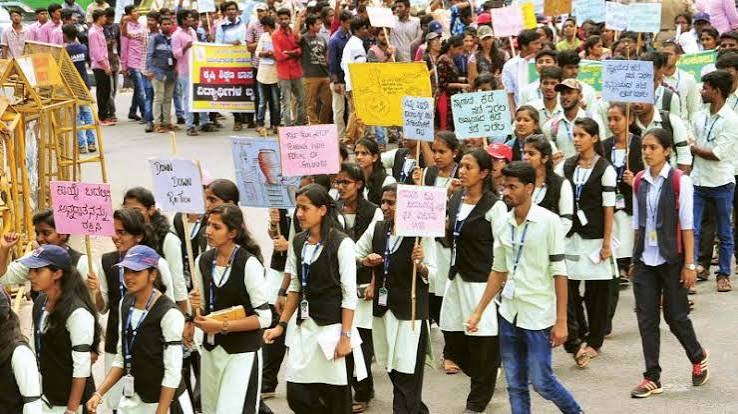
Over the past few months, students across Karnataka’s agricultural universities mobilised through protests, class boycotts and demonstrations. The struggle culminated on 6 August, when students from all five agricultural universities converged at Bengaluru’s Freedom Park. Their sustained, peaceful agitation compelled the government to postpone the AO/AAO examination and initiate a review of the contested eligibility decision. It demonstrated the power of organised student action to make governments respond.
Who Controls Agricultural Education?
The struggle must also be seen against the wider transformation of agriculture and agricultural education in the post-liberalisation era. In Karnataka’s agricultural universities, inadequate public funding, weak infrastructure, faculty shortages and growing pressures of privatisation and commercialisation have eroded public agricultural education.
Meanwhile, agribusiness and corporate influence, including through biotechnology, have increasingly shaped agricultural knowledge within a market-driven framework. The issue is not opposition to science or technology, but who controls its direction and who benefits from it. Public agricultural universities must remain adequately funded, accessible to rural youth and oriented towards farmers and the public interest. Many agricultural students come from farming and rural families, for whom higher education is a major investment in an increasingly uncertain agrarian economy.
Rising educational costs and shrinking employment
opportunities therefore impose a double burden on them.
This raises a crucial question: who governs these universities? When Vice Chancellor appointments are influenced by political considerations, money power, caste interests or personal networks rather than merit, institutional autonomy and credibility suffer. Students bear the consequences through opaque recruitment, weakened academic standards and, crucially, diminished opportunities within their own universities. Their demand for transparent, merit-based leadership and fair recruitment is therefore part of the same struggle.
The transparency and fairness demanded through recent nationwide agitations over public recruitment and examinations such as NEET must equally apply to Vice Chancellor appointments, which shape academic priorities, recruitment, finances and governance. Accountability must extend beyond the examination hall to those who govern these institutions.
From Victory to Wider Struggle
Farm graduates’ victory should be seen as a beginning, not an end. It reflects the wider employment crisis facing India’s youth. Despite expanding higher education, stable public employment has not grown proportionately. Delayed recruitment, limited vacancies, examination irregularities and paper leaks have deepened insecurity. The crisis is therefore not merely unemployment, but the erosion of secure and dignified employment. The students’ experience offers a wider lesson: collective struggle can win. The task now is to carry it into the universities, connect it with the struggles of students, unemployed youth and young workers, and build wider solidarity for education, employment, dignity and a more just and democratic future.
*Retired Professor, UAS Bengaluru; Former Chairman, Karnataka Agricultural Prices Commission (KAPC); Member, Karnataka State Policy and Planning Commission (KSPPC)