
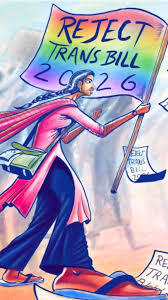
Existing as a visibly trans person in this country has never been easy. During British colonial rule, eunuchs (an outmoded term for hijra, kinnar, intersex people, feminine men, and gay men) were outlawed alongside tribal, adivasi, denotified tribes, and nomadic tribal communities under The Criminal Tribes Act of 1871. When the law was repealed in 1952, trans people emerged unbent, proving that criminalization alone cannot stop people from self-identifying with a gender not assigned at birth. That power will always reside with the individual.
Legal status aside, socio-culturally, transness and intersexness remained poorly understood, deeply stigmatized, and perpetually marginalized. The only exceptions, if you can even call it that, would be the socio-cultural communities that are allowed to participate in upper caste Hindu religious and cultural institutions. These are the ones that find mention in the Transgender Persons (Protection of Rights) Amendment act, 2026 as pre-identified trans people – the hijra, kinnar, aravani, jogta. Similar communities – the thirunambi and the thirunangai from Tamil Nadu, as well as the kothi, durani, nupi manbi, khwaja sira – have found themselves excluded from this act, perhaps because they do not slot quite so easily into the current regime’s Hindutva agenda.
The issue is not simply that some groups have been added while others have not. The malicious intent of this act, and of the powers behind it, is a bid to align certain sociocultural groups toward them politically – a plan which may have backfired in the short term. The act does this by conflating sociocultural communities with gender, which is like saying all Hindus are men. This begs the question – are there any Hindu women, and do they have rights? This is not a frivolous question; the act lays forth the path to marginalize any group within a wider body of previously protected individuals. If Hindu women think they are safe now and that the trans act does not apply to them, they are clearly not paying attention.
You can see this exclusion at play in the diverse groups that have specifically been left out in this act. Self-identified trans men, trans women, non-binaries, and genderqueer people no longer exist according to this act. They have to have undergone sex-reassignment surgeries BEFORE they can legally change their gender markers to either ‘Third Gender/Trans’ or the one opposite to their gender-assigned-at-birth. What a wild expectation from this administration – that people not live out their lives in terms of the gender they identify with, before undertaking surgical interventions that are expensive, excruciating, and sometimes dangerous or debilitating (such as bottom surgeries for trans men in India). The government will now dictate the direction and pace at which one is expected to modify one’s body, or at least this is the panic it is trying to create.
Do not misunderstand this act – this is a pro-surgery act. This Ramrajya wants everyone to undergo surgeries immediately, at unequipped and inept government hospitals, so that you can look the part. In the Ramrajya, if you say you are a woman, you better look like you have breasts and a vagina. In the Ramrajya, if you say you are a man, you better not be carrying a womb and vagina that can issue children, because then the government would want access to your reproductive labour instead. The issue with autonomous trans people is that they understand that gender-affirming care goes beyond surgeries. Even for binary trans people, their refusal to play the gender roles expected of them is part of the ungovernability that this regime finds particularly like a mote in their eye.
Wherever fascist regimes find ungovernability, they introduce increased bureaucracy and repression, both of which feature largely in this act. We could be quick to denounce the fact that The Ministry of Social Justice and Empowerment did not consult anybody from the National Council for Transgender Persons, or any NGOs, or the community at large. But it is important to understand that this act is not simply incompetent (which assumes benevolent intent from the government). No, this act is flawed by design. Even if consultations were made, this fascist state has shown that it is not a democratic republic. This is machinery run by brown sahibs.
Since 2014, with the NALSA judgement, magistrates had been defanged to some extent. Bureaucratic machinery remained dense as ever, but they could no longer outright deny trans people the right to choose between “T”, “M”, and “F” markers. The medico legal complex had also slowly, if begrudgingly, begun to grant trans people more choices. Society, in parts, had begun to move beyond selling transphobia and homophobia on screen. Privately, these stigmas still remained, but with the legal force of the Trans Act 2019, trans people now had certain freedoms and recourse within the system. With the new act, all this progress is now reversed. Sahibs sitting in some office, with no education or sensitization on the matter, will have more say on the matter of an individual’s gender at a legal level than the individual themself. Medical boards set up in government hospitals comprising doctors who have never interacted with trans people nor learnt about trans healthcare, will determine the individual’s gender at a medical level. All of these gatekeepers are sites of possible discrimination, humiliation, and traumatization.
If we know one thing, it is that sahibs will always take advantage of the historically vulnerable. So long as there is a chair of power somewhere (and this Act will enact many such chairs of power), trans people will be exploited financially, sexually, and physically. They will be pushed mentally to breaking points as the Act potentially criminalizes anybody who offers support to trans people during their transitioning journey, including queer/trans elders, trans partners, trans-affirming psychologists, and private trans medical care providers. Thankfully, resistance also seems to be coming from the latter two corners, not just the LGBTQIA+ communities.
Like with the Criminal Tribes Act, this law will eventually be struck down. Like Advocate Kanmani of the Thirunangai community herself said, “Trans people existed long before the NALSA judgment. They will continue to exist long after this Trans Amendment Act has come and gone.”
In the interim, the lives of trans people will become harder than ever before. It is incumbent on Communist organizations to provide support to trans individuals and movements. It could be material support in the form of mutual aid drives; or encouraging discourse on the matter through discussions and campaigns; or joining protests in solidarity; or providing structures to help their organization efforts; or pushing for greater inclusion and visibility of trans and genderqueer folks within their ranks; or all of the above. It is vital that trans people see that Communists view the causes of gender minorities in the same vein as they view class struggles. Then and only then, will vulnerable communities feel safe enough to join with broader struggles.