

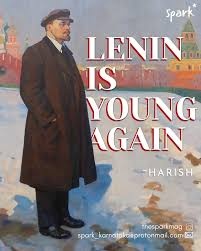
On 8th March 1887, five Russian students who were running a secret revolutionary study circle at St. Petersburg University were hanged by the Tsarist regime. The leader of the group, Alexander, had a younger brother who was only 17 years old at the time. Alexander’s martyrdom deeply impacted this young man; however, instead of following a path of mindless revenge, he chose a different path. He would later grow up to become someone who would change the course of history forever. Looked up to by revolutionaries like Bhagat Singh, Charu Majumdar, and others, he was Vladimir Ilyich Ulyanov, known by his party name, Lenin.
Comrade Lenin was born on 22nd April, 1870 in the city of Simbirsk, Russia. He was first attracted to Marxist ideas at the age of 18 through secret study circles at the University of Kazan. Due to his systematic method of study and steely discipline, within months he was capable of delivering lectures in illegal circles and went on to start a Marxist study circle of his own. Within a few years, Lenin moved to St. Petersburg, an industrial city of the toiling masses. There, he worked under the cover of an assistant lawyer while increasingly involving himself in revolutionary activities. He played a key role in persuading the study circles in St. Petersburg to take up mass agitation among the workers.
He later united these small study circles into the Russian Social Democratic Labour Party (RSDLP) and pioneered the idea of a strong vanguard party, a close-knit group of professional revolutionaries armed with revolutionary theoretical knowledge and skilled in underground work, who would lead the broad masses through mass organizations. He also launched the party’s propaganda newspaper Iskra (meaning spark).
Thus, even under severe repression, ranging from illegal study circles and secret poster distributions in factories and farms to militant general strikes and outright armed insurrections of workers and peasants, organisational work continued. Comrade Lenin led the Russian toiling masses to victory by establishing the world’s first workers’ state in 1917.
Comrade Lenin’s other major contributions include theorizing imperialism as the highest stage of capitalism, or capitalism in decay. He also played a crucial role in combating empiricist, opportunist, and reformist tendencies that constantly arise within the revolutionary movement. From fighting the Menshevik reformists to opposing the renegades in the Second International, Comrade Lenin demonstrated to revolutionaries of all generations that only through relentless struggle can true progress and the emancipation of the working class be achieved.