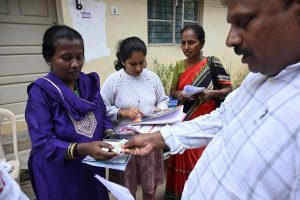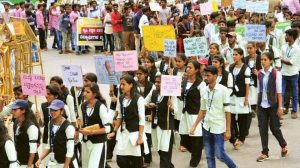

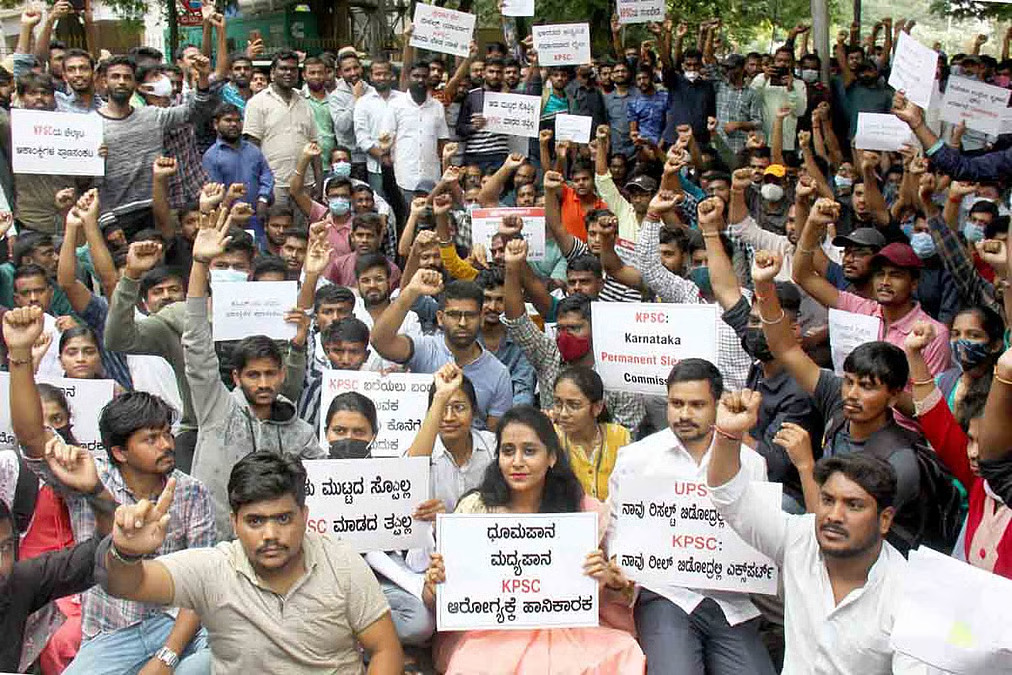
When over 4.5 lakh candidates across 800 centres in Karnataka were sitting to take their Police Constable Recruitment Exams on August 2nd, many were faced with confusion. Exams that were supposed to start at 10:30 am instead started at 11:00 am, some candidates missed either their question papers or OMR sheets and those who got them were met with mismatched serial numbers between their two sheets. This happened across many centres, reported by Karnataka Examination Authority (KEA) itself. But in an examination centre in Tikota, Vijayapur, unrest began; students unwilling to compromise the results of their efforts due to an opaque recruitment process walked out of the centre demanding that the authorities redo the examination given the mishandling. With the overall reduction in government recruitment despite thousands of vacancies, the few examinations that happen see immense footfall.
KEA claims that the codes on the OMR sheets and the question papers need not match, and that this confusion was present in many centres but students ‘calmed down’ and continued with their exams after the administrators of the centres explained to them what the actual procedure was. But KEA has not acknowledged the delay or other issues the students faced during the process. Priyank Kharge, the Home Minister of Karnataka, even went so far as to say that he would resign only after protesters undertook a 25-day hunger strike and after a lathi-charge if the situation remained uncontrolled. KEA has now barred the students who walked out of the examination centre from ever taking the test citing their walking out after receiving question papers as a violation of rules and an act that compromised the integrity of the examination. With these excuses, coveted government job opportunities are stripped from students, leading them to rely on private or contractual employment.
Why is it that a body that exists for the sole purpose of conducting examinations has mishandled a recruitment process, compromising the futures of many? The recruitment of police constables was initially the responsibility of Karnataka State Police, and was recently taken over by KEA. Examinations were also taken over by the KEA from Karnataka Public Service Commission after scams.
Similar to the NTA, KEA has expanded largely, having taken 17 competitive examinations and processed over 20 lakh applications in 2024. To maintain this agency would require a large workforce. Most autonomous examination bodies (e.g., NTA) in India typically run on a mix of permanent employees and contractual, outsourced employees, and in Karnataka, we see that out of 5.88 lakh government employees, 16% are outsourced employees. These employees come and go, meaning structure and smoothness in operation are absent. KEA has been faced with paper leaks and malpractices in the past. Yet these bodies rely on contractual workers solely to exploit them harder, pay much below government scales, without giving any social/job security. Unionising is also cracked down upon instantly making it difficult for workers to have any bargaining power. This results in jeopardising the future of thousands of candidates. For many candidates now, all their effort and preparations are for naught.