

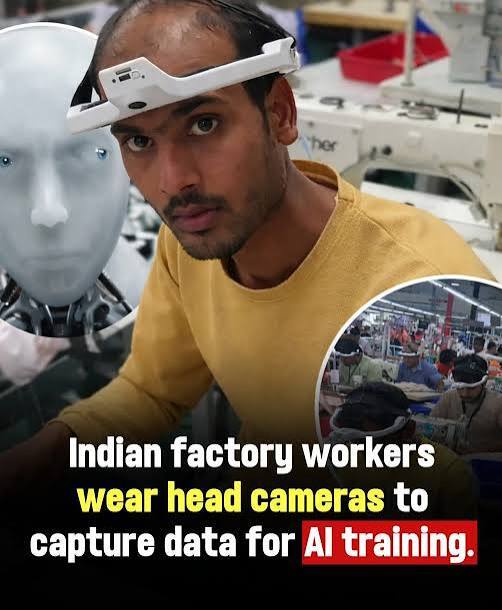
As Orwellian dystopia arrives at Indian factories, workers strap cameras on their forehead to train Artificial Intelligence (AI) models that will replace them in the future. Workers from textile mills to domestic kitchens help train AI to help build humanoid robots of the future.
Human data anchors are the new class of digital labour that has quietly emerged in India’s urban centres. This requires labourers to strap a camera to their foreheads, recording first-person video footage designed to teach AI models and humanoid robots how to navigate the real world. This model was developed by Egolab.ai founded in January 2026 at Maharashtra, India which was later acquired by Build AI, a U.S registered company based in Delaware in March 2026.
In Chennai, a 25-year-old housewife straps a smartphone to her forehead as she slices fruits in her kitchen, earning Rs.250 an hour from a specialised smartphone application. In a fake, fully furnished studio apartment a 21-year-old engineering graduate records approximately 90 videos a day of folding clothes to train the depth-sensor from every angle conceivable. These recordings of first-person view are called “egocentric data”. While developers estimate that at least one billion hours of human activity data is required for this technology to reach baseline operational capability, Morgan Stanley estimates market projections of this sector could reach a valuation of $5 trillion with over one billion units deployed by 2050. As Tech firms celebrate this idea by claiming that there would be fewer errors, increase in productivity and profitability, there is increasing anxiety among the workers.
At a manufacturing plant outside Delhi, a factory owner pays an additional Rs.120 an hour for workers to wear head mounted cameras while fabricating auto parts. “When the camera is on your head, you fear making mistakes,” noted a factory worker, emphasizing that continuous recording has stripped away workplace autonomy and introduced a culture of constant monitoring. By physically capturing every aspect of factory assembly they are directly training automated systems designed to replace them and the workers recognise the paradox of their task. A similar concern was also expressed by a 55-year-old roadside flower garland vendor who was paid to film her craft. For these blue collared workers, the monetisation of their daily physical routines is an invasion to their lived experience. The labourers have to always be conscious as the video footage can be used by their employers to assess their work and productivity, which could pose a threat to their existing labour. This systemic extraction reveals a glaring disparity between technology conglomerates who promise eager investors with a highly automated future while workers physically laying the groundwork for this technological revolution are compensated with near to nothing.
Legal scholars and economists argue that workers are providing more than simple physical labour, that they are transferring “embodied knowledge” of human expertise that involves pressure, grip, sequence and tactical judgements. This drastically changes the true nature of data being harvested. Factories operate with severe imbalance of power and the inherent power hierarchies force the labourers to record their work even if it threatens their replacement. Consent is rarely given as a choice to the proletariat. To add to these fears India currently has no legal mechanists to regulate AI or to ensure these workers are trained in other sectors of labour to ensure their job safety in this neo-liberal market. Labor economist Avin Kumar describes the situation as a “double whammy” for workers while talking to DW News. The workers endure continuous workplace surveillance while surrendering the value of their human skills without long-term protection or equitable compensation.
Government think tank NITI Aayog in a recent report warned that the public discussions primarily focus on white collar AI displacement. And little attention is given to the 490 million informal workers who form the backbone of this country’s economy. This automated transition poses a threat to India’s socio-economic framework.
Subcontracting consulting services which manage thousands of contributors equipped with wrist and leg motion sensors continue to rapidly expand just to meet the demand of their overseas clients, yet this urgency lacks dedicated legal framework governing the use of AI on workplaces and protecting workers from automated-driven displacement. This leaves the workers vulnerable as factories and consulting services collect public incentives for AI adoption without having any transition plan or disclosing employment impact in the near future. As seen in the industrial revolution, rapid growth that has no regulatory safeguards or robust transition policies to protect the labour force will inevitably lead to mass unemployment and displace most of the informal workers who can’t naturally assimilate to the high-tech economy.