

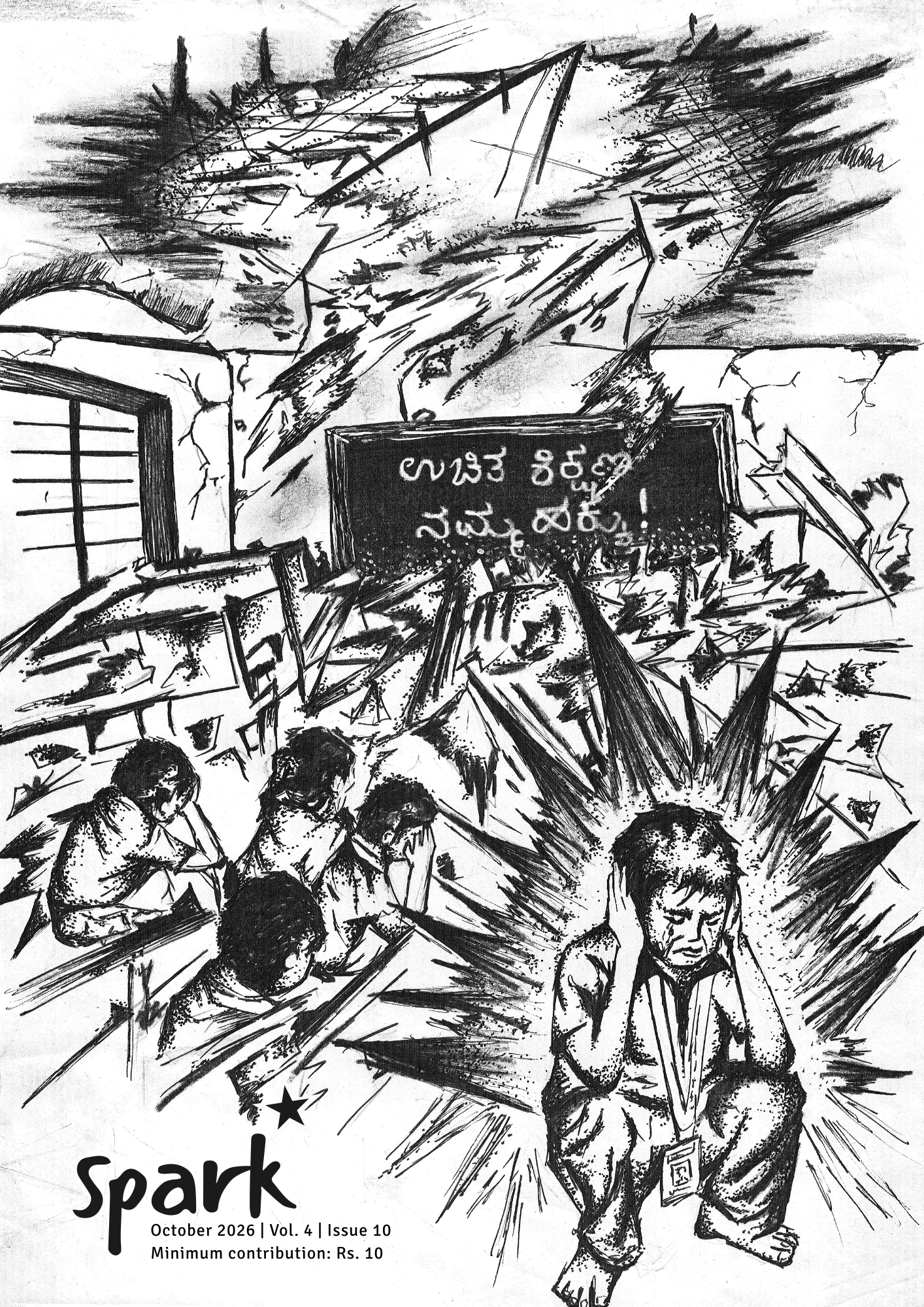
Children in school should think about playing and complaining about their homework! They should not have to worry about whether the roof above their classroom will hold. Yet, in September 2026, six students were seriously injured when the concrete ceiling of the Government Primary School in Bagalkot district collapsed while classes were ongoing. This is part of the much larger crisis in Karnataka’s public education system: crumbling buildings, inadequate classrooms, unusable laboratories, dysfunctional computers, insufficient toilets and equipment, severe teacher shortages, and low funding that cannot translate into functioning infrastructure.
Karnataka has more than 49,000 government schools. Yet data from 2025 showed that 1,052 government schools lacked functional electricity and 213 had no drinking water. More than 2,600 schools had no toilets for boys and nearly 1,000 had none for girls. These are not luxuries; they are among the basic conditions necessary for a child to attend school with dignity.
The shortage of classrooms is equally serious. In Raichur, nearly 190 children at the Government Higher Primary School in Askihal have been attending classes outdoors for months after unsafe classrooms were demolished. Reconstruction has been held up pending the release of ₹1.60 crore from the Kalyana Karnataka Region Development Board. The school has been forced to operate in two shifts because there are not enough usable rooms.
In a school in Chitradurga 250 students from LKG to Class 7 are studying in seven usable classrooms when ten are required; one room is considered unsafe. At Sakkara, only three of eight classrooms are usable. In Hosadurga taluk, 64 classrooms are reportedly dilapidated, while a roof collapse at Madayyanhatti left 55 students studying in a kitchen, corridor and office.
In Dharwad district, 674 classrooms reportedly require major repairs and another 680 need minor repairs. Nearly 14% of government schools operate from rented buildings, while 34% lack compound walls and 37% have no playgrounds. In Udupi, a government primary school with 156 students is still waiting for four additional classrooms, while a 140-year-old government school in Hebri with 750 students has only eight classrooms.
Our schools cannot provide quality education when children lack safe classrooms, desks, laboratories and other basic learning equipment.
Karnataka’s 2026-27 budget allocated ₹44,054 crore to education, sports, arts and culture, around 10.7% of total expenditure. The government announced ₹565 crore specifically for classroom construction and repairs, ₹75 crore for toilets, ₹25 crore for furniture and ₹125 crore for maintenance of government schools, high schools and PU colleges. This is already grossly inadequate compared to the recommended 25%. In terms of implementation, Karnataka’s budget records reveal that allocations are not always fully spent. In 2024-25, the state had budgeted ₹40,945 crore for education, sports, arts and culture but the actual expenditure was ₹34,210 crore (about 16% below the budget estimate). Meanwhile, Kodagu schools reportedly waited for repair works even after more than ₹1.16 crore had been released, because projects remained stuck in the tendering process.
The national picture is equally concerning. The National Education Policy recommends public expenditure on education reaching 6% of GDP. Yet combined expenditure by the Union and state governments was estimated at only 4.1% of GDP in 2022-23. Union government expenditure on education has remained around 2.4-2.6% of its overall expenditure in recent years. For 2026-27, the Union Budget allocated ₹83,562 crore to the Department of School Education and Literacy.
For Karnataka, the entire education, sports, arts and culture allocation amounts to roughly 1.3% of projected GSDP in 2026-27. This is not the same as saying that only 1.3% is spent on schools, since the allocation covers several sectors, but it demonstrates the limited scale of public expenditure relative to the state’s economy.
A whopping 8,042 schools had only one teacher. Compounding this, 1,13,000 teacher posts have been reported to be vacant. Rather than staffing and reviving public schools, the state is pursuing rationalisation. In response to falling enrolment created by its own neglect, the government plans to close over 25,000 public schools and merge them into roughly 700 Karnataka Public Schools (KPS). This KPS scheme is a centralised model akin to Kendriya Vidyalayas modelled after NEP recommendations. The government has also introduced an expanded ‘KPS Magnet’ scheme. Under the wider roadmap, it is estimated that the government can merge more than 40,000 government schools into about 6,000 Karnataka public schools across the state, establishing one such institution per gram panchayat. A government order issued in October 2025 mandates the merger of all schools within a one-to-five-kilometre radius into these magnet centres, effectively shutting down functioning village schools that have served rural communities for decades.