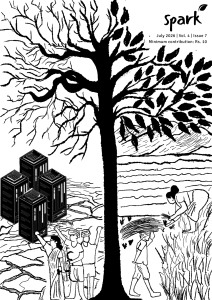

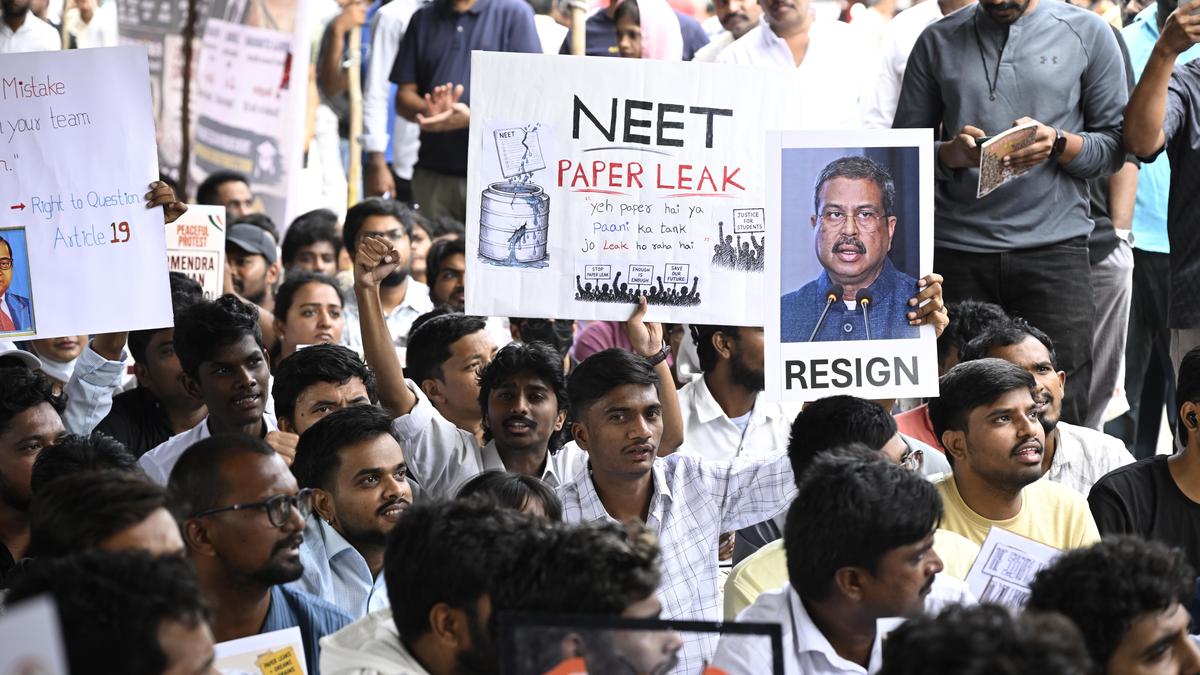
NEET-UG 2026 paper leak once again exposed the deep crisis of India’s examination system. Nearly 23 lakh students appeared for the NEET examination, which is the gateway to medical colleges across the country. The exam conducted on May 3 was cancelled on May 12 after it was found that a PDF circulating weeks before the exam contained 135 of the 180 questions asked in the paper, many in the same order and with the same options. The Central Bureau of Investigation (CBI) has arrested 11 persons in connection with the paper leak. The network involves National Testing Agency (NTA) appointed subject experts who leaked the questions, coaching institute owners who funded the operation, and middlemen who sold the papers to students for ₹10-35 lakh.
This is not the first time that a NEET paper has been leaked, NEET has a long history of systemic vulnerabilities, severe administrative failures, and paper-leaks. Prior to the NEET-2026, there were paper leaks in 2016, 2021, and 2024. In 2024, 67 students achieved a perfect score of 720/720, and some students received mathematically impossible scores such as 718 and 719. The NTA attributed this to ‘grace marks’ awarded for lost time at specific centres. In previous cases, the Supreme Court rejected the cancellation of the exam. This time a re-examination is scheduled for June 21.
Paper Leaks, Unemployment and the Crisis of the Examination System
A cage went in search of a bird.
– Franz Kafka
In the last 10 years, more than 100 paper leaks have occurred in examinations, including NEET, JEE, CUET, NET, SSC exams, Judicial Services, Teacher Eligibility Tests, Railway recruitment, Constable recruitment, etc. What began as a localised crime has become an organised industry involving politicians, exam officials, businessmen, and criminal networks. Most major scandals involve printing press staff, transport handlers, IT administrators, coaching intermediaries, different agencies conducting exams, and political protection networks. Despite the volume of cases, there were no significant inquiries or punishments.
These repeated paper leaks are not isolated incidents, but the symptoms of a much deeper social crisis. Behind every leaked paper lies a history of unemployment, inequality, commercialisation of education, and institutional decay. There is mass unemployment and a reserve army of jobless, educated youth. India has never before had such widespread insecurity among educated youth. Millions study for years for examinations whose credibility is increasingly questioned. Families spend enormous amounts on coaching, yet secure employment remains scarce. Even a low‑paying government job today requires passing a brutal, competitive exam with millions of applicants for a handful of posts. The crisis intensified after the LPG (Liberalisation, Privatisation, Globalisation) reforms of the 1990s. Stable public‑sector jobs declined, private employment remained precarious, and inequality soared. This is the section that was recently vilified by the CJI as ‘cockroaches’. The outrage emerging in the form of the ‘Cockroach Janata Party’ is thus justified. It remains to be seen if it is able to formulate a program capable of a radical societal transformation.
The crisis of education is that of a society where millions compete desperately for limited opportunities. Paper leaks, exam mafias, student suicides, and credential obsession are expressions of the inherent contradictions of our education system and society, which have transformed education into a permanent competition in the struggle for economic upliftment and social mobility.
NTA and Paper Leaks: Coincidence or Correlation?
What is the robbing of a bank compared to the founding of a bank?
– Bertolt Brecht (The Threepenny Opera)
Before a parliamentary panel, NTA Director General Abhishek Singh said that the NEET-UG 2026 question paper ‘was not leaked’, and ‘only certain questions from the May 3 exam were circulated beforehand’ despite a 75% leak.
NTA was established in 2017 to ‘address’ corruption in different examinations. Centralised exams such as NEET, JEE, NET, and CUET were promoted as mechanisms to standardise evaluation, improve efficiency, and selection. The National Testing Agency has conducted hundreds of national-level exams since its creation, and a surprisingly large number (>50) of exams have faced paper-leak (e.g. NEET-2024, 2026, JEE-2021, UGC and CSIR NET-2024), proxy candidate controversies (e.g. NEET-`19, `22, `24, `25, JEE-`20, `21, `22), technical failures (e.g., JEE-`19, CUET-`22, NCET-`24), answer-key controversies (e.g. NEET-`20, `24, `26, JEE-`23, CUET-`24), normalization disputes (e.g. JEE-`19, `24, CUET- `22), grace-mark disputes (e.g. NEET-`24), exam cancellations (e.g., NEET-`24, `26, JEE-`21, CUET-`22, CSIR and UGC-NET-`24) and court cases. Students have started calling the NTA the ‘National Tampering Agency’. Despite these irregularities, NTA exams determine access to IITs (JEE), AIIMS and other medical colleges (NEET), Central Universities (CUET), PhD fellowships (CSIR and UGC NET), and many other elite careers.
These are not new accusations for NTA. What is different this time is that the leak occurred despite guidelines issued by a committee formed to reform the NTA following the 2024 leak. In October 2024, a Committee (chaired by ex-ISRO Chairman K. Radhakrishnan) submitted a report with 101 recommendations to the Ministry of Education, but the ministry and NTA ignored the suggestions. Unlike older constitutional or statutory bodies, the NTA functions with a minimal permanent cadre (from June 2024 to October 2025, the NTA did not even have a full-time chief), relying almost entirely on a combination of deputed officials, contractual hires, and third-party outsourced labour. This dependence on contractual staff increases the risk of leaks and weakens accountability, as there is no fixed institutional responsibility. Also, NTA is registered as a society (under the Societies Registration Act of 1896), not a statutory body, thus limiting the scope for enforcing accountability.
Education not a Commodity, but a Fundamental Right
This, then, is the great humanistic and historical task of the oppressed: to liberate themselves and their oppressors as well.
– Paulo Freire (Pedagogy of the Oppressed)
Despite no solution existing within the current system, a significant transformation is possible through learning from the Soviet experience. In the Soviet Union, education was not a commodity but a fundamental right for everyone, employment was guaranteed, and labour allocation was planned, examinations did not determine survival. The Soviet model emphasised producing socially useful citizens rather than reproducing class inequality.
Universal free education through government schools, public universities, libraries, laboratories, and teacher training can remove dependency on coaching centres. Guaranteed employment for everyone according to their ability can end the life-or-death stakes attached to examinations. As long as education remains subordinate to market needs and scarcity of opportunities, reforms alone will remain insufficient. Such radical changes will not be gifts by the government, we will have to fight for it.