

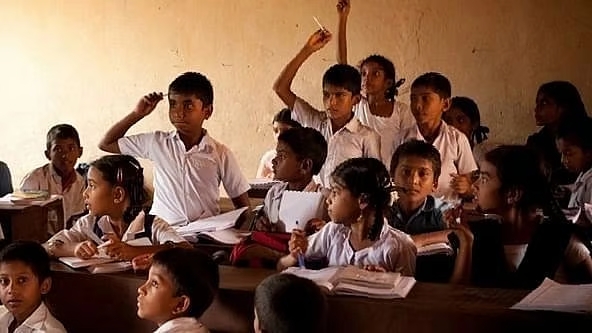
The Department of school education and literacy under the Congress government on October 15th 2025 announced their plans to merge 25000 government schools by starting 800 KPS-magnet schools at a cost of about ₹3,000 crore. The scheme will consolidate small schools into centrally located large Karnataka Public Schools – meaning the closure of nearly 25000 schools across Karnataka. These KPS (Karnataka Public Schools) magnet schools will provide education from pre-primary to II PUC, with introduction of computer science education, vocational skills and special coaching for competitive exams in the curriculum. Each school will be developed to cater to 1200 students.
The government states that the aim of this scheme is to curb high dropout rates in schools and ensure a better use of infrastructure and relocation of resources. But realistically, this scheme would only increase dropout rates – students from villages – lakhs of children will be deprived of education and higher transportation burden on those who can afford it. The government has promised free transport for students, but how feasible is this and how safe would it be for the students? It’s easy to spot that the government isn’t aiming to aid students but instead aid their own pockets, a smaller number of schools would mean they would be able to reduce the budget for education as well as privatise education. By centralising resources they are undermining and weakening the existing public education system. And it is also important to note that out of the ₹3000 crores cost, ₹2000 crores has been loaned by the Asian Development Bank. The involvement of an imperialist institution creates dependencies and cost-cutting measures – promoting Public-Private Partnerships and privatisation and corporatization of education, focusing on profits over education.
The Karnataka government has also had the same approach towards higher educational institutions as well, they have been focusing on bringing in private and foreign institutes to increase competition and reduce brain drain, while ignoring the dire state in which state universities are in – a chronic staff shortage and infrastructural issues. This would only benefit a small section in society, only deepening the rift of inequality.
Interestingly enough, in 2020 the NEP proposed by BJP included a school merger proposal which this very same Congress government had opposed then, but now their KPS magnet school proposal aims to do exactly what the NEP they opposed aimed to do. By closing schools on such a large scale they are simply repurposing the NEP they rejected after coming to power, a tool to oppress marginalized communities by making education less accessible to them. And it is not new for Congress, BJP or even CPM and DMK to pretend to oppose an anti-people policy when they are the opposing party only to bring back the same policy after coming to power.
Many student groups as well as educators have been strongly opposing this scheme across Karnataka. Student organisations such as AISA and AIDSO have been very vocal in their opposition to the scheme, conducting flash protests and petitions. There have been other very vocal groups, such as the Save the Government School Committee formed in Chatnahalli Palya and Chatnahalli village consisting of local villagers and office bearers to protect local schools. Instead of the school merger scheme, what is required is an emphasis on preexisting public education systems by increasing public spending, addressing vacancies in teaching positions by appointing adequate permanent teachers and ensuring access to education for all.