

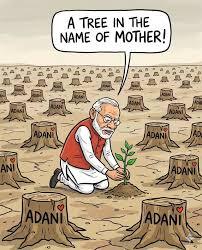
The world has seen a meteoric rise of the Indian business magnate Gautam Adani since 2014, exemplified by his quantum leap in the Forbes richest list to the 29th position as of 2026, from the 609th position in 2014. Around 2022, before the whole Hindenburg fiasco, Adani even climbed to the 3rd position for a while. In stark contrast, India’s Global Hunger Index has risen to a ‘serious’ 25.8 in 2025 as compared to a ‘moderate’ 17.8 in 2014. Wealth being a creation of labour, the rise of Adani and the fall in mass standards of living have to be seen in the light of private appropriation of surplus while it is generated collectively. This article will explore in particular Adani’s assault on nature, propped primarily by the BJP government, that has led to massive displacement, loss of livelihoods, pauperisation, and environmental collapse.
Despite a worsening climate crisis, Adani Power has been investing majorly in coal extraction and thermal power plants. It is doubling its thermal power capacity to 38,000 MW in the coming years through consumption of 155 million tonnes of coal. A total of 20 proposed and operational coal mines have Adani enterprises as the Mine Developer and Operator (MDO) within India. Internationally, Adani owns the Carmichael mines in Australia and Bunyu coal mines in Indonesia. The displacement of indigenous people remains a common thread. These mines together have a reserve of over 7 billion tonnes of coal. Most of these reserves coming under dense forests, mining would involve clearing of huge tracts of forest land. The most recent images coming from Hasdeo exhibit both the human and natural cost of these projects. Adani Power is also planning to expand its thermal power production capacity to 37.83 gigawatts. These plants are in various stages of approval, functioning, or have been halted due to ongoing local protests. One close example is that of Udupi Power Plant that has faced local protests due to its polluting effects. The use of police forces to evict villagers and forest-dwellers have often been reported. The collusion of government agencies with the Adani enterprises is also visible in the interplay between Adani-operated mines supplying coal for government utilities and vice versa.
As of today, the Adani Ports and Special Economic Zone Limited (APSEZ) operates 13 ports across India, emerging as India’s biggest private port operator. The APSEZ website states that it manages 24% of the national port capacity. Adani Ports also has their fingers dipped in international ventures at Haifa (a recent acquisition in Israel, amidst the ongoing genocide of Palestinians), Colombo (Sri Lanka), Dar-es-Salaam (Tanzania), Chabahar (Iran), besides operating a port facility in conjunction with the Carmichael mines in Australia. Recently, the Adani group has expressed interest in investing in a massive trans-shipment port in the Great Nicobar islands at a debilitating human and environmental cost, as part of the Government of India’s ambitious Great Nicobar Development Project. The locals as well as observers from the mainland have been protesting this plan that will obliterate a biodiversity hotspot. Around 2022, there was a massive popular movement against the then upcoming Adani port in Vizhinjam, Kerala, that was crushed by the state government through the use of brutal state machinery, in collusion with the BJP at the centre. Since the start of operations, at least two people lost their lives to truck accidents in the area. If the struggle to protect the Nicobars is not strengthened, it may meet the same fate.
Adani’s ‘Pocket Squires’: What stands out in the Vizhinjam movement is the role of the CPI(M) in enabling the Adani takeover and brutalising the protesters through the use of police force, false cases, and defamation. It exposed the class collaborationist character of CPI(M) and its consonance with any other bourgeois party when it comes to serving the ruling classes. In the neighbouring Tamil Nadu, residents of Ennore have been protesting the expansion of Adani’s Kattupalli port since 2021. The locals have repeatedly appealed to the DMK government to halt the expansion into the surrounding eco-sensitive zones. Despite verbal assurance by MK Stalin, the project remains on the cards, with significant delays resulting from popular resistance. In December, 2025, Adani Group bagged the lowest bid for the Bangalore tunnel road project. This tunnel road project spearheaded by Deputy CM DK Shivakumar, is anticipated to be disastrous for the city. Despite wide opposition from different quarters, the Congress government in the state has not budged.
As for the BJP, the rise of Adani can be visibly traced to BJP’s coming to power at the centre. With Modi’s allyship, Adani has expanded its presence in the coal sector, ports, airports, weapons, solar power, aerospace, etc. at unprecedented scales. In 2017, an agreement was signed by Adani Power with the Bangladesh government for transport of electricity from Adani’s 1600 MW Godda (Jharkhand) power plant. Recently, a committee from Bangladesh discovered ‘egregious anomalies’ in this deal and has pushed for its annulment. In 2018, Adani Enterprises and Elbit Systems (Israel’s largest arms producer) launched a joint venture, Adani Elbit Advanced Systems India Limited to manufacture weaponry for the Israeli Occupation Forces. In 2023, when Adani’s string of cons was exposed by the US-based Hindenburg firm, the company responded with a statement equating the attack on Adani group to an attack on the sovereignty of India. Despite the filing of bribery charges, securities fraud, wire fraud and related conspiracies against the Adanis, both the US and Indian governments have so far failed to summon the accused.
The bottom line is, Modi’s rule did manage to bring Achhe Din, however it remains limited primarily to the Adani enterprises.