
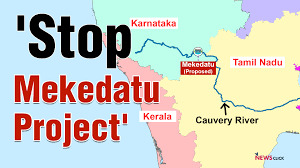
Bengaluru is facing an acute water crisis. Groundwater levels are rapidly declining, borewells are being drilled deeper with uncertain results, and residents are increasingly dependent on private tankers. The burden falls most heavily on working-class communities. In this situation, the Karnataka government has announced that it will move ahead with the ₹9,000 crore Mekedatu dam project, claiming it will solve the city’s drinking water shortage. The project proposes to store 67 thousand million cubic feet (TMC) of water from the Cauvery River by constructing a balancing reservoir. However, serious concerns have been raised about its ecological and social consequences.
The proposed dam would submerge over 5,000 hectares of forest land within the Cauvery Wildlife Sanctuary and adjoining reserve forests. Five villages face displacement. The region is part of an important ecological corridor and habitat for elephants and other wildlife. Riverine ecosystems, including ancient arjuna trees and endangered fishes such as the hump-backed mahseer, would be severely affected. Experts warn that habitat fragmentation could intensify human-elephant conflict and cause irreversible ecological damage.
At the same time, scientists have repeatedly pointed out that Bengaluru’s crisis is rooted in the unplanned urbanisation caused by the liberalisation, privatisation, globalisation policies of the 1990s. Massive concretisation, loss of vegetation, and large-scale destruction of lakes and rajakaluves have reduced the city’s ability to recharge groundwater. Bengaluru was once known as the ‘City of Lakes’, with over 1,400 interconnected water bodies sustaining its residents. Today, only a fraction remain, many encroached upon or polluted. Rainwater that once replenished aquifers now runs off as floodwater during monsoons, causing drought in the summer.
Experts say that lake restoration, rainwater harvesting, wastewater recycling, and reducing distribution losses could significantly address the shortage. In this context, the Mekedatu project is not an urgent or inevitable solution, but a part of a larger infrastructure-driven model of development.
Across India, large dam projects have repeatedly shown a pattern where displaced communities bear the costs while industrial and urban centres receive the bulk of the benefits. Forest diversion and ecological destruction are often justified in the name of development, while vulnerable communities carry the consequences. Bengaluru’s water crisis is real. But sustainable and equitable solutions require addressing structural ecological damage rather than submerging forests and villages in the name of progress.