
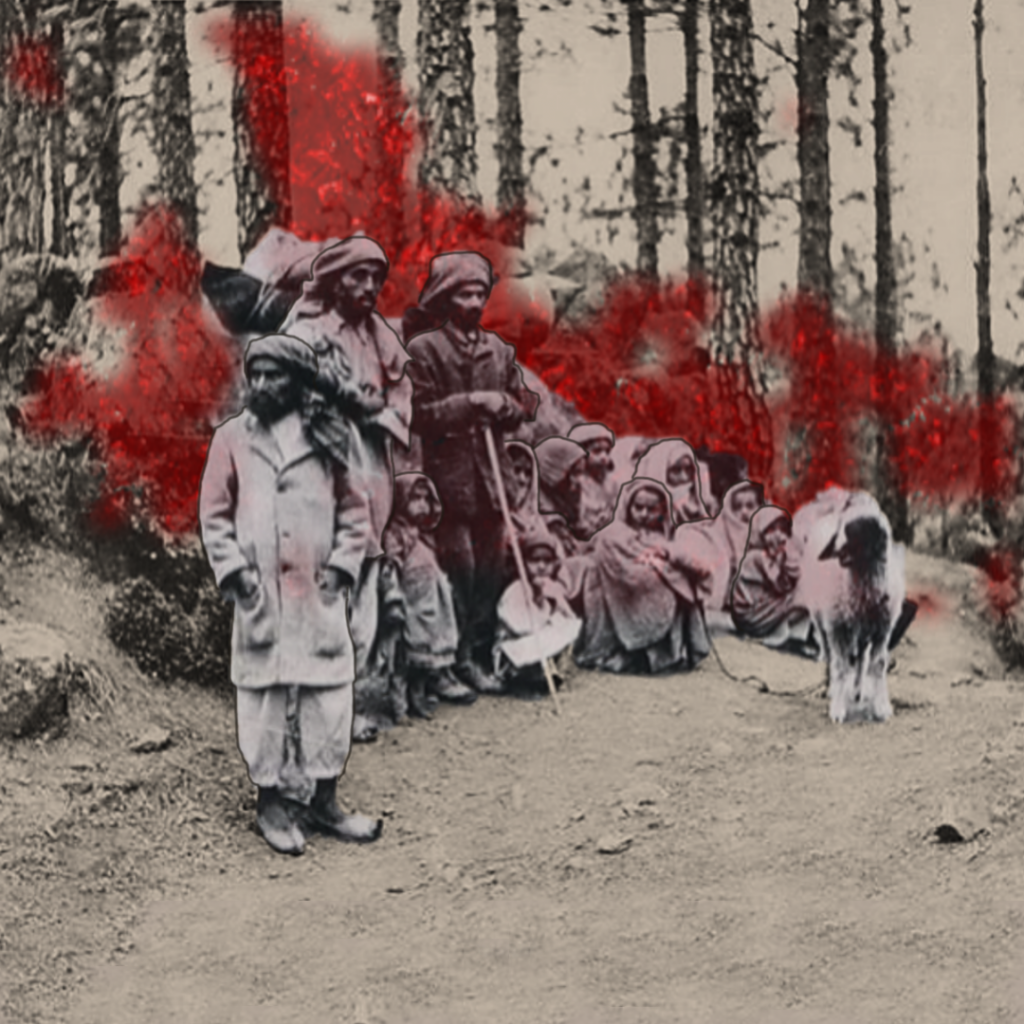
On 5th and 6th Nov, 350,000 Jammuites were cut into pieces like vegetables and young girls were abducted. On 5th Nov 1947, under facilitation of Hari Singh, an enormous number of caravans who wanted to migrate to Pakistan began their journey and nobody knows their fate. On 6th Nov, after sunset young boys of Jammu city entered in police line and started shouting that “Those who went with the caravan today and yesterday, they all got butchered and young girls were abducted.”
– A survivor’s testimony
The ground was prepared
Jammu Muslims comprised roughly 61% of the population before 1947. Over the summer the Maharaja’s rule was already fraying. Poonch had risen in revolt against his taxes, and in Jammu, Hindu and Sikh refugees from West Punjab were arriving with stories of communal riots they faced. By mid-September as many as 65,000 of them arrived in Jammu city alone, bringing tales of death and plunder that poisoned the atmosphere against its Muslims. At the same time, the community lost its leadership. With the Muslim Conference leader Abbas kept from guiding them, groups including the RSS and embittered refugees could terrorize eastern Jammu’s Muslims with little publicity.
October and November
What followed, in Kashmiri accounts, was organized rather than spontaneous. Villages across Udhampur, Akhnur and Kathua saw large-scale killings, with reports of women abducted and raped. At times the order to surrender was itself a trap. In Talab Khatikan, Muslims were told to give themselves up, and terrible carnage followed. Contemporary newspaper reports, as later collected by the researcher Christopher Snedden, claimed that 8,000 people were killed near Kathua and 15,000 near the Akhnur bridge on 20 October. Alastair Lamb, writing in 1966, also described a series of massacres that reduced Jammu’s Muslim population by more than 200,000.
Two days that changed everything
We must emphasize the chronological order of events that unfolded during October, 1947 to get a true holistic picture. First, the state forces and militias of the Maharaja massacred and displaced hundreds of thousands of Muslims. Five days later, Pashtun tribesmen from the newly formed North-West Frontier Province, many of whom shared kinship ties with the people who had been massacred, crossed the border in response. Facing this advancing force, Maharaja Hari Singh signed the Instrument of Accession to India.
The narrative usually begins at the moment of the tribal invasion, overlooking the preceding violence in Jammu that triggered the crisis. Whatever the number, the demographic result is not in doubt— the Muslim population of eastern Jammu was reduced by about two-thirds. The massacre was erased because it was inconvenient to India’s founding story and its uncritical leaders. Gandhi on 25 December, 1947 stated “The Hindus and Sikhs of Jammu and those who had gone there from outside killed Muslims. The Maharaja of Kashmir is responsible for what is happening there… Muslim women have been dishonoured.” The acknowledgment soon faded, and the dead went unmourned in textbooks.
Preserving feudal power
This idea is based on the belief that a plebiscite for the whole of Kashmir is bound to be lost and therefore let us save Jammu at least: You will perhaps remember that some proposal of this kind was put forward by the Maharaja some months back.
–Nehru’s letter to Patel, 17 April 1949
It was not communal ‘riot’ but a class war, waged by the feudal Dogra regime, against the rising peasant movement which was fuelled by the imposition of taxes and transfer of Jagir lands under the Maharaja’s control. The Maharaja disarmed Muslims and removed the few who had served in his forces, while arming and coordinating a Hindu-Sikh communal militia composed of Sikh and Hindu extremists and RSS cadres. In another letter to Patel dated 30 October, 1947 Nehru stated that the RSS had been organizing in eastern Punjab and 500 of them were already sent to campaign against Muslims in Jammu. All to preserve Zamindari power.
After inheriting the state from the Dogras, nothing was done to undo the counter revolution. The attempts for ‘rehabilitation’ have been an empty gesture, plots of land in some cases or a few thousand rupees in cash all while depoliticising the demand of victims for return. Genuine restitution of usurped land and property was never the agenda. Only 5,300 families who had originally fled were regularised decades later. The displaced Muslims of Jammu even today remain a reserve army of cheap labour.
The suffering of the people must not be forgotten. This is all the more important today as efforts to erase, rewrite history and silencing dissenting voices intensifies under fascist governments that seek to suppress perspectives that challenge their ideology.