
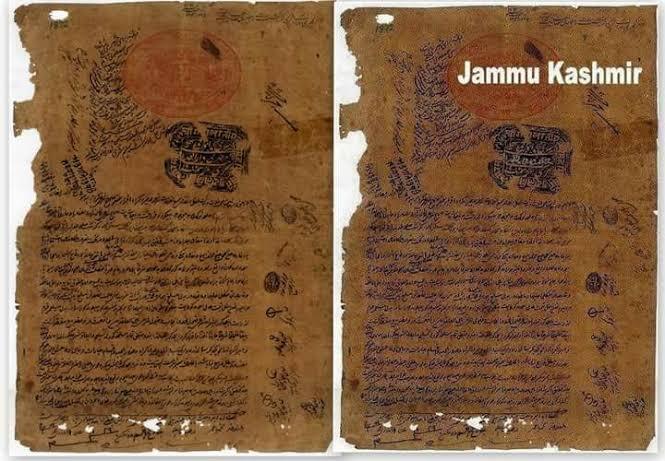
By the mid 19th century, Jammu and Kashmir was governed by the Dogra dynasty. The people suffered from the feudal Zaildari agrarian system, punitive taxation, and forced labour. Despite Muslims being the majority, they had no representation. The 1931 uprising was the culmination of decades of oppressive Dogra rule set up by the British in 1846. The Viceroy of the time, Sir Henry Hardinge, writing to the Queen on two separate occasions following the Treaty of Amritsar in 1846 noted that it was logistically hard for them to govern Kashmir unless the Sikhs were weakened. It was from this interest that the British Empire installed not just a puppet, but a ruler willing to call himself a slave to the British Crown. Maharaja Gulab Singh, founder of the Dogra dynasty, proclaimed himself a gold-bought slave (Zar-Khureed) of the British Crown. The subservient nature of this relationship was codified in Article 10 of the 1846 Treaty of Amritsar, “Maharaja Gulab Singh acknowledges the supremacy of the British government and will in token of such supremacy present annually to the British government one horse, 12 shawl goats of approved breed (six male and six female) and three pairs of cashmere shawls.”
The Dogra rulers bought Kashmir for a sum of 7.5 million Nanakshahi rupees (1£ = 10 Nanakshahi rupees) from the British who themselves had no ownership of the region. Addressing the East India Association in 1889, Sir Edward E. Meakin commented, “It was clearly wrong for the East India Company to cede Kashmir to Gulab Singh for £750,000 when it was not in possession of theirs and they had no manner of right to deal with it, but ‘a bargain is a bargain’.”
In the face of such tyranny, the 1931 uprising was not the first act of resistance. One of the earliest acts of resistance was on 29 April 1865, where the workers of the shawl weaving industry took to the streets in Srinagar to protest the oppressive taxation and exploitative working conditions. In this instance, at least 28 workers lost their lives and many more were left injured. This incident is also known as the Zaldagar massacre. Many credit this moment as Asia’s first labour uprising.
The subservient relationship between the Dogra monarchs and the British Crown, dictated the region’s governance for nearly a century. The Dogra rulers consistently strengthened the British Empire in order to be favoured. For instance, during the First War of Independence in 1857 (‘Sepoy Mutiny’), the Dogras provided crucial military support to the British, cementing their status as loyal, indispensable allies. This alliance was stark even during the events of 1931; as widespread public outrage threatened to overwhelm local authorities, the British dispatched 500 troops to the valley to help the Dogras suppress the people’s rebellion.
Following an incident of disrespect towards the Quran on 21st June, 1931, a man named Abdul Qadir Khan at Khanqah-e-Maula, Srinagar, had delivered a speech addressing the people to wage a war against the brutalities of the Dogra rulers. On 25th June, he was arrested on charges of sedition and treason. This sparked widespread outrage among the people in the valley, catalyzing the existing emotions.
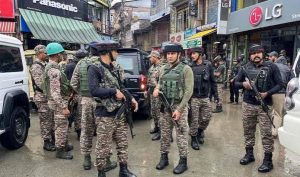
On 13th July, 1931, while an in-camera trial of Abdul Qadeer khan was ongoing in the Srinagar Central Jail, thousands of Kashmiris assembled outside in protest. Dogra police fired at the crowd of people upon the orders of Rayzada Trilok Chand, the governor at the time, which resulted in killing of 22 Kashmiris.
The loss of 22 innocent Kashmiri lives on 13th July, 1931 left its mark on the people of Kashmir and its impact can be felt nearly a century later. This day was remembered as the Martyrs’ Day and observed as a public holiday post-1947 across Jammu and Kashmir. After the removal of Article 370, the state was reduced to a union territory and the public holiday was struck off in an attempt to rewrite the regional history.
Sunil Sharma of the BJP, current leader of the opposition in the Jammu and Kashmir legislative assembly, stated last year that the 13th July martyrs were traitors and anti-nationals for rebelling against the Dogras. He later added that “we are sitting in Maharaja’s state, enjoying the Maharaja state.” By communalising a just resistance against the British and its puppets, Sunil Sharma and his ilk carry forward the legacy of subservience to the crown.
From the Zaldagar weavers of 1865 to the twenty-two Kashmiris who laid down their lives outside the Srinagar Central Jail, Kashmir has a history of valiantly fighting against the tyrannical Dogra rule. The memory of these atrocities, and the courage of those who faced them, serves as a lasting reminder to look back, admire, and pay tribute to all who fought against feudalism and imperialism.