
“We invite the whole world’s data to reside in India.” PM Narendra Modi said recently, pitching the country as a global data hub ahead of the India AI Impact Summit 2026.
The massive boom in artificial intelligence (AI) all over the world has turbo-charged data-centre growth in India. Foreign tech companies are investing billions to set up these campuses here. The process to fast-track such projects has only resulted in massive land grab, privatisation and loot of public resources, not just tax-free but with concessions. As global tech companies race against each other in advancing their artificial intelligence systems, the cost is borne by third world nations like India. Several such tech facilities have been planned to be put up in India, especially in cities like Mumbai, Bengaluru, Visakhapatnam, and Chennai. As the whole world rejects these projects as they are known to be water guzzling and resource hungry, our prime minister welcomes them with open arms. The people most affected by this are the people who have troubled access to resources. Jai Bhim Nagar in Mumbai was demolished last year to make way for a data centre by the Hiranandani Group, one of the wealthiest real estate developers in the city. Similarly in Karnataka, farmers of Bidadi are being forcefully evicted by the state for a proposed AI township. The marginalised are being displaced from their land for these projects.
In October 2025, the Government of Andhra Pradesh signed an MoU with Google to execute the construction of a massive data centre complex in the Visakhapatnam and Anakapalli districts, with investments worth 15 billion US dollars. While being proposed by its proponents as a crucial engine of jobs, green growth, and economic upliftment for the state of Andhra Pradesh, this project brings forth a serious environmental and humanitarian crisis. If built, the environmental damage the state would incur is irreversible. This project is nothing but corporate loot under the guise of technological advancement.
Close to 400 acres of land has been proposed for the construction of these massive hyperscale data campuses. These establishments are notoriously known for being water and energy-hungry; a data centre of this capacity would drink up as much water as 50,000 households. Visakhapatnam, which is already water-stressed, will be pushed to its limits to keep these centres active by providing several hundred million litres of water continuously to keep them from overheating. Moreover, another critical concern is energy consumption. A one-gigawatt (GW) facility, as proposed initially across these sites, would demand enormous amounts of electricity, equivalent to that consumed by half-a-city with several lakh houses in it every day.
In April, the state issued Environmental Clearances for both the sites, Tarluvada and Rambilli. It was then revealed that the 1 GW centres proposed across the aforementioned sites had taken the shape of 1 GW centres each for Tarluvada and Rambilli. The government is unwilling to make the MoU signed with Google public, shrouding information about this project in secrecy.
The 260 acres acquired for the AI data centre at Tarluvada is land taken away from almost 200 Dalit households in the village. Relli Ramakrishna, an elderly woman from the village, shares that the land was given to her parents during Indira Gandhi’s government almost 50 years ago. Just like her, everyone from the village had been given two acres of land to farm. For five generations they have been able to sustain themselves by farming on the land, while some men also go out for municipality work. The municipality work hardly pays ₹10,000 per month, but having a piece of land on which the family could farm brought them dignity and independence, especially for the people of the SC colony who belong to the Mala sub-caste within the Dalits.
These plots allotted for farming to the members of the SC colony were given to them as D-form lands, and the farmers are obliged to comply if the government decides to take them back at any given point. Kondamma, another resident of the colony, shared that these lands should now be registered permanently in their names since they have been farming them for over half a century. In light of the AI data centre proposed to be built here, the land has since been transferred to Adani for the same purpose. Moreover, the compensation for an acre of land lost to the project is just 40 lakhs and 20 cents (0.2 acre) of land, which hasn’t been given yet. Relli Ramakrishna expresses her concern over the fact that the money given to them as compensation will soon run out and they will be left with nothing in the future.
The state’s action in taking the land away from the farmers of Tarluvada is an attack on the right to livelihood. The land-owning members of the Dalit community are very few. The dependency on daily wage work is bound to increase among the members of the SC colony of Tarluvada. Furthermore, one of the biggest concerns is the close proximity of the data centre to the colony. They are more prone to radiation, sound, water, and air pollution since the proposed complex is hardly a kilometre away from their houses.
The Mudasarlova-Adavivaram site proposed for a 0.5 GW data centre is planned right next to the Mudasarlova reservoir and just 0.8 km from the Kambalakonda Reserved Wildlife Sanctuary. The reservoir, which is almost 100 years old, is one of the main water sources for the city of Vizag. Arilova colony, which falls on the same stretch and has been one of the most water-scarce areas in the entire city, is living on tanker water. It is reported that water is supplied barely for an hour a day, except for most days when there is no supply at all. The claim that water is the only solution for cooling these data centres is false. It is just the cheapest option.
The brazen illegalities of this project are multiple. The project has been categorised as a B2 building and construction project under the Environment Impact Assessment (2006) in order to obtain rubber-stamp clearance from the state. These establishments consume industry-level energy and thus need to be put under Category A for a proper Environmental Impact Assessment to take place. The EC was issued within just 9 days. Moreover, this data centre is planned right on top of the catchment area. During the monsoon, streams flow down from the Simhachalam and Kambalakonda ranges to recharge groundwater levels. When such a project is planned in such an eco-sensitive zone, it not only violates the laws put in place to restrict such development projects from taking place but also completely alters our water futures.
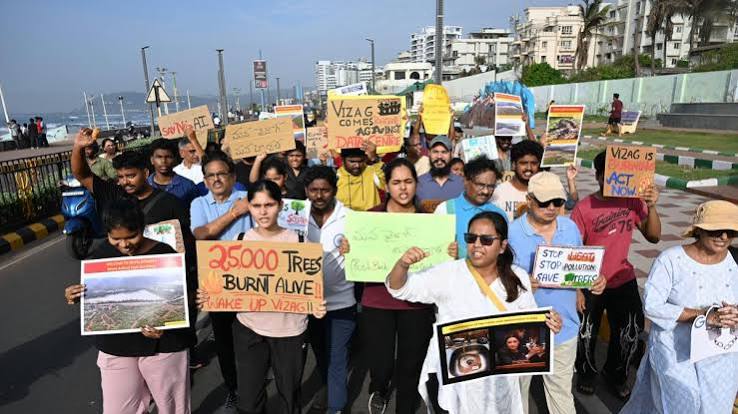
This is textbook corporate loot. The state of Andhra Pradesh is not only letting foreign companies like Google come in and destroy our commons but also allowing them to benefit from public utilities by offering substantial concessions. A 20% concession on land, water, and energy for the first 10 years, along with other tax exemptions, has been granted; the concession itself would amount to over 2 billion dollars. When citizens voice their concerns and demand transparency, the state machinery shuts them down, goes further to spread misinformation about the project to appease their imperialist masters, and its supposedly minimal usage of the natural resources. Even videos of protests against these data centres have been censored by Meta in response to the government’s requisition.
The struggle against data centres is not one against development and technology. Displacement of people for building data centres is no different from displacing people for mining bauxite. The struggle to save jal-jangal-jameen is against the assault on nature and people’s livelihoods. We must build broad struggles against this loot and unite all those who are fighting for their lives and livelihoods.