
That time of the year is here- Pride Month. Spectacles, performances, and marches of ‘remembering’ and ‘strengthening solidarity’ among the queer communities and allies. Once rooted in collective resistance against patriarchy and state violence, the mainstream queer movement in India has increasingly taken a liberal and individualistic turn, mirroring capitalist logic. In doing so, the movement has opened itself to co-option by both capitalist and Hindutva forces, leading to the depoliticisation of queer struggles and their use in ultra-nationalist, Islamophobic, and profit-driven agenda.
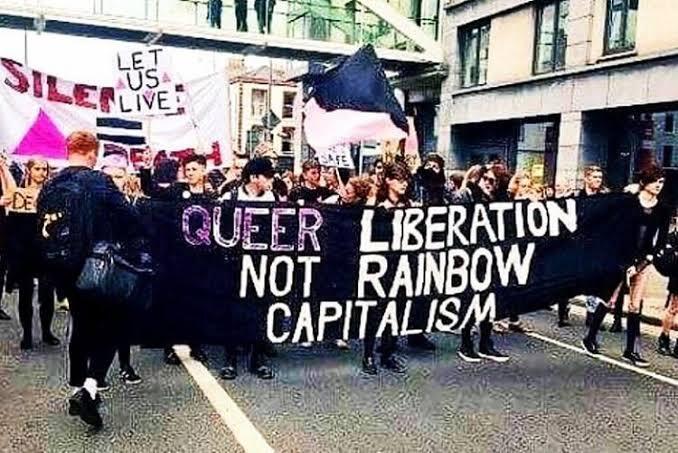
Only through queer liberation struggles can the heteronormativity imposed by the ruling classes be countered. However, in this era of neoliberalism, MNCs have resorted to rainbow capitalism to include the LGBTQIA+ communities, all the while erasing its radical past. This inclusion is tokenistic, limited to holding grand marches with police permission, devoid of any critique of the government. This is not solidarity. It is the commodification of the queer identity.
The tradition of conversion therapy has been historically justified by religious superstition, support from big pharma, and from state institutions. This has enforced the criminalisation of queer bodies, and propagated ideas of queerness being pathological. Against this the queer movement has fought hard to establish that queerness has existed fundamentally as part of nature and society. Today, a new contradiction has cropped up in place of the old one where the norm has flipped to the extent that a consumerism-driven, market-accepted, queer body has become the ‘ideal’.
This new norm in essence excludes those who do not conform, like sex workers, visibly gender non-conforming people, working class queer individuals, and trans-people surviving outside societal approval. Mainstream queer visibility today often centers on the elite subject: dominant class/caste, English-speaking, urban, and aspirational within capitalism. The success of a queer CEO, actor, or politician is treated as a triumph of the movement while the struggle of the vast majority of workers, unemployed youth, Dalits, Muslims, Adivasis, etc. are made irrelevant to the cause.
What is thus missed out is that the ruling classes very much benefit from the oppression of queer bodies. The concepts of social reproduction, division of labour, and maintenance of class rule are very often left out of the analysis. Both capitalism and feudalism depend on rigid gender roles and the patriarchal family to maintain unpaid domestic labour. Queer identities challenge this, also defying the traditional structures of inheritance and maintenance of property, to be handed down along generations.
The recent Transgender Persons Amendment Act and subsequent policies reveal how the Indian state seeks bureaucratic control over queer bodies. The state now positions itself as the supreme authority that decides who qualifies as ‘trans’ through certification procedures, documentation, and medicalized scrutiny. Rather than affirming self-identification, the law bureaucratizes gender and places trans existence under state surveillance. Thus, exposing the political system within capitalism where identity becomes regulated by administrative machinery. The state’s concern is not the welfare of queer people but the maintenance of social order. Queer people continue to face discrimination, police violence, unemployment, caste oppression, and denial of healthcare, representation, or even the right to marriage, while the government promotes token welfare schemes that leave structural inequalities untouched. Therefore, queer liberation cannot simply mean inclusion within these very institutions.
Hindutva politics also appropriates queerness, by conveniently cherry-picking events from Puranas, while simultaneously demonizing Muslims and other minorities as backward and queerphobic. It attempts to project India as culturally tolerant while intensifying authoritarianism, caste violence, and communal hatred. A playbook clearly borrowed from Israel’s branding of Tel Aviv as a queer paradise while they commit genocide against Palestinians.
Through the various experiences, we can conclude that only a collective struggle to build a people’s democracy can break the system that persecutes queer bodies. It can be seen that there is a gap between the queer liberation movement and class struggle of the oppressed masses as a whole. While introspecting on the roots of this divide and reflection on the world communist movement, we must acknowledge the dire need for the queer liberation movement to be assimilated within the class struggle.
We must viciously reject the idea that any liberation can be achieved through reforms or class-collaboration. The fight for queer liberation is not merely a demand for rights; it must become a fight for systemic transformation that breaks existing power structures. It demands solidarity across struggles against class division, caste oppression, patriarchy, racism, and communalism. Because no one is free until everyone is free.