

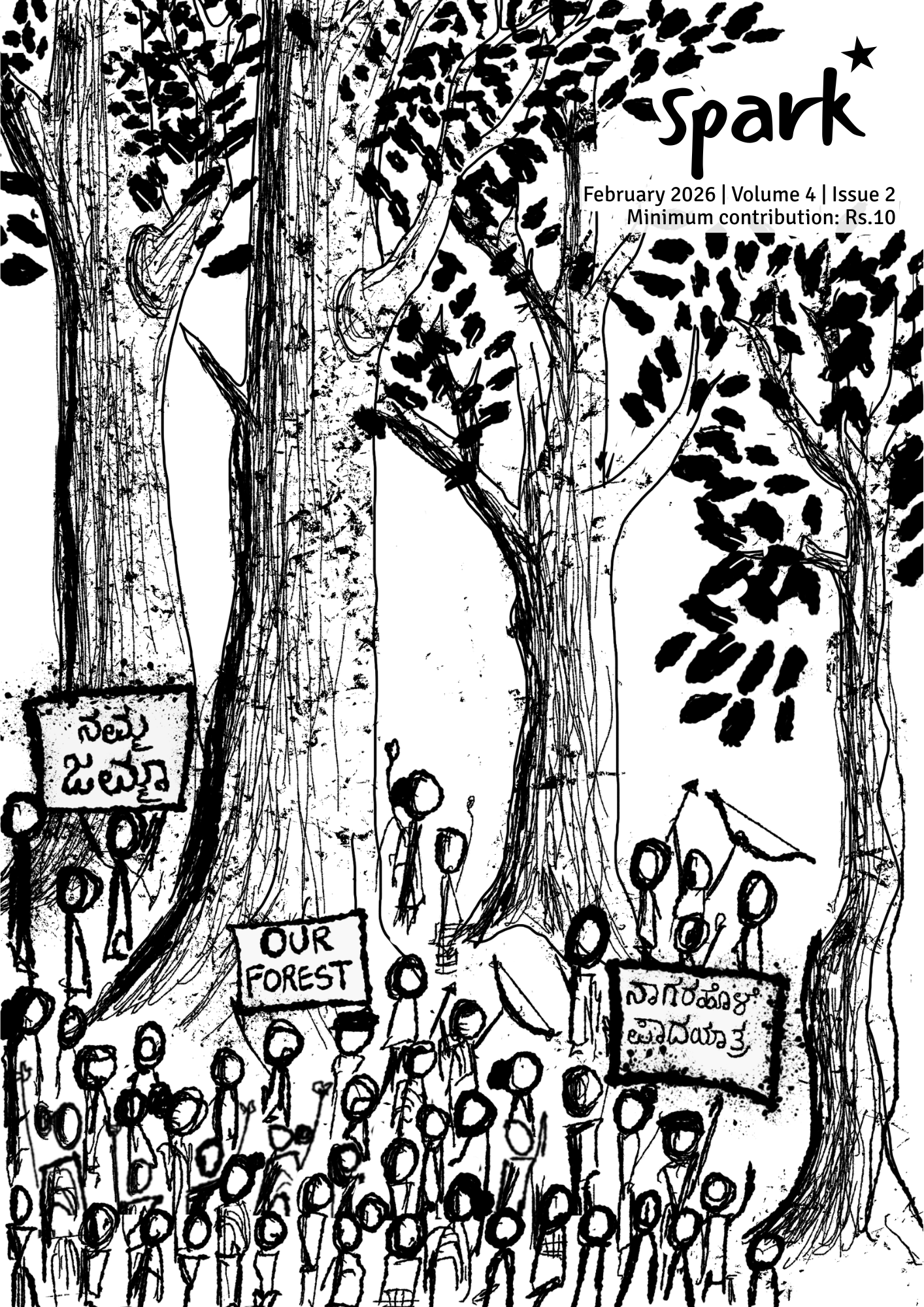
On December 21, the Adivasis of Nagarhole started their historic 13-day Padayathra (December 21 – January 2), organised by Nagarhole Adivasi Jammapale Hakku Sthapana Samiti (NAJHSS), the federation of Gram Sabhas in Nagarhole, to reclaim their rights. In Padayathra, people from each haadi (hamlets and villages) visited other haadis, and gram sabhas were held to raise awareness among the gram sabha members about the Forest Rights Act (FRA, 2006) and to promote the idea of a struggle for forest rights. The Gram Sabhas were held in 29 haadis. This Padayathra concluded with a protest on 1st and 2nd January at the Udhburu forest gate in H.D. Kote. Demands were submitted to Additional Deputy Commissioner Mysuru.
A team of comrades from All India Students Association (AISA) joined this Padayathra in solidarity with the Adivasis of Nagarhole, to understand their socio-economic conditions, their struggle against displacement, eviction and state violence in the name of conservation.
Nagarhole National Park: Displacement in the Name of Conservation
Nagarhole forest, spread across Kodagu and Mysuru districts of Karnataka, is part of the Western Ghats-Nilgiri Biosphere Reserve. It is among India’s most significant biodiversity hotspots. Declared a wildlife sanctuary in 1955, expanded and converted into a national park in 1983, later notified as the 37th Project Tiger Reserve in 2003, and critical tiger habitat in 2007, each transition extended the protected area (from 284.15 sq km in 1955 to 1205.76 sq.km today), and tightened restrictions on human habitation and livelihoods.
These successive changes and expansion were not merely ecological reclassifications, but a tool to displace the Adivasis. It intensified state control over forest land and imposed increasingly restrictive regulations on human habitation and livelihood practices. It facilitated the looting of jal-jangal-jameen through large-scale evictions and coercive relocations, particularly during the 1970s, 1980s. Haadis located within newly demarcated core and buffer areas were forced to relocate, homes were destroyed, and traditional livelihoods were criminalised under wildlife protection and forest laws. Adivasis were forcibly displaced in the name of conservation, while tourism infrastructure and safari activities were simultaneously expanded within the same landscape. International and local NGOs working on conservation reinforced the ‘fortress conservation’ narrative of pristine wilderness, portraying Adivasis as threats while legitimising tourism and corporate interests. In Nagarhole, corporate NGOs are working with the forest department to displace Adivasis.
Adivasis of Nagarhole
Nagarhole forest and its fringes are home to several tribal and traditional forest-dwelling communities (Jenu Kuruba, Betta Kuruba, Yerava, Paniya, Koraga, Soliga, etc.) who traditionally lived in and around these forests. Jenu Kurubas are the largest group in the Nagarhole area. Adivasis historically inhabited large tracts of what is now the Nagarhole Tiger Reserve. According to the Madras Census Report, 1891, they have lived in Nagarhole since the 7th century and are deeply connected to the landscape at cultural, economic, and spiritual levels. Before state intervention, they lived in the forest under their traditional system of governance, which ensured the sustainable use of forest resources. All these communities are legally recognised as Scheduled Tribes (STs), with Jenu Kurubas and Koraga also being Primarily Vulnerable Tribal Groups (PVTGs) (Ministry of Tribal Welfare: State/UT-wise List of the Particularly Vulnerable Tribal Groups). These Adivasi families live in small forest haadis and fringe villages spread across Mysuru and Kodagu districts. The haadis typically range from 10 to 40 households, depending on the location, access to services, and past experiences of displacement. As reported to the Lok Sabha on December 12, 2011, 45 villages (1353 families) live within the Nagarhole core area, and 86 villages (16896 families) in the periphery of Nagarhole. State intervention dismantled their systems, replacing them with bureaucratic authority enforced through forest laws.
Historically, Adivasi livelihoods combined minor forest produce collection with small‑scale subsistence agriculture. Practices such as interspersed cultivation and shifting cultivation (kumri or podu) were ecologically integrated and community‑regulated. These were banned after the area’s conversion into a national park, forcing communities into wage labour and market dependence. Today, honey collection remains a key livelihood, carried out sustainably by cutting only part of the hive. Yet incomes are meagre. Honey sold through Large Area Multipurpose Society (LAMPS) in Thithimathi fetches far below market prices, while direct sales are restricted. Annual earnings from forest produce rarely exceed subsistence levels. Plantation labour, particularly in coffee estates, has become unavoidable. Working conditions are harsh, wages are low and uneven, and cases of bonded labour persist. Displacement from forests created a captive labour force for plantations, binding Adivasis into cycles of debt and exploitation. Kodagu’s coffee economy, rooted in colonial land grabs, rests on large‑scale forest clearance and labour exploitation. While a small minority of large landholders control significant acreage, thousands of landless Adivasis toil seasonally for survival wages. Plantation owners profit, while displaced forest dwellers bear the costs of conservation and development. As Adivasi leaders point out, agriculture and habitation are prohibited for them inside the reserve, yet plantations, resorts, and safaris are permitted. Describing their condition, Thimma J.K. said, Moor thingalu Jenuthuppa, moor thingalu gandasu-soppu, moor thingalu thota kelasa, moor thingalu upavasa, idhe namma jivana [3 months of honey harvesting, 3 months of wild leafy vegetables and yams, 3 months of estate work, and 3 months of fasting, this is our life].
History of Resistance against Displacement in Nagarhole
Adivasi resistance in Nagarhole is decades old. The anti‑Taj resort struggle of the 1980s and 1990s became a landmark in environmental justice. When the Taj Group proposed a luxury resort inside the protected area, Adivasi communities mobilised, blocked construction, and pursued legal action. The Karnataka High Court ultimately struck down the project, ruling that eco-tourism is a non‑forest activity. The struggle demonstrated that conservation cannot be separated from social justice and that corporate eco‑tourism is incompatible with indigenous rights.
The biggest shift in forest rights and conservation came with the Scheduled Tribes and Other Traditional Forest Dwellers (Recognition of Forest Rights) Act, 2006, which corrected the historic exclusion by colonial and post-colonial laws and recognised the rights of forest-dwelling communities to land they traditionally used. FRA provided pathways for the legal recognition of the customary rights of Adivasis. But the bureaucratic resistance and enforcement gaps have prevented FRA from fully transforming forest governance, with new policy amendments sometimes undermining the spirit of FRA. In recent years, Adivasi communities of Nagarhole have been asserting their rights under the Forest Rights Act, 2006. Since 2010, several evicted Adivasi families have been trying to return to Nagarhole but have been mercilessly beaten and harassed whenever they attempted such a comeback. In Nagarhole, the FRA claims are delayed or rejected, and displacement continues to be promoted. In May 2025, 52 families returned to the ancestral land they were evicted from in the mid-1980s, invoking their legal rights under the FRA. Adivasis now challenge the logic that lets tourism and tiger safaris flourish while their own habitation and customary authority remain unrecognised.
In Nagarhole, Gram Sabhas are formed under the FRA. There are 43 haadis in the Nagarhole Tiger Reserve area. Each Haadi has a Gram Sabha that includes all adults in the Haadi.
The Gram Sabha together elects a 15-member Forest Rights Committee (FRC), comprising 5 women and 10 men. This election occurs every three years. To strengthen the movement for forest rights, adivasis are forming a higher committee, the Grama Sabhada Okkutta, with 2 representatives from each Haadi. The recent padayathra symbolised this renewed assertion of self‑rule, rejecting the forest department’s monopoly over administration.
In the Padayathra, people walked from one haadi to another through the forest, raising powerful slogans and songs against the displacement and oppressive forest laws, and asserting their forest rights. These slogans and songs powerfully represented the struggles and valour of the Nagarhole Adivasis. People in different haadis were eagerly and deeply invested in the Gram Sabhas, eager to discuss and decide. From energetic youngsters to calm elderly men, from new leaders with well-matured ideas to active old women throwing sharp criticisms, we could see a clash of ideas. In Padayathra, middle-aged women marched in the front rows, while teenage girls excitedly carried banners. In every haadi, the inhabitants welcomed the protesters with aarti. People cooked food with great care for strangers they had never met before, united by a shared commitment to the struggle. In some haadis, such as Golur and Balle, even enthusiastic children took part in the Padayathra, believing they were fighting for a just cause. With passion and innocence, they raised revolutionary slogans, adding to the collective spirit of resistance.
Loot of Jal-Jangal-Jameen and Adivasi Resistance
Today in India, the nexus of the corporates, landlords, and their political pawns steamrolls Adivasis, peasants, and workers. Adivasis are being displaced in different parts of the country in the name of development (e.g., for mining in Chhattisgarh, Jharkhand, Odisha, Maharashtra, and Telangana) and conservation (e.g., in Karnataka and Madhya Pradesh). Natural resources are increasingly opened to private capital for exploitation. Corporations benefit from state-backed land acquisition, tax concessions, and legal immunity, while displaced adivasis are forced into wage labour and shift from subsistence-based autonomy to dependency on markets. National parks, wildlife sanctuaries, and tiger reserves are created by evicting forest-dwelling communities who have lived there for generations. Adivasi communities that historically protected forests are portrayed as threats to wildlife, while resorts, safaris, and corporate eco-tourism projects flourish within or around protected areas. Wherever displacement meets resistance, the Indian state responds with militarisation. Adivasi regions are among the most heavily policed and militarised areas in the country. Peaceful struggles for land and forest rights are criminalised, while state violence is normalised.
Since the British Raj, Adivasis have continued their struggle against state oppression. Movements for forest, land, and self-rule rights challenge the imperialist model of development and
conservation. Nagarhole today is not just a local forest conflict, it is a node of global capital, conservation ideology, state power, and Adivasi resistance. From colonial forest acts to World Bank eco-development projects, external forces have repeatedly shaped forest governance in ways that marginalize Adivasis. Conservation here has meant enclosure, displacement, and pauperism of forest dwellers, while profits flow to eco-tourism operators, plantation owners, and NGOs. Adivasi movements asserting Forest Rights Act claims, habitat rights, and community control are not anti-conservation, they are anti-colonial struggles for justice.
The main demands of the movement are:
-Rejection of the colonial-imperial model of conservation.
-Recognition of Forest Rights under FRA, 2006.
-Set up a judicial inquiry committee to assess the effects of the declaration of the National Park and Tiger Reserve.
-End of forced and coercive displacement and relocation of the displaced Adivasis in their original habitat with legal documents of land ownership.
-Stop eco-tourism, safaris, and the commercial exploitation of Nagarhole.
-Democratization of Forest Governance and inclusion of Adivasis in decision-making.