
Written with the help of Akhil Mythri, Climate Researcher, NIAS
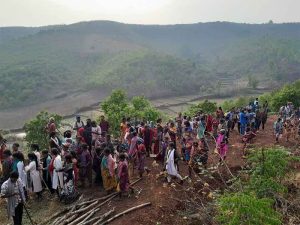
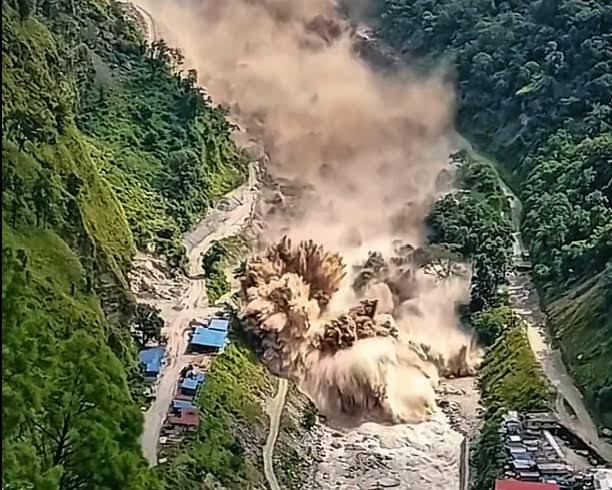
Late August this year, videos showing falling bridges, vehicles being swept away and buildings breaking apart as sounds of people screaming in fear echoed in the background went viral on social media. These videos were depicting the extent of the destruction and its impact on people during the floods in the Bhote Koshi and Trishuli rivers of Nepal. Many media outlets have portrayed the floods as “Nature’s fury”, making the floods sound like an “act of God”. In this article, we will try to understand the physical cause of the disaster and its implications for the future in a geopolitical context.
The Himalayas receive heavy snowfall in winter. Over long periods of time, this snow accumulates into a large mass called a glacier. As more snow accumulates, the glacier grows and slowly moves under its own weight. You can think of the glacier as a slowly moving river of ice and debris. The Himalayas are estimated to have more than 50,000 glaciers! In summers, some of the snow melts, and the water feeds into rivers that flow down the mountain and provide water to millions of people.
With increasing global temperatures due to accumulated greenhouse gas emissions, most glaciers in the western, central and eastern Himalayas are showing a clear retreating trend in the last many decades with the exception of a few stagnant or advancing glaciers in the Karakoram region (dubbed the “Karakoram anomaly”). Apart from the slow retreating trend, there have also been cases of sudden glacial collapses, when large chunks of the ice mass break away from the body of the glacier and rush downstream. A recent such event occurred in India in 2021 in Chamoli in Uttarakhand, which led to the washing away of a hydropower unit and the loss of more than 200 human lives. While establishing a direct causal connection between global temperature rise and a specific disaster event requires deeper scientific investigation, the general trend of retreating glaciers and increasing glacial floods is consistent with a warming world.
In the Nepal floods, the bedrock below the glacier in the mountain Langtang collapsed at an altitude of about 5200 meters. Huge amounts of snow, ice, rocks and debris fell thousands of meters into the river below, which caused the floods downstream. The collapse was so massive that it was recorded as 5.2 on the Richter scale – i.e., a moderate earthquake! The result? A massive flood that affected more than 84,200 people. 1300 people have died, and another 5000 people have gone missing. Roads, bridges and highways have been destroyed, which prevented aid from reaching people. Thousands of families have lost their homes, and an estimated 400 billion Nepalese rupees’ worth of property has been damaged.
But what mechanism leads to such a sudden collapse of the glacial bedrock? One of the possible explanations lies in understanding what keeps the rocky slopes of the Himalayas stable. The steep rocky slopes in the higher Himalayas are not single rocks but rock assemblages with gaps and cracks between them in which ice acts as a stabilising agent. These cracks in the rocks and the steep slopes of the mountains create weak points that are prone to getting dislodged. With increasing mean temperatures, the ice masses that stabilise the rock assemblages are likely to melt, increasing the chances of glacial rock collapse.
However, irrespective of the exact physical mechanism, this is not the first time a large-scale flood event has happened in the higher Himalayan region. For example, Nepal experienced floods in 2021 where ~2300 houses were destroyed, more than 2500 families were displaced and 100+ people were killed. Why wasn’t Nepal better prepared this time? To answer this, we must move beyond physical science to look at the global inequalities in economy and development and access to technology.
Climate change, caused by accumulating greenhouse gas emissions since the industrial revolution, has two kinds of impacts – slow onset events and extreme events. On short time scales, it leads to events like heatwaves and excess rainfall, which are showing an increasing trend in occurrence. On longer time scales, melting ice in the North and South Poles and the high mountains will increase the mean sea level and flood coastal areas. Because of their geography, these effects will be felt most profoundly by mountain countries like Nepal and island countries like the Maldives.
Who is responsible for climate change impacts that these countries are facing? Nepal emits only around less than 0.1% of the total amount of greenhouse gases emitted annually. Since industrialisation, Nepal has contributed less than 0.02% of the total greenhouse gases emitted across all countries. The USA, on the other hand, is one of the largest greenhouse gas emitters. The USA emits 11-12% each year and has emitted 20-25% historically. Rich countries emit the most and hence contribute the most to climate change; however, the poorest countries face the worst impacts of climate change. This is the “justice” component of climate change.
Why does this inequality matter in the case of the Nepal floods? In order for countries to adapt to climate change, they need to invest in research, monitoring, technology development, innovation and education to train people. For the Himalayan regions, development and deployment of technologies for remote sensing such as RADAR, LIDAR, satellites and drones, as well as ground-based sensors and monitoring stations, are an essential part of disaster mitigation. Access to resources to develop such technologies will allow countries to carefully plan their infrastructure for a changing climate and build early warning systems to warn people of impending disasters. The story of Blatten illustrates this. In Switzerland, the village of Blatten experienced a massive landslide that destroyed the entire village in 2025. However, due to well-developed early warning systems, the entire village was evacuated. Only 1 person died. Contrast this with Nepal, where the death toll has exceeded 1000. The impacts of climate change are occurring in an unequal world – a world where economic resources, development, and technical capacity are all distributed unequally due to an imperialist global order.
Because countries that contribute least to climate change are most affected by it, developing countries lobbied and established the “The Fund for Responding to Loss and Damage (FRLD)” in 2022 under the United Nations Framework Convention on Climate Change (UNFCCC). However, it is not mandatory for developed, rich countries to contribute to the FRLD. Hence, although developing countries have requested $2.8 billion, the rich countries have voluntarily contributed only $822 million to the fund to date (i.e., not even 1/3rd), leaving poorer nations to suffer from existing disasters and unable to prepare for future ones. Importantly, developing countries have made it clear that these funds should be made available not as loans or conditional aid but rather as compensation for historical emissions. This is important, since the loss and damage finance should not be utilised to further entrench the debt cycles that poor countries are trapped in due to the loan structures of the IMF-World Bank complex.
The attitude of the rich countries is not surprising. Measures like early warning systems and climate and meteorological information services are all public services. The capitalist system, which in the neoliberal era is designed for the profiteering of multinational corporations, actively constrains crucial economic and technological development from reaching poorer countries – directly putting billions of lives at risk. In order for people around the world to gain resources and capacity to develop these technologies necessary for adapting to a changing climate, the current global capitalist system and its corresponding imperial relations are a great hurdle. It is necessary to replace this unequal, oppressive system with a new socialist one – in which countries’ access to life-saving resources and services is not constrained by the profit motive of private capital but rather becomes a global common good to be disseminated equally, guaranteeing people’s right to life in a changing climate. In this larger context, the compensation demanded by Nepal from the rich, historical emitters is only a temporary, symbolic reparation but powerful nevertheless.
On the regional front, there is a need for greater co-operation between the Himalayan countries – China, India, Pakistan, Afghanistan, Nepal, Bhutan, and Bangladesh – since the climate impacts are transboundary and regional in character. While there are multiple military and territorial disputes among these nations, it is imperative that, for the purposes of disaster warnings, the countries come together to establish a common base for monitoring Himalayan glaciers and detecting early signs of glacial hazards through sharing and dissemination of important information.