

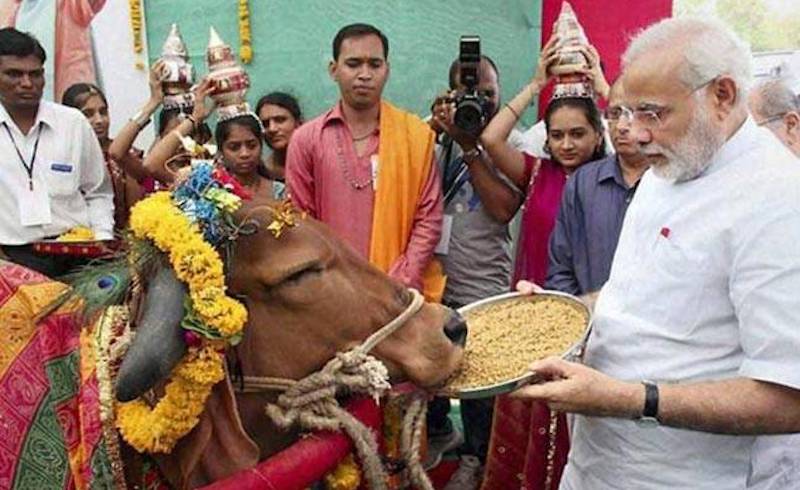
For years, the narrative that cow slaughter is the foulest and vilest deed above all has been propagated by the Indian media. Those who consume beef are labelled crude and insensitive, “What has that bovine done to you? That pure, godly bovine with every part of it worth celebrating and worshipping, including its excreta! The holy cow!” Holy to the Hindus, a staple food for everyone else. Mob lynching over cow slaughter and consumption has been going on for years— Muslims, Dalits and other have been targeted over this, over what is just a staple food.
In 2020, the BJP government went so far as to criminalise the slaughter of cattle in Karnataka, with the Karnataka Prevention of Slaughter and Preservation of Cattle Act. This Act in a stroke took away jobs from lakhs of Muslims, Dalits, poor farmers, cattle traders, etc. Beef for many remains the only affordable nutrient-rich food source. Through active saffron propaganda, cow-slaughter has become a tool to incite communal riots that have been running rampant for many decades in India. It is ironic that India regularly features among the top 5 beef exporters in the world even under the watchful eyes of cow vigilantes. Clearly, the ban aims to fatten the pockets of capitalists while making the marginalised poorer.
Before Congress came to power in Karnataka, they openly criticised this Act and pushed to repeal it. After having been in power for more than half the term, there has been no initiative from the Congress to repeal the Act. They are now worried about losing a large number of votes by coming across as a party that is insensitive towards Hindu sentiments. There truly is no lesser evil here, both parties set out to criminalise minorities further by criminalising their food. Muslim organisations in Karnataka have vocally reminded the Congress of their hypocrisy.
Historically, communal violence has been repeatedly engineered in India, first by the British and later by successive governments that have ruled from Delhi. The motive has remained the same, that of sowing discontent within the people, dividing them on religious lines, and harming the unity forged through the anti-British freedom struggle or other forms of democratic movements post-1947. The situation may often feel like a hopeless one. Brotherhood and fraternity may seem difficult to achieve in such a vitriolic atmosphere that is kept alive by the ruling powers.
Communism teaches us to look beyond what is apparent, obvious, and superficial. It teaches us to understand that our way of looking at the world or any other political/juridical/religious phenomena have its roots in the question of the economic life of the society as a whole. The same goes for communal violence. While economic growth for the wealthy minority increases inequality and reduces the quality of life for the broad masses, polarisation on communal lines is created by the state to ensure no unity on the basis of basic livelihood demands can be forged among the people.