

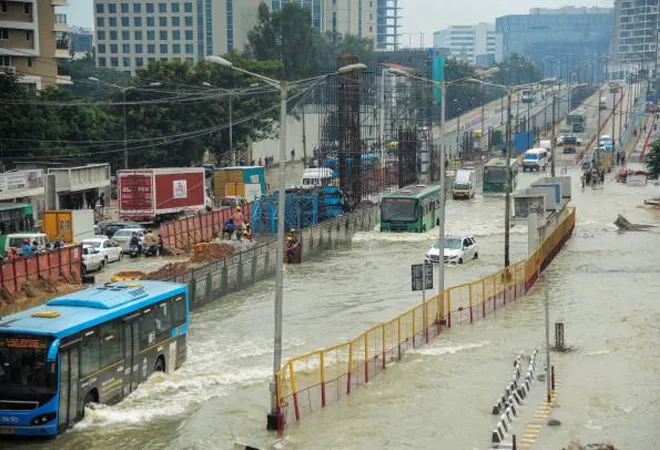
The recent deaths during the Bengaluru rains once again exposed the brutal reality of urban flooding in India’s ‘Silicon Valley’. In April 2026, heavy rains led to the collapse of a compound wall near Bowring Hospital, killing several people, including street vendors and daily wage workers sheltering along the pavement. Most of the victims were working people trying to protect their small stalls and belongings during the downpour. Investigations later revealed that construction debris and poor maintenance had weakened the wall long before the rains. Yet, as always, the tragedy was reduced to a story of ‘heavy rain’, while the deeper issues of negligence, unsafe urban infrastructure and unequal living conditions were ignored.
The current state of affairs has certainly been intensified by climate change, as rising temperatures are increasing the frequency of extreme rainfall events. Bengaluru too has witnessed unusually intense rainfall over the past decade. According to studies on the 2022 floods, the city received nearly 1,958 mm of rainfall that year, almost double its long-term annual rainfall. Climate change induced heavy rain becomes disastrous only when a city destroys the ecological systems that once absorbed, stored and channelled water.
Historically, Bengaluru was known for its interconnected network of lakes, wetlands and rajakaluves. These water systems acted as natural flood-control mechanisms. Rainwater flowed from one lake to another through stormwater channels, reducing flooding while simultaneously recharging groundwater. Over the last few decades, Bengaluru’s expansion has come at the direct cost of its lakes and wetlands. Studies by researchers such as T.V. Ramachandra from the Indian Institute of Science showed that between 1973 and 2017, Bengaluru witnessed a staggering 1028% increase in paved surfaces, alongside an 88% decline in vegetation cover and a 79% decline in wetlands. Historically, the city had nearly 1,452 interconnected water bodies capable of storing enormous quantities of rainwater. By 2016, only around 190 lakes remained, and their storage capacity had fallen drastically from nearly 35 TMC (thousand million cubic feet) to barely 5 TMC. Even these surviving lakes are heavily polluted, encroached upon or cut off from their natural drainage systems. The rajakaluves that once connected lakes and carried excess rainwater across the city have been narrowed, blocked or built over by roads, apartment complexes, tech parks and commercial infrastructure. As a result, rainwater that earlier flowed gradually through wetlands and lakes now accumulates rapidly on roads, low-lying slums, etc., turning entire neighbourhoods into flood zones after just a few hours of intense rainfall.
Some of Bengaluru’s most prominent infrastructure projects stand directly on destroyed lakebeds. The M. Chinnaswamy Stadium was built over the Sampangi Lake bed. The Kempegowda Bus Station at Majestic replaced the historic Dharmambudhi Lake. Large parts of the Outer Ring Road corridor, Manyata Tech Park and the Bellandur region were developed over wetlands, floodplains and interconnected lake systems. Today these same areas become some of the worst flood-hit zones during heavy rains. Roads turn into rivers, tech parks are submerged and apartment complexes are inundated. Bengaluru is now witnessing the consequences of treating lakes as “vacant land” available for commercial expansion.
The extreme concretisation amplifies the issues. Earlier soil, vegetation and wetlands absorbed rainwater naturally. Today roads, malls, apartments, parking spaces, and glass office towers dominate the landscape. Water can no longer seep into the ground. Instead, rainwater rushes rapidly across concrete surfaces and overwhelms drainage systems. In many places, drains themselves have disappeared under roads and buildings. Bengaluru receives enormous rainfall every year, yet it lacks even basic mechanisms to store this water effectively.
This is why the city faces the absurd situation of floods and water scarcity simultaneously. During monsoons, rainwater floods the streets because there is nowhere for it to flow or accumulate. Months later, the same city suffers severe water shortages and groundwater depletion. The issue is not lack of rain, but destruction of the infrastructure needed to conserve it.
However, the burden of this crisis is not equally shared. The people who profit from Bengaluru’s speculative urban expansion are not the ones who suffer its harshest consequences. It is the working classes who are forced to pay the price. Migrant labourers, street vendors and low-income families often live near drains, lakebeds and low-lying areas because affordable housing elsewhere in the city is unaffordable. When flooding occurs, their homes are submerged first, their belongings destroyed and their livelihoods interrupted immediately. A tech employee may continue working remotely during floods; a street vendor or construction worker cannot. For daily wage workers, even a few days without work can mean hunger, debt and displacement.
Bengaluru’s crises therefore reveal the class character of urban development itself. Ecological destruction is carried out in the name of economic growth, smart-city infrastructure and global investment, but its social costs are imposed upon workers and the poor. The same workers who build the city, clean its streets and sustain its economy, are pushed into the most vulnerable spaces and abandoned during disasters.
The floods are not simply a warning about climate change, they are a warning about a model of urbanisation that treats lakes, wetlands and working-class lives as expendable in the pursuit of profit. Unless the government puts people over profit, flooding will continue to become more frequent, more destructive, and more unequal.