
Earlier in February, the National Green Tribunal dismissed a petition filed against the Nicobar Project on grounds of “considering the strategic importance of the project”. Further it found that ‘adequate safeguards’ were in place to mitigate environmental damage. What is the Nicobar project? Why have people objected to its environmental clearance? Have scientific facts and due processes been followed in the matter?
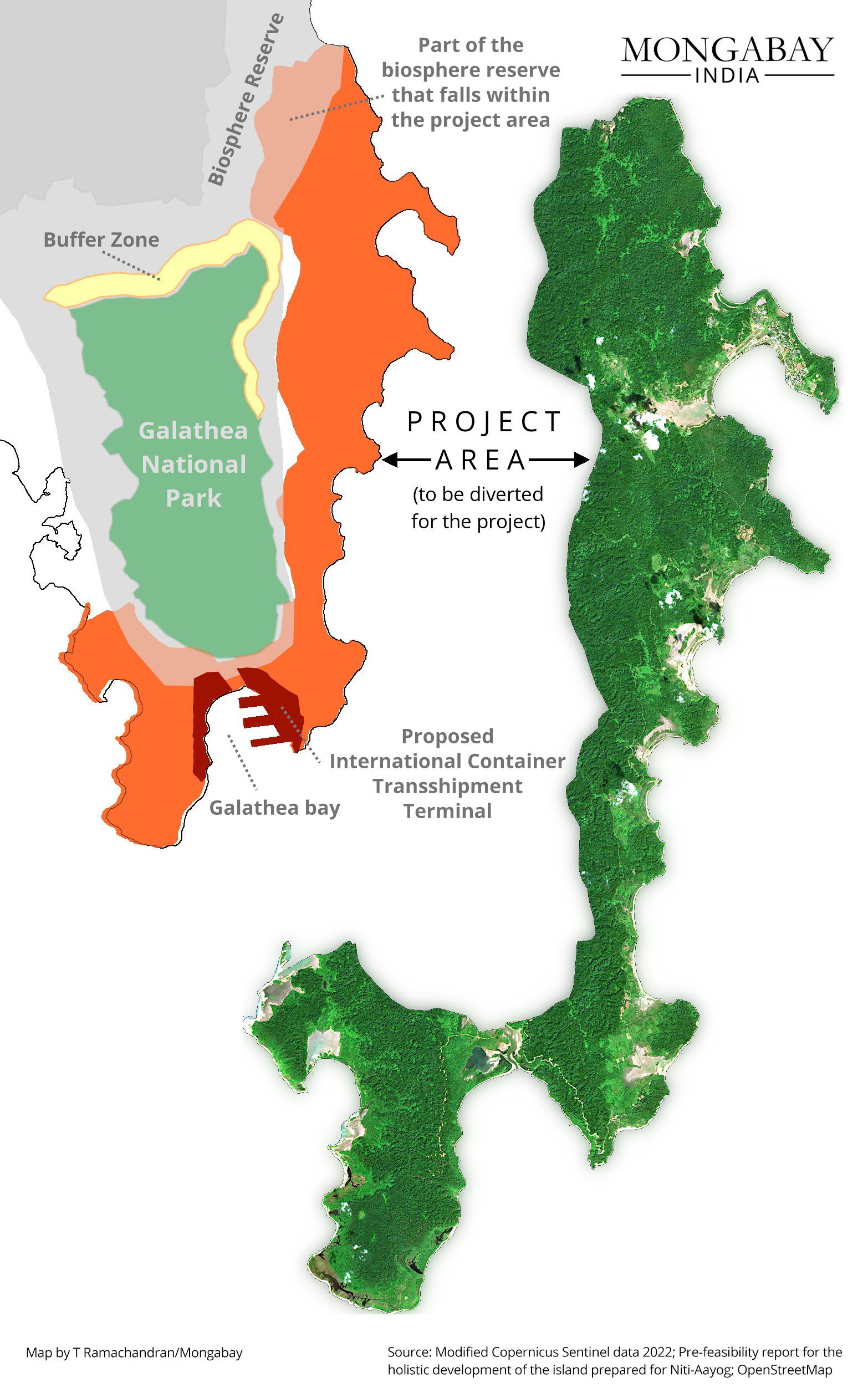
In 2020, the NITI Aayog proposed the Nicobar Project – a plan to ‘holistically develop’ the Great Nicobar Island. Spread over 166 sq km it proposes building a transshipment port, airport, township, and a powerplant that comes at a cost of Rs. 75,000 crore! The government claims that the location of the port is ‘strategic’ to take advantage of trade routes to boost economic development.
While the project may seem lucrative, experts warn that the project will destroy the biodiversity of the islands and upend the lives of Adivasis. In the first part of this two part article, we will examine the ecology and geography of the Andaman & Nicobar (A&N) islands to understand how the government has ignored scientific findings and removed legal protections to clear the project.
A volatile land
The A&N islands are an earthquake-prone zone coming under category 5 of seismic hazard zones. The continents on the earth sit on top of massive rock layers known as tectonic plates that are moved around by the heat inside the earth. When they collide, it creates a subduction zone releasing massive amounts of energy triggering earthquakes and tsunamis. A&N sits at a subduction zone. Data shows that each year, the location experiences around 44 earthquakes of magnitude 4.4-6.0. Experts warn that an earthquake of 5.0 magnitude is enough to significantly damage the port and cause chemical/oil spills which will cause long term ecological damage. A 2005 report by EERI and IIT Kanpur states that 8 m high waves hit the Nicobar coast during the 2004 tsunami. The Indira point – the south tip of the island is suspected to have submerged by 4 m by its impact. The project authorities have completely sidelined these facts and stated that they will take precautions by ‘earthquake-proofing’ the port. However, no amount of proofing will be able to prevent damage in such a volatile zone.
Islands are test tubes of biodiversity
When organisms end up on islands, they become isolated from their mainland population. Through time, they evolve independently. Over many millions of years this can give rise to unique species found only on islands. Indeed surveys have documented many unique species in the A&N islands such as the Nicobar Shrew, Nicobar frog, Nicobar megapode, etc.
Scientists think that many rare organisms might still remain hidden on the islands unknown to science. Nicobar is also home to the vulnerable leatherback turtles, the largest ones in the world. Huge numbers of females lay their eggs in Galathea Bay – the site where the port is to be built. All these make Nicobar (Galathea in particular) one of the key sites to be preserved for conservation.
Galathea was originally a wildlife sanctuary. However, in January 2021, the National Board for Wildlife denotified it specifically for constructing the port. The environment ministry also declared that the Galathea area will have a ‘zero extent’ Ecologically Sensitive Zone further stripping away protections for wildlife. Later in February 2021, the National Marine Turtle Action plan was released and Galathea beach was included in Coastal Regulation Zone – 1 (CRZ-1) conferring it with legal protection. Ironically the latest 2026 NGT verdict ignores this and has cleared the Nicobar project.
Lies and pseudoscience will protect the trees
On paper, MOEFCC claims that only 9.5 lakh trees will be cut for the project. 13,000 ha of forest have been marked for felling and the jungle in Nicobar is dense with 500-900 trees per hectare. This means, 60 lakh to 1.2 crore trees will be cut in reality! To further greenwash the public, the government plans to plant trees in Haryana and Madhya Pradesh as ‘compensatory afforestation’. This ignores basic science. Each location has its own functioning ecosystem, hence planting trees in Haryana cannot undo the damage in Nicobar. Secondly, the BJP has amended policy and included plantations under the definition of ‘forest’ to boost India’s green cover and hide the ongoing deforestation. Monocultures cannot perform the same function as a healthy forest, and can degrade the land, but this has conveniently been ignored.
Islands are particularly vulnerable to exploitation and climate change
For the common public, a mega infrastructure project might seem like a good investment. However, the key is to understand that while the Nicobar project might bring in short term economical gains, it is a terrible gamble to take in the long term. Let us deconstruct this idea.
Given their small sizes, space and other resources are often limited on islands making them particularly vulnerable to over-exploitation. The capital – Port Blair is a sad example of this. Over the years, an increasing number of settlers along with urbanisation has disrupted hydrological cycles. In some regions rainfall periods have reduced from 10-11 months to just 5-8 months in a year. More people and less rain means that existing water resources are now used at a faster pace than they can regenerate. For the first time, Port Blair has begun to experience water shortages.
Currently Great Nicobar has a population of 8500. The population across all islands in A&N is around 4.5 lakhs. However the Nicobar project plans to settle around 3.5 lakh people in Great Nicobar alone. Drawing from Port Blair’s experience, this move to rapidly urbanise and overpopulate the island is unsustainable and will lead to resource shortages in just a few years.
Over the last few decades a new threat has emerged – climate change! Due to global warming, ice in the polar regions have already begun melting causing sea levels to rise, islands being extra vulnerable. The threats of water and resource shortages, earthquakes and sea level rise will all result in the inevitable downfall of the proposed township and port. Combined with the immense ecological damage, this makes the Nicobar project one of the worst projects the government has taken up. The question now is, why should we pay a huge financial and ecological price for a project that is doomed to collapse?