
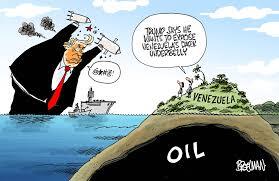
The United States’ kidnapping of Venezuela’s president through an overt military operation against a sovereign state, followed by the public arraignment of a sitting head of government in a US court, marks a decisive rupture in the already eroded landscape of international law. Whatever rhetorical disguises are employed, whether ‘capture’, ‘law enforcement’, or ‘counter-narcotics’, the substance remains unchanged: it was a naked act of imperial coercion.
Under both customary international law and the United Nations Charter, the operation is indefensible. Heads of state enjoy immunity except in one narrowly defined circumstance: an arrest warrant issued by the International Criminal Court. No such warrant exists for Nicolás Maduro or for any member of the Venezuelan government. By contrast, an ICC warrant does exist for the Zionist prime minister Benjamin Mileikowsky, aka Netanyahu, who recently flew through European airspace and entered Washington.
What we are looking at is not a one-off, but a model being tested for export. If this decapitation play works even partially, if a sovereign government can be struck, its head of state seized, and the world can be trained to call it “law enforcement”, then every Latin American government that has ever tried to resist US-imperialism is in threat. Even in the case of Europe, Trump’s calculation is long-term: he does not need today’s so-called centrist politicians. He is betting that within a decade, Europe’s fascists will consolidate, with figures like Nigel Farage in the UK, Le Pen types in France, the AfD, and similar parties in Germany gaining power. The Arab world, meanwhile, remains highly compromised. Not because Arab populations lack courage, but because the regimes have perfected an art of silence. The Arab League has basically gone to sleep, and the governments that should be threatening to tear up agreements with the Zionist regime instead normalise, provide diplomatic cover, and act as if genocide is a weather report. Imperialism thus manufactures a class of compradors serving the imperial interests.
The Venezuelan operation also clarifies something else. Unlike in Iraq, Afghanistan, or Libya, this intervention was not preceded by extensive ideological conditioning of domestic US audiences. There was no decade-long, focused Hollywood propaganda, nor was there a sustained narrative of humanitarian rescue. The justification was rushed, incoherent, and quickly abandoned. Even within the United States, the narcotics narrative collapsed almost immediately, replaced by open admissions that the real objective was oil and geopolitical leverage. This reflects a structural change in US power, where, while the capacity to destroy remains overwhelming, the capacity to persuade is degraded. It is essentially a system that compensates for economic and industrial decline by intensifying its reliance on military and police force. The United States can flatten infrastructure, disable power grids, and abduct leaders, but it cannot translate this violence into stable political outcomes.
That contradiction is already visible on the ground. Despite the seizure of the president, the Venezuelan state has not collapsed. Constitutional succession mechanisms were activated, the military command structure remains intact, and mass mobilisations demanding Maduro’s return have been taking place. On the other hand, the loudest applause to the kidnapping has come from a narrow, privileged diaspora and the local compradors: English-speaking, affluent, and structurally aligned with US capital. Their visibility is amplified through online bots, astroturf campaigns, and AI-generated imagery portraying grateful Venezuelans welcoming their own destruction. On the ground, among the poor and working classes who bore the costs of sanctions and blockades, the response has been defiance, not gratitude.
The geopolitical implications extend far beyond Caracas. Venezuela has functioned for over two decades as a nodal point of anti-imperialist coordination in Latin America: sustaining Cuba, enabling regional integration, and offering material support to left movements across the continent. In this sense, the attack on Venezuela parallels the ongoing campaign to weaken Iran and the axis of resistance in West Asia. The kidnapping of Maduro is about disciplining the Global South, and that international law will not be allowed to constrain imperial action. It is, of course, also about sending a warning to other defiant actors such as Cuba, Colombia, Mexico, and Iran.
Yet the operation also exposes imperial limits. The United States has not occupied Venezuela, nor is it likely to. The scale of mobilisation required would be catastrophic, both militarily and politically. What we are witnessing instead is coercive bargaining through terror: strikes, seizures, and threats designed to force compliance without full-scale invasion. This strategy, however, rests on the assumption that people will accept colonial humiliation, but history suggests otherwise. Latin America remembers the consequences of U.S.-backed regime change: mass repression, disappearances, and counter-revolution. The kidnapping of Venezuela’s president is therefore not a demonstration of imperial confidence but of imperial desperation by a power that can no longer rule by consent and increasingly governs through spectacle and force. In doing so, it accelerates the erosion of the illusion of legitimacy and consolidates resistance in the Global South.
This is not merely a Venezuelan question. If a head of state can be abducted in broad daylight and the world is instructed to call it “order,” then sovereignty becomes a myth. What stands before us is a choice: either surrender and help consolidate an imperial world order, or resist by coming together, across the Global South, to defend sovereignty and collective dignity.