
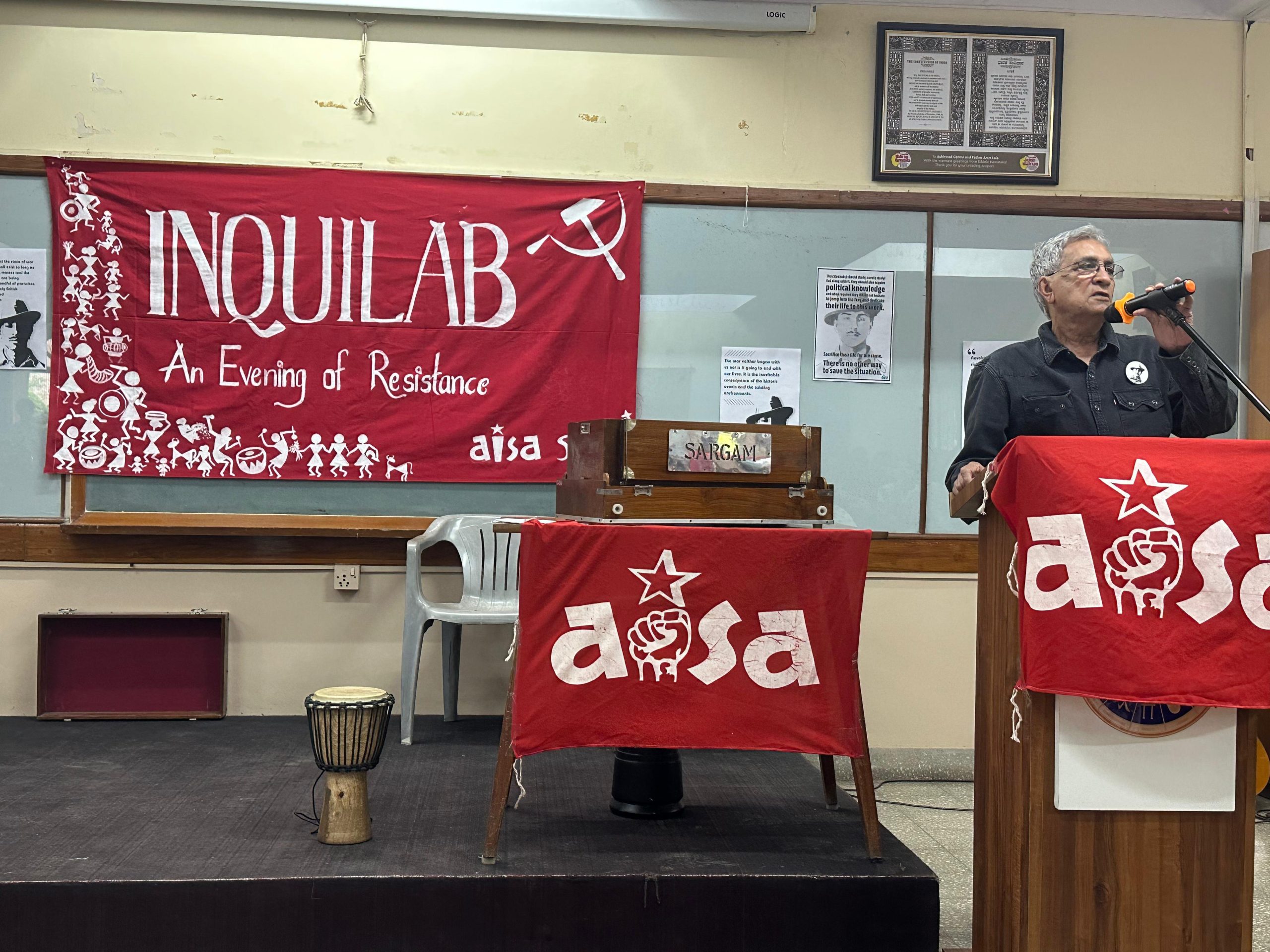
On 28th March, Inquilab: An Evening of Resistance was organised by All India Students’ Association and Spark*, in Bengaluru to commemorate the martyrdom of Bhagat Singh, Sukhdev and Rajguru. It was not a routine act of remembrance but an evening of resistance, reflection and engagement. It brought together students, comrades, and listeners not merely to honour the sacrifice but to confront the social, political, and intellectual ideas that shape today’s idea of revolution. Rather than following the familiar script of patriotic tribute, the event created a space to revisit their legacy through songs of resistance, poems of revolution, with a more questioning lens. What does it mean to inherit such a legacy today? Whether remembrance without engagement risks the symbolism? The atmosphere itself signalled that it would not be a conventional homage, but an attempt to reclaim that Bhagat Singh is not just a symbol but was a foremost Marxist thinker.
Dr. Shamsul Islam joined the event as the guest speaker to deliver a lecture on the ideas of Bhagat Singh and the contrasting role played by propagators of Hindutva ideology. It was not about glorifying sacrifice or repeating familiar slogans. Instead, it felt like an attempt to disturb that comfort—to question what we think we know about Bhagat Singh.
One of the threads running through the talk was the idea that political freedom without economic justice is incomplete. Socialism was repeatedly emphasised, not as an abstract theory, but as something central to Bhagat Singh’s thinking. The argument was clear: there can be no real equality in a system structured by class inequality and exploitation. These were not seen as accidental problems, but as deeply embedded in the system itself.
The discussion on revolution stood out because it challenged a very common misunderstanding. The speaker rejected the narrow idea that revolution simply means violence. Bhagat Singh emphasised on the idea of revolution through not only guns and pistols, but also through equipping oneself with revolutionary theory. This insistence on rethinking revolution made it feel less romantic and far more demanding. At one point, the speaker said something that stayed with me: “Organise yourself and get on your feet. Do not wait for others to organise.” This shifted responsibility directly onto individuals, especially students. There was also a line that echoed the spirit of revolutionary thought—“you have nothing to lose but your chains”—which reinforced the urgency of action and participation.
The lecture also connected Bhagat Singh’s ideas to present-day concerns around education and access. The speaker referred to figures like Kumar Mangalam Birla and Mukesh Ambani, arguing that certain policy directions and institutional decisions restrict higher education access for the poor and middle classes. This was presented as part of a broader concern about how inequality continues to reproduce itself through modern systems.
Another powerful intervention came through the ideas of Periyar E. V. Ramasamy, especially his critique of martyrdom. The lecture questioned blind hero worship and the emotional glorification of death. It pushed the audience to think: is remembering Bhagat Singh only about honouring his sacrifice, or about engaging with the ideas he stood for? The suggestion was clear—without the latter, remembrance becomes shallow.
There were also references to broader ideological traditions. The speaker pointed out that communism and socialism are older than the red flag itself, challenging the common association of the flag only with violence or bloodshed. Instead, the red flag was explained as a symbol of resistance and a refusal to surrender to injustice. That idea of not giving in felt more important than the imagery often attached to it. There were also references to communal politics and Bhagat Singh’s own understanding of it. What stood out more than the specifics was the larger concern about how identity and division continue to shape political narratives.
The lecture returned repeatedly to Bhagat Singh’s intellectual life. One striking detail was how, during his time in jail, he prioritised reading over comfort. Instead of asking for better food or small privileges, he asked for books. It was mentioned that he read extensively finishing hundreds of books across different traditions and countries within that limited period of imprisonment. Whether one remembers the exact numbers or not, the image is powerful: a revolutionary shaped as much by reading as by action.
This emphasis on learning came through strongly towards the end. The message was simple but forceful—learn, read, and keep learning. Revolution is not only about protest; it is also about developing the ability to think critically. There was also a reference to Marx and Lenin, suggesting that ideas must not just be followed, but creatively adapted and implemented.
Another moment that stood out was a reference to a recent incident involving abduction of student and trade union activists where the Delhi police labelled Bhagat Singh as a “terrorist” while torturing them in custody. In UP the memorial to martyrs Ramprasad Bismil, Ashfaqullah, and Roshan Singh was recently bulldozed to the ground by the government. These incidents have laid bare the ideological incompatibility between the Sangh and the legacy of the Hindustan Republican Association martyrs.
Towards the conclusion, the lecture seemed to move away from the idea of martyrdom altogether. It suggested that what matters is not the label of “martyr,” but whether the ideas survive. In that sense, Bhagat Singh’s legacy is not something to be preserved in memory alone, but something to be actively engaged with.
The overall impact of the lecture was not one of comfort or inspiration in a simple sense. Instead, it left behind a series of questions—about inequality, about responsibility, about how we understand revolution, and about whether we are willing to move beyond admiration into action.