
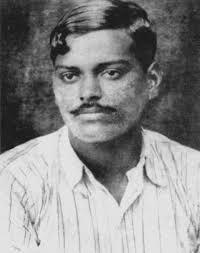
Chandrashekhar Azad (23 July 1906–27 February 1931) stands as a symbol of uncompromising resistance against British Imperialism. Born in Bhavra (Madhya Pradesh), Azad became politically conscious very early on; he was aware of how brutal the system of colonialism was, and he was greatly affected by the mass killing of Jallianwala Bagh. At 15 years Azad entered the freedom movement as a participant in the Non-Cooperation Movement (1921). He was arrested and brought before court for picketing. In the court, the judge asked the young satyagrahi :
“What is your name?” – “Azad.” (Free)
“Your father’s name?” – “Swadheenta.” (Freedom)
“Residence?” -“Jail.”
Infuriated by these answers, the magistrate sentenced him to fifteen lashes. The young Chandrashekhar later gave real meaning to the name ‘Azad’, and was never arrested later.
Disillusioned by the abrupt withdrawal of the Non-Cooperation Movement by Gandhi after the Chauri Chaura incident in 1922, he joined the revolutionary movement. Soon, he became a member of Hindustan Republican Association (HRA) formed by Ramprasad Bismil, Sachindranath Sanyal and others. HRA rejected the bourgeois leadership of Gandhi and Congress which compromised with British after each movement. Gradually, he became a central figure in HRA. Azad never aspired to formal leadership positions. Yet, naturally, everyone looked to him in moments of crisis. His decisions were practical, his judgement sharp, and his courage steady. He neither panicked nor hesitated. After the Kakori Action and subsequent arrest and execution of Ram Prasad Bismil and his fellow Comrades, Azad assumed the responsibility of re-organising HRA and helped mentor a new generation of revolutionaries, who followed him and continued a link in the ideological tradition. HRA was later renamed as Hindustan Socialist Republican Association (HSRA) in September 1928 to give an ideological direction to the revolutionary movement, that was missing earlier. HSRA declared the aim of the revolution is not only the national liberation from British imperialism, but to bring Socialism, to establish the dictatorship of the proletariat, and finally to establish a classless society. Chandrashekhar Azad was elected Commander-in-Chief of HSRA. He was also the chief organizer and military strategist of the HSRA. Their adoption of socialism and vision of a republic free from exploitation of workers and peasants marked a step beyond narrow nationalism toward class-conscious anti-imperialism. Under Azad’s leadership, HSRA carried out propaganda and actions aimed at destabilizing colonial rule and inspiring mass awakening. Betrayed by a spy, Azad was surrounded by the British police on 27th February, 1931 in Allahabad’s Alfred Park. A fierce encounter followed. Azad took shelter behind a tree and returned fire with remarkable calm. Several policemen were injured. The police could not advance despite being in large numbers. When his ammunition began to run out, he assessed the situation clearly. Escape was no longer possible. Azad had long resolved that such a fate would never be allowed. With his last remaining bullet, he fulfilled his vow. He shot himself, choosing death over captivity.
Today, 95 years after his martyrdom, his life and legacy inspires ongoing struggles against imperialism, and all forms of exploitation. Today when the workers and peasants of India are still suffering, true emancipation of people demands fulfilment of dreams of early revolutionaries like Azad.