
The pain endured by the people of this land is not something that can be described in mere words! From the Aryans to the British, it has been 4,000 years of continuous agony, with the baton passing from one oppressor to another. Yet, eight decades ago, at the stroke of the midnight hour, we were told that all this suffering would end in a single night, and that from the next day onward we would finally be free. Instead, what followed was eight decades of broken promises, thus, becoming the most treacherous chapter of all. Whenever the people raised their voices, they were told, “No, we are a democracy. You have the right to choose your oppressors.” Now, those very oppressors have come up with the Special Intensive Revision (SIR) exercise, which strips millions of common masses even of that right to choose.
During the first phase of SIR in Bihar, 6.5 million poor citizens were disenfranchised. One of the globally accepted measures for assessing the quality of an electoral roll is the Electoral-to-Adult Population (EP) Ratio. Before the exercise, Bihar’s EP Ratio stood at 97%, slightly below the national average. Following the exercise, however, the ratio fell sharply to 88%, representing a decline of nine percentage points.
During the second phase of SIR, when the process happened across 9 states and 3 union territories the damage was more severe, especially in West Bengal. Approximately 9.1 million names were deleted from the state’s electoral rolls, accounting for more than 10% of its electorate. Of the total deletions, around 3.1 million names, roughly 34%, belonged to Muslims. The deletions were heavily concentrated in districts such as Murshidabad, Malda, Uttar Dinajpur, Bankura, and Purulia, many of which have substantial Adivasi population also.
In Karnataka, where the third phase of the process is underway, as of 28 July 2026, nearly 54% of voters in Bengaluru are either unmapped or have been classified under the ASDDO (Absent, Shifted, Duplicate, Dead, and Others) category. Owing to inadequate training of the Booth Level Officers (BLOs) and unrealistic time constraints, there have been numerous instances of incorrect progeny mapping, particularly affecting married women. In areas such as Yelahanka and Mahadevapura, entire polling stations are missing from the digitized 2002 electoral records, making it impossible for many voters to be mapped.
India till now has had only ‘Special’ revisions or ‘Intensive’ revisions. The destructive fusion of both ‘Special’ and ‘Intensive’ revisions, an approach not supported under the framework of Registration of Electors Rules, 1960, combined with the document-intensive nature of the exercise, has serious consequences. Implementing such a process in a land where stable documentation and access to bureaucratic institutions are already lacking, and doing so within an unrealistically short timeframe, is bound to disenfranchise millions of marginalised people, particularly Muslims, Dalits, women, and Adivasi communities. The more fascist aspect of the SIR, however, is its striking similarity to the National Register of Citizens (NRC) exercise.
The NRC demanded every citizen to produce documentary evidence, known as “legacy data”, to prove that they were Indian citizens. The current SIR demands that: (i) those born before 1987 must prove their date and place of birth; (ii) those born between 1987 and 2004 must prove that one parent is an Indian citizen; and (iii) those born after 2004 must prove that both parents are Indian citizens. As proof, voters are required to submit one of the 11 documents listed by the Election Commission of India (ECI). Thus, it is clear that SIR is not merely an attack on one’s right to choose; it is an attack on one’s very right to exist legally.
While this circus was unfolding, one would expect opposition mainly from two forces. One was the Supreme Court, which, through its Association of Democratic Rights v. Election Commission of India (27 May 2026) decision, gave a full green signal to the SIR. The second was the opposition parties, most of whom did little to nothing, apart from a few obligatory growls here and there. Even in a Congress ruled state like Karnataka, Chief Minister D. K. Shivakumar called for the successful implementation of SIR, while senior Congress leader Shashi Tharoor claimed that the SIR had helped the Congress secure victory in Kerala.
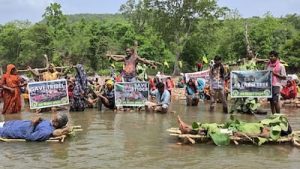
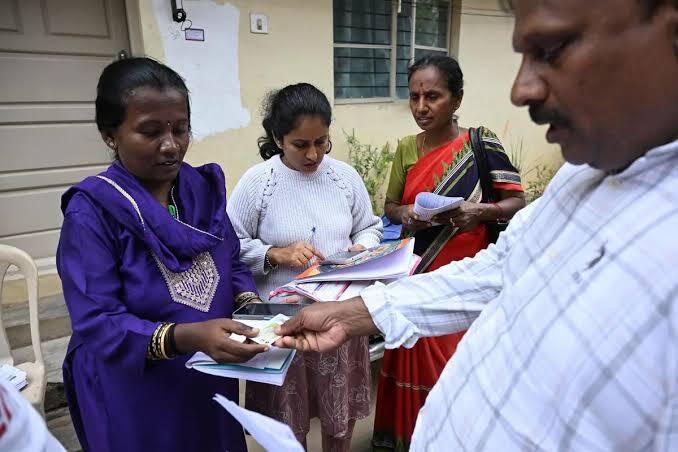
Thus, the burden of resisting this fascist onslaught fell fully upon the people and the democratic civil society organizations. In Karnataka, these organizations came together to launch the “My Vote, My Right!” campaign. Under this banner, they have organised several help desks to assist people to navigate through the process. The campaign also organised protests and Jathas, spreading awareness among the masses about the anti-people nature of the process.
Even after eight decades of so-called freedom, the people are still forced to take to the streets to fight for their citizenship, their right to vote, and, as we have seen in recent times, even for basic accountability. In moments like these, the wise words of Comrade Bhagat Singh come to mind: “What difference does it make whether Lord Reading is the head of the Indian government or Sir Purshottamdas Thakurdas?”
It was never about Reading or Thakurdas; it was, and continues to be, about the entire system that produces them, a system that keeps the toiling millions under its iron fist to exploit them. So long as this system exists, hundreds of NRCs and SIRs are bound to emerge!