

Soviet history, especially the unprecedented achievements it made possible under the leadership of Comrade Stalin, is often subjected to slander, distortion, and conspiratorial attacks by bourgeois historians, intellectuals, fascists, and opportunists who claim to be communists. One such vicious slander is the case of the Katyn Massacre.
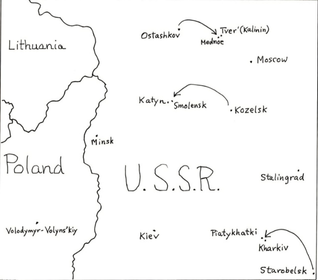
According to the widely accepted narrative, the Soviet government, under the leadership of Comrade Stalin, transferred nearly 22,000 Polish prisoners of war (POWs) between April and May 1940 from the camps of Kozel’sk, Starobel’sk, and Ostashkov to Smolensk, Kharkov, and Tver, where they were executed and buried at Katyn, Piatykhatky, and Mednoe respectively. This narrative first entered the pages of history through the Nazi regime in 1943.
Although the Katyn Massacre might not be as sensational as the Holodomor in public discourse, within anti-Soviet academia it is regarded as one of the clearest crimes committed by Stalin. To this day, it plays a significant role in the politics of Eastern and Central Europe.
To understand the falsehood surrounding Katyn in depth, one must not only verify the validity of its sources but also examine the historical junctures at which the narrative was invoked and the political forces that wielded it.
(I) It was the spring of 1943. Nazi Germany had already suffered its first historic defeat at the Battle of Stalingrad. Meanwhile, in occupied Poland, anti-Nazi guerrilla forces such as the Armia Krajowa and the communist-led Gwardia Ludowa were gaining support among the Polish population. Earlier that year, the Nazis had begun the extermination of nearly 300,000 Polish Jews in the Warsaw Ghetto. As a result, under the leadership of Joseph Goebbels, the Nazi regime launched the Katyn campaign to promote the idea that ‘communist terror’ was worse, thereby concealing its own crimes.
(II) It was 1991. The Soviet Union was by then completely captured by the capitalist roaders and traitors from within. Neo-liberalism was seeping in under the name of Perestroika.
Mass protests against capitalist restoration emerged with a major trend advocating a return to the socialism of the Stalin era. Thus, under the fear of the spectre of Marxism-Leninism once again rising in Russia and to legitimize the illegal dissolution of the Soviet Union, the Katyn narrative was again invoked, this time by the treacherous Mikhail Gorbachev and Boris Yeltsin clique.
(III) Following the 2008 global financial crisis, the countries of Eastern and Central Europe bore the full burden of capitalist restoration. Rising unemployment, inflation, and massive dumping of IMF capital in the name of bailouts pushed these nations further into the mire of Western imperialism. As a result, people once again took to the streets; fertile grounds for revolutionary consciousness were once again laid. It was in
this atmosphere, only a month before the 65th anniversary of the victory over Nazi Germany, that Polish Prime Minister Donald Tusk and Russian Prime Minister Vladimir Putin, accompanied by the capitalist media, once again invoked the Katyn narrative.
Thus, it can be understood that whenever people gather beneath the revolutionary banner, the ruling class attacks them with ‘Katyn’. With that said, an obvious question arises: What actually happened at Katyn? Did the Soviets execute 22,000 Polish POWs? If not, who did?
To answer this, we must examine the two principal sources upon which this narrative rests:
- The Nazi report ‘Amtliches Material zum Massenmord von Katyn’ (1943).
- Closed Packet No. 1, released by Gorbachev and Yeltsin in 1992.
1) The Nazi Report
The Nazi report was produced following a joint excavation conducted in the Katyn Forest in 1943 by German officials and representatives of the Polish Government-in-Exile. Based on the recovered evidence, the commission concluded that thousands of Polish POWs had been executed between April and May 1940. The report gained further legitimacy after the publication of Soviet archival transit lists, which contained the names of officers from the Kozel’sk, Starobel’sk, and Ostashkov camps. Later, Jędrzej Tucholski’s 1991 work Mord w Katyniu, which compiled the names and details of the victims, elevated the ‘Soviets did it’ narrative to unprecedented prominence.
However, the fundamental problem with this argument is that transit lists are not execution orders. They merely record the transfer of prisoners; they do not demonstrate that the Soviet authorities executed them. This point is reinforced by the fact that 231 individuals buried in the Katyn graves do not appear on the Kozel’sk transit list. Many were POWs from the Ostashkov camp, located hundreds of kilometres away. In addition, Soviet soldiers identified by their coats and insignia, as well as local civilians from the Smolensk cemetery, were also found among the remains, raising serious questions.
The report contains numerous other irregularities. Although it presents itself as an objective collection of evidence, several letters cited as proof use the German occupation names of cities introduced after 1941, for example, Lemberg instead of Lwów, and Litzmannstadt instead of Łódź. If authentic, documents dating from 1940 should not contain these later German designations. Further, several letters and bills recovered from the victims bear dates later than May 1940, the highest till June 20, 1941, suggesting that at least some transferred POWs were still alive; automatically another question arises: if they were alive, how were they buried with the dead POWs? Then all the POWs must have been alive till June 1941.
On 27 July, 1943, the Propaganda Section of the German General Government admitted in a letter to the German Red Cross that documents recovered from different bodies had often been mixed together, with the papers of a single individual scattered across as many as twelve separate envelopes. On October 12, 1943, the Technical Commission of the Polish Red Cross, which participated in the excavation, likewise agreed on the unreliability of the documentation in its letter to the International Committee of the Red Cross in Geneva.
2) Closed Packet No. 1
The second major body of evidence is Closed Packet No. 1, released by Gorbachev and Yeltsin as official proof of the executions. These documents include a letter written by Lavrentiy Beria recommending the execution of Polish POWs, along with the minutes of a Politburo meeting approving the proposal.
There are 49 signs of falsification found in the documents. These include inconsistencies in dates, institutional designations, and signatures in comparison to the other Politburo documents. Most notably, the documents use the letterhead of the Communist Party of the Soviet Union, a name adopted only in 1952; before then, the party was officially called the All-Union Communist Party (Bolsheviks). Forensic examinations have also proven that two different typewriters were used in producing the documents. When these materials were first presented before the Russian Constitutional Court, an anti-communist body, in 1992, during cursory examination, they were rejected due to their falsity.
When the sources supporting the “Soviets did it” narrative are proven false, the question naturally becomes: What evidence exists to prove that the Nazis committed the massacre?
96% of the bullets recovered from the bodies were of German manufacture. The modus operandi, execution, and a pistol shot to the back of the head resembled the standard pattern of German mass executions carried out against Soviet civilians in places such as Orel, Voronezh, and Krasnodar.
Also, the later findings in the 2010 excavation in Volodymyr-Volyns’kiy should be taken into account. Here, bodies of Polish soldiers from the Ostashkov camp whose graves located in Mednoe were found. Volodymyr-Volyns’kiy is 1000 km away from Mednoe; along with it, the bullet found in this burial site was of German manufacture of 1941, with the modus operandi being Nazi, proving that the POWs were captured during the occupation of various parts of Western Russia, Ukraine, and Poland after their transfer to Soviet camps and were brutally executed by the Nazis in 1941.