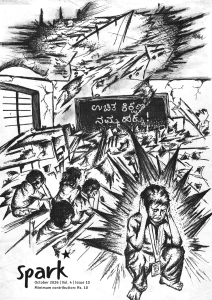

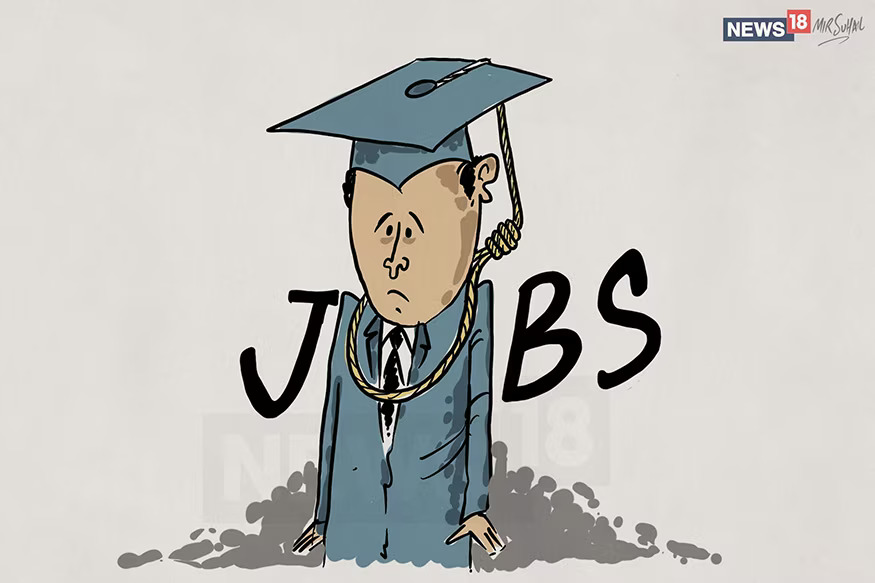
The discussions on the recent protests have largely focussed on the nature of this generation of youth, their modes of expression, and so on. But we need to shift the focus to the objective reasons for their anger. India’s youth confronts a privatised and expensive education system, clearly the outcome of the economic policies followed in the neoliberal era. What is less widely understood is the link between these policies and the prevailing repressive conditions.
Higher education as a method of extracting the meagre resources of working people
Sixty years ago, the Kothari Commission and recently the National Education Policy, 2020, recommended that public expenditure on education should be 6% of GDP. But the combined spending of the central and state governments is stuck at around 2.7% of GDP. Neoliberal policy opposes any increase in public spending, arguing that the private sector is more efficient at delivering the goods. But the private sector enters education only if it finds it profitable, for which it charges higher fees; so the burden on households grows. Household spending on education, as a share of GDP, nearly doubled between 1990-91 and 2017-18.
Let us look specifically at higher education, in the context of the recent protests. The State of Working India 2026 (SWI), a study by the Azim Premji University shows that, over the last few decades, a larger section of Indian parents are sending their children for college education with hopes of better employment. Hence, nearly a third of India’s college students are now drawn from the poorer half of the population.
In the post-1991 neoliberal era, the government restrained spending on higher education, and so a growing market was handed over to the private sector. The number of higher education institutions has grown rapidly, to 69,534 today; but while half of higher education institutions were government-run till the 1980s, substandard private education now accounts for over 80%.
Only a third of graduates get salaried jobs
The central problem, however, is not the supply of adequately skilled labour, but the demand for labour. While India’s colleges have churned out 100 million graduates over the last 20 years, only 56 million of them found employment, and only 34 million of them got salaried jobs, implying that the other 22 million ‘employed’ graduates were consigned to self-employment or casual labour. With rising competition for jobs, employers have the upper hand in deciding salaries. The growth in monthly salaries of graduates has flattened since 2011.
The employment crisis and the pattern of growth
At the heart of this crisis is the entire pattern of growth. The absence of a revolutionary transformation of agrarian relations after 1947 prevented the widely-dispersed growth of demand, and prevented the emergence of a widely-dispersed, labour-intensive industry catering to that demand by making humble items of mass consumption. As a result, workers were not drawn out of agriculture into manufacturing. Employment in larger private firms (the ‘organised sector’) grew slowly; in 1991 it was still only 40% as large as public sector employment. And public investment itself grew too slowly to absorb all those who had acquired education and training.
When growth did take off in the 2000s, it was driven by the demand of the top 5-10% of the population, who consumed high-end goods and services made with capital-intensive technology, requiring large imports but creating fewer jobs. As the agrarian crisis has intensified, agricultural households have sought to supplement their meagre farm incomes by engaging in casual labour, low-paid service jobs, petty retail, and various types of self-employment – all expressions of distress. This model of development has not essentially changed even as governments have changed hands from the Congress to the BJP over the years.
Now, with changes in the global economy, the better-paid jobs in IT have stopped growing and, owing to AI, may shrink too. The employment crisis is set to worsen, and today’s youth – both those with college degrees and without – will have to think about what changes need to be brought about to overcome it. How much difference these youth make to Indian society, and even to their own lives, will depend on the extent to which they link up with the labouring majority of Indian society.
The link between neoliberal rule, the suppression of protest, and sudden eruptions
Even those who realise the link between neoliberal rule and the present pattern of growth may fail to see its link to the autocratic suppression of all protests. Recall that, hardly three months ago, the National Capital Region witnessed a different wave of protest, namely, the upsurge of workers first in the Manesar industrial belt, and then in the Noida industrial belt demanding better working conditions.
Unlike in the case of the Jantar Mantar protests, the authorities did not back down in the Noida case, and no minister resigned. The difference, of course, is of class; the middle class were better represented in the Jantar Mantar protests, whereas the Manesar-Noida protests were exclusively working class.
However, there are certain commonalities between the two protests. Both erupted with explosive force, and spontaneously drew in masses of people. There is a reason for this.
Before the neoliberal era, protests and movements did face repression, but were not yet treated as criminal activity. It was in the post-1991 era, under governments of both the Congress and the BJP, that all dissent was systematically wiped out (e.g., ban on protests outside Freedom park, Bengaluru).
The reason for this is that the neoliberal regime requires the intensification or acceleration of widely unpopular measures and policies: privatisation, land acquisitions, closure of industries, retrenchment, hikes in government-administered prices, repeated fee/fare/rate hikes, tolls, and so on. In these conditions, when protest erupts, it does so not at the point of mere discontent but at the point of desperation; and once the protest is underway, a multitude throng in to express their own desperation. This is what we saw at Jantar Mantar.
The rulers promptly ascribed this wildfire-like spread to a deep-seated conspiracy by the protesters, but in fact it is the outcome of a decades-long conspiracy by the rulers to suppress the people.
(This is an abridged version of the essay,‘What Links Jantar Mantar with Noida’ published on the Research Unit for Political Economy (RUPE India) blog on 30 July 2026. Scan to read the full article.)