
On September 13th, 1929, revolutionary Jatindra Nath Das (Jatin Das) was martyred after a 63-day hunger strike in Lahore Central Jail. Bhagat Singh, Jatin Das, and other Hindustan Socialist Republican Association (HSRA) comrades launched this historic 116-day hunger strike (June 11 – October 5, 1929), demanding the status of political prisoners. Today, September 13th is observed as Political Prisoners’ Day to support the fundamental rights of those imprisoned because of their political activities or beliefs.
One of the greatest ironies of India is that almost all the institutions used today in policing, criminal investigation, and prisons were inherited from the British Raj. After 1947, the Indian state inherited not only colonial administrative institutions but also elements of the colonial legal framework. The Constitution guaranteed fundamental rights, including equality before the law (Article 14), freedoms of speech, assembly, association, movement, and occupation (Article 19), protections of life and personal liberty (Article 21), and safeguards against arbitrary arrest (Article 22). But these guarantees and safeguards disappear when people’s demands go against the interests of the domestic ruling classes and their imperialist masters. Also, the same Constitution maintained preventive detention laws, public order legislation, emergency powers, sedition laws (with some phrasal changes in 2024), and provisions restricting assemblies and publications to enforce the state’s will on the people. There is still no liberty, due process, and right to dissent. With globalisation (1991) and increasing conflicts over land, forests, and mining, there came an expansion in preventive detention laws and prolonged pre-trial detention of activists.
After 1947, these preventive detention laws were first used for the arrest and detention of lakhs of peasants and their leaders during the Telangana uprising (1946-1951) after the annexation of Hyderabad. Again, after the Naxalbari uprising (1967), thousands of students, intellectuals, and peasants were arrested under these laws for supporting the struggle. Comrade Charu Mazumdar, the general secretary of undivided CPI-ML, was tortured and killed in a police lock-up. The Unlawful Activities (Prevention) Act (UAPA) was passed in 1967. During the Emergency (1975-1977), activists were detained under the Maintenance of Internal Security Act (MISA). With time governments introduced a series of special laws like NSA (National Security Act, 1980), TADA (Terrorist and Disruptive Activities Act, 1985), POTA (Prevention of Terrorism Act, 2002). All these laws can allow the state to keep someone in prison for a long time without any trial, and are misused by the state to suppress any dissent. In Kashmir and the North-East, AFSPA (Armed Forces Special Powers Act, 1958) has been used to suppress the movement for self-determination. With globalisation and the rise in people’s movements against displacement, the UAPA (with amendments in 2004, 2008, 2013, and 2019 to make it more draconian) has become the tool the state uses to suppress these movements.
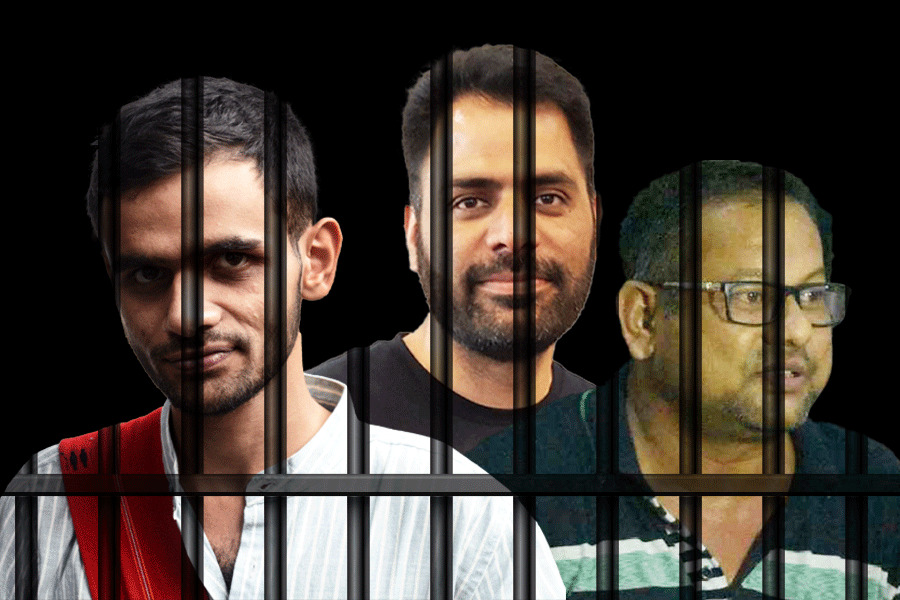
The Bhima-Koregaon (Elgar Parishad) prosecutions are one of the examples that show how the legal framework and prison conditions today are still the same as in the colonial era. There are striking structural parallels in the treatment of political defendants in the Lahore Conspiracy Case and the Bhima Koregaon prosecutions, including pre-trial detention, disputed evidence, and trial delays. Inhumane treatment of Jatin Das in prison led to his death; similarly, 83 year old Fr. Stan Swamy, who was suffering from Parkinson’s disease, was denied access to a straw and a sipper, and died in prison without proper treatment. While criminals convicted in murder and rape cases (e.g., Ram Rahim) and police officers like Davinder Singh (involved in terror attacks) are easily getting parole and furlough, activists arrested in the Delhi riots case like Sharjeel Imam and Umar Khalid are still struggling to get bail. While most of the BK-16 were granted bail recently under people’s pressure, advocate Surendra Gadling is still in prison without trial. The parallels between the Lahore Conspiracy Case and the Bhima Koregaon prosecutions show how dissent is criminalised, and the conditions of political prisoners remain the same. In recent years, many forest and adivasi rights activists, such as activists of Moolvasi Bachao Manch (MBM) of Bastar, a democratic forum, were arrested under UAPA and are still in prison without trial.
In the colonial era, the actions of Bhagat Singh and his comrades were considered acts of sedition. Today, the fascist government is considering any dissent against itself as sedition. In our struggle against the present regime, let us remember the history of those who fought, suffered, and sacrificed their freedom for a just society, stand firmly with every political prisoner, and every person persecuted for raising their voice against oppression. Let us unite all the struggles of all oppressed people and carry forward the struggle for a free and just society.
When crime becomes authority
And hunts down people,
branding them as criminals,
Everyone with a voice,
who choose to remain silent
Becomes a criminal
(A rough English translation of Varavara Rao’s poem)