
In 2023, as Karnataka was heading for elections , the current Leader of the Opposition in the Lok Sabha, Rahul Gandhi came to Bengaluru and held a convention with Powrakarmikas and Street Vendors, calling them Bengaluru’s assets. He promised to stand with street vendors and protect their rights.
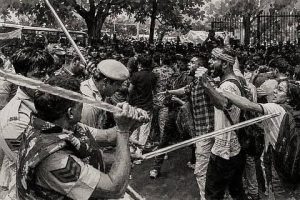
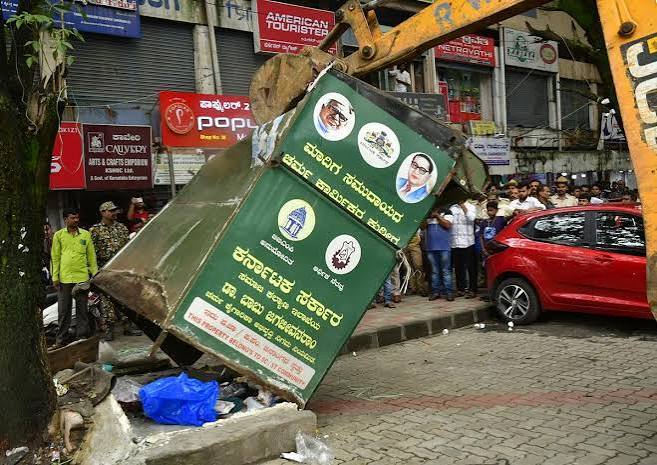
Cut to July this year, when Krishna Byre Gowda, minister in charge of Bengaluru development and considered to be part of Rahul Gandhi’s team, announced a city-wide, illegal and inhuman eviction of street vendors. The Minister’s reasoning for the street vendor eviction was twofold – that the Supreme Court had ordered encroachments to be removed from footpaths; that Bengaluru saw a high number of accidents where pedestrians got injured or died and therefore action had to be taken. He ordered that all street vendors must be evicted from all the main roads of the city.
In this article I will show how this reasoning was flawed, how it violated the Street vendor’s act, and also point to the impact of his illegal announcement.
Street Vendors Act 2014 – a landmark legislation to democratically govern street vending
In 2014, after years of agitations by Street Vendor Unions from across the country, Parliament unanimously passed the Street Vendors (Protection of Livelihoods and Regulation of Street Vending) Act, 2014 (referred to as ‘the act’). This landmark law not only protected the right of street vendors to vend on the street but brought in a democratic structure in the form of a town vending committee which would both protect the rights of street vendors and regulate street vending itself. The very definition of a street vendor and of a vending zone includes footpath/sidewalk etc. The law also mandates a survey of all existing street vendors, a bar on evictions (only relocation is allowed, that too after a 30-day notice ) and offers creation of vending zones as a means of organised vending. The Town Vending Committee is to have 40% of its members as street vendors (elected by street vendors of the city). The other members include the police, town planning officials, health officials, representatives of a central trade union, a local Resident Welfare Association and others. In mandating that the survey of vending and zoning should be done by the Town Vending Committee, the act truly created a democratic structure.
Flawed Reasoning of the government
The government stated that since the Supreme Court asked for the removal of encroachments on the pavements, street vendors had to be evicted. As already demonstrated, Street Vending on the footpath is legal as the act allows for the same. In fact in 2010 itself, the Supreme Court in Gainda Ram and Ors. Vs M.C.D and Ors stated as follows – “The hawkers’ and squatters’ or vendors’ right to carry on hawking has been recognised as a fundamental right under Article 19(1)(g). At the same time the right to commuters to move freely and use the roads without any impediment is also a fundamental right under Article 19(1)(d). These two apparently conflicting rights must be harmonised and regulated by subjecting them to reasonable restrictions only under a law”.
Thus, Street Vendors cannot be considered as encroachers! The government in fact is yet to clear actual encroachments such as private gardens on footpaths, is yet to shift transformers on footpaths, has failed to regulate shops and restaurants who occupy the footpath, etc.
The second reason for the government is that there are a high number of accidents involving pedestrians. The government implied that because street vendors are on the pavement, pedestrians walk on the road and are getting affected. Data from the Traffic police and other agencies shows that the maximum number of pedestrian accidents are while crossing wide roads such as the Outer Ring Road and due to drunken driving. The Street vendors unions have in fact asked the state to show any FIRs which name street vendors as cause for accidents but to date there is no data to show the same.
Illegality of the evictions
The Street Vendors Act sections 18 and 19 mandate that no vendors shall be removed without a written notice, without an alternate space of same business potential being identified; that if any goods are seized, it should be only after a list of such goods is made and verified by an independent witness. However the vendors were evicted without a notice, were given no alternate space for vending and there was no list made of the goods and tables seized! Additionally it is only the Town Vending Committee which can decide which spaces can be no-vending zones, however here the minister decided on his own that main roads should be no-vending zones.
Who owns the streets?
The Street Vendors unions demanded from the government that even if vendors cannot be accommodated on a pavement, they should be given space to vend at the edge of the same road, next to the pavement. However the government refused. The number of private cars in Bengaluru has now touched 25 lakhs. Most of these cars park on the street. A city which has no qualms providing free car-parking for the rich, on the edges of the road, refused to provide the same space for vendors. Streets are public property and they are meant to be used equitably. However, in saying that it is fine for cars to be parked but unacceptable for poor vendors to eke out a livelihood, the government is showing that it intends to protect the privileged and indicate that the poor really have no right to the city. This notion must be challenged and fought.
Evictions of street vendors a blow to common people
Many students, auto drivers, gig workers, and others depend on street vendors for their food. A plate of two idlis costs Rs. 50 in a darshini, but with a street vendor you get 5 idlis for Rs. 50! Go outside any garment factory and you will see lines of carts selling vegetables, fruits, and other goods. Garment workers cannot afford to go to a shop, nor do they have the time. Similarly street vendors keep the street safe from sexual harassment and reduce incidents of crimes like chain snatching. Street vendors make streets safer. An absence of street vending thus affects the city in many different ways.
Urgent need for public support
The street vendors’ eviction received wide support from the middle classes and upper classes on social media. This is one of the reasons that the government brazened it out, in spite of it being illegal. There is a need for more people to speak out in favour of street vendors, publicly. Additionally during the eviction drive, the unionised vendors who fought back against the eviction were not affected; many of the non-unionised vendors have not been able to fight the eviction. There is an urgent need for students and youth across the city to reach out to vendors in their areas and see if they need support in resuming vending, in ending harassment, and then connect them to unions. There is also a need for more vendors to be unionised.
We must challenge the notion that the pavements can be either only for pedestrians or only for street vending. Both are in fact inter-dependent and through political will and good design it is possible to ensure both needs are met. It is only when both needs are met will we have a vibrant, happy, and just city.
[The author is an advocate and a member of the Karnataka Pragaptipura Beedhi Vyaparigala Sangha (affiliated to AICCTU)]