
The economic reforms of the 1990s, and the developments that followed, proved catastrophic for many sections of Indian society. Among those affected were the youth, who were crushed under ever-increasing educational fees, widespread unemployment, and the replacement of stable public sector employment with precarious private-sector jobs.
This situation was further aggravated under the BJP regime with the establishment of centralized institutions such as the National Testing Agency (NTA) in 2017. This body will then go on to conduct highly centralized exams such as the NEET, JEE, NET, and CUET in a land that is a union of several diverse nationalities and ethnic groups, which was in itself a grave mistake. Adding to this, the agency’s heavy reliance on contractual and third-party outsourced labour rids itself of any form of accountability. As a result, over the past decade, more than 100 paper leaks and other irregularities have occurred, affecting lakhs of students. It is against this backdrop that the subject of this article’s concern, the Cockroach Janata Party (CJP), emerged.
On 15 May 2026, during a court hearing, the Chief Justice of India, Surya Kant, called the unemployed youth ‘cockroaches’. The remark poured petrol on the already simmering anger of India’s youth. Social media erupted with a flood of trolls, memes, and rebuttals, pressuring the fear-stricken CJI to issue a half-baked clarification.
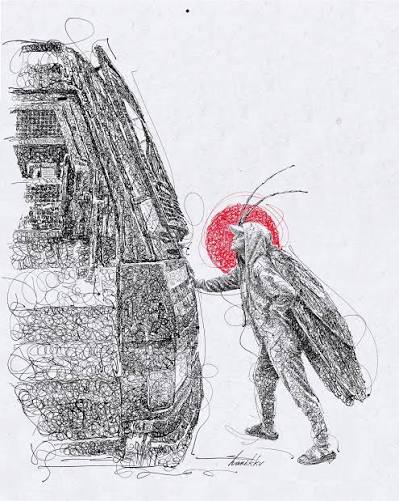
Though the entire remark episode in itself was short-lived, amidst it, a 30-year-old digital media strategist from Boston, Abhijeet Dipke, created an Instagram account and website called the Cockroach Janata Party (CJP), carrying the tagline, “Voice of the lazy & unemployed”. What was intended as a joke quickly transformed into something much bigger. Within 72 hours, the party had attracted over 350,000 membership sign-ups, while its Instagram following crossed 3 million. It eventually grew to over 22 million followers, surpassing the BJP’s official Instagram account. The response was so overwhelming that Dipke himself remarked in an interview, “The Cockroach Janata Party was supposed to be a joke. But I had not expected it would draw such an encouraging response.”
The Fascist ruling class reacted to this by withholding the CJP’s X account, citing ‘national security concerns’, thus bestowing the CJP with a good dose of legitimacy with its own buffoonery. What transpired next was even more interesting, drawing upon the intensifying anger of the masses towards the paper leaks, the CJP called for a protest at Delhi’s Jantar Mantar on 6th June, demanding the resignation of Education Minister Dharmendra Pradhan. The protest received support from Sonam Wangchuk and witnessed a massive mobilization, with thousands of young people joining from across the country, making a transition from internet memes to the streets.
An online petition demanding Dharmendra Pradhan’s resignation gathered over eight lakh signatures, while demonstrations spread to Pune, Amritsar, Nagpur, Lucknow, Hyderabad, Bengaluru, and Jaipur. The movement continues to gather momentum. A peaceful sit-in remains underway at Jantar Mantar, and since 28 June, Sonam Wangchuk, along with 20 other student activists, including six members from AISA, have been on an indefinite hunger strike, demanding Dharmendra Pradhan’s resignation.
While the traction earned by the CJP is a glaring sign of the rage of the Indian youth, it is upon us to analyze the scope of it as a political solution to our problems. The central demand of the CJP and associates is the resignation of Dharmendra Pradhan. A minister of a fascist government being corrupt and incompetent is just a symptom of a decaying system.
The liberalization, privatization, and globalization policies have transformed education into a commodity that serves the greed of the domestic and foreign capitalists. The conglomerates treat India as a breeding ground for cheap labour; to sustain and leverage this model, policies such as fee hikes, school closures that deny education to large sections of the population, the structural underfunding of the sciences, arts, research, the attack on student unions have been pursued. These measures strip the population of opportunities for critical thinking. It is in furtherance of this process that the centralization of education and later saffronization have been aggressively advanced over the past few decades by initially the UPA and later NDA regimes.
It is by looking at these historical experiences that we must tell our friends in the CJP and the thousands of cockroaches who stand behind them that the problem extends far beyond Dharmendra Pradhan, Amit Shah, or Narendra Modi. It is not the whip that must be attacked, but the one who wields it. This understanding comes with the imbuing of class-consciousness, a task that falls on the shoulders of the left-democratic student-youth forces participating in the movement.