
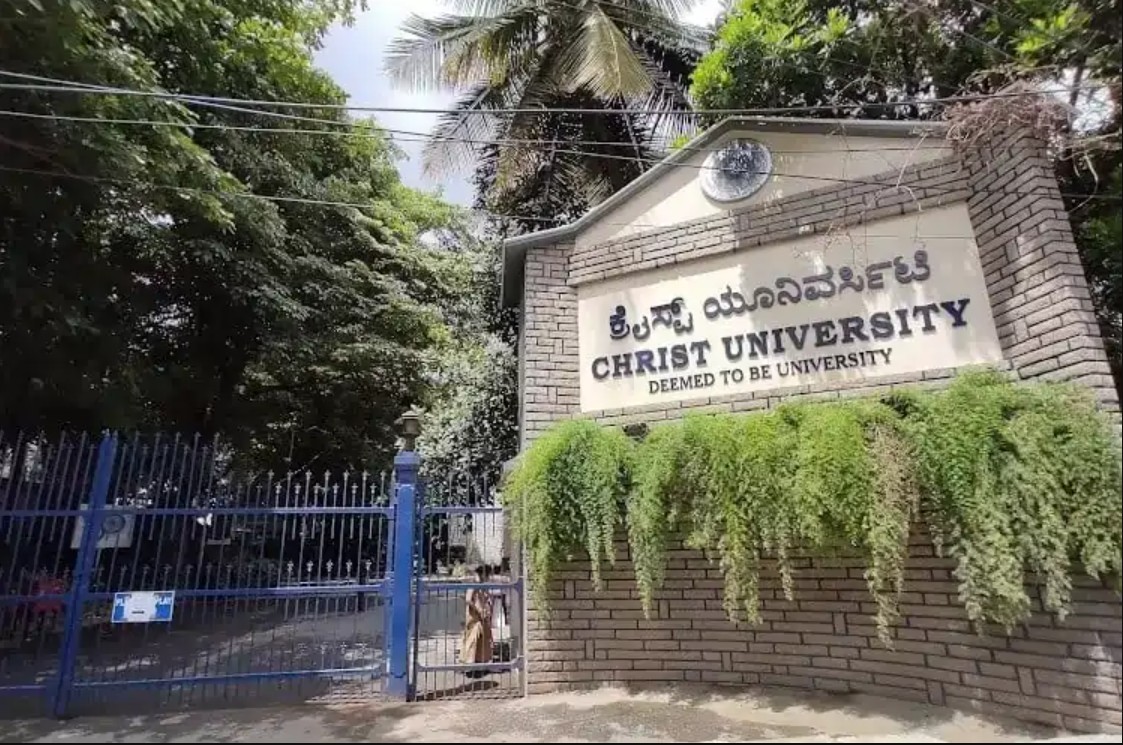
Every day, one new rule: Welcome to CHRIST (Deemed to be University) (CU). Why would any institute like CU be called a university! It’s a rule book of torture. Shameful, they host a PhD programme amongst others.
Best of the best research institutes in the country do not expect certain things out of research scholars. Please note, we are only talking about universities producing quality research in terms of articles and thesis. CU also does it, to an extent. But who are the major contributors? PhD scholars. But the cost they pay for the same, apart from the obnoxiously high fees, is infinite. We’ll make an effort to list the same and mind you, none of it is a joke. It exists!!! We have spoken to many PhD scholars from the University before writing this down. All of them recommended a clear ‘no’ to PhD at CU. We are sure if we dig deeper into other programmes, there would be some that would join this list.
Firstly, UGC guidelines suggests that full-time PhD scholars are expected to provide not more than 10 hours of work, a week to the department/university, in case one is a JRF (Junior Research Fellow) scholar, since they receive a particular stipend from UGC for the research. However, most universities emphasise on building quality research environment and allot work that helps scholars for their research unlike CU where more than 6 hours work is extracted out of scholar. They are given full papers to handle all by themselves and sometimes sharing it with faculty where easily more than 6 hours of work per week is spent on easing the burden of the professors, who are deriving salary to teach. Full-time scholars who receive stipend from the university are also made to work for the department/university for more than 6 hours. When we mention scholars, it is applicable to the majority of them. If any scholar questions the work load, they’re simply told UGC guidelines prescribes particular number of hours of work per week and scholars are expected to do the same. They also have to maintain work logs/ sheets to show how their work has added up to 6 hours. If the sheet shows more work, there is no written guidelines to provide them any kind of exemption for the overwork. How convenient!! The revised version of the same expects the non-JRF full-time scholars (who receive stipend from the university of Rs. 15,000 if they have 100% attendance) to provide 195 hours of work per semester/year without pay and after completing these many hours of work, they can ask for pay which is about Rs. 120/per hour. If taking classes is one aspect of work, working for the university in other capacities is another, which includes administrative works, NAAC work, IQAC work etc which have been used to exploit research scholars. One of the scholars mentioned going back home and continuing to do such work, while their research takes a backseat. Another scholar mentioned spending time on preparing for classes at home as well, while they are unable to dedicate time for their own research. Yet they are expected to complete their PhD in 3 years with two Scopus indexed publications.
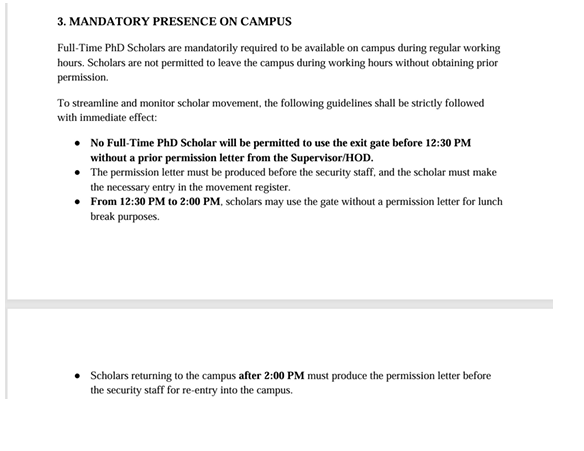
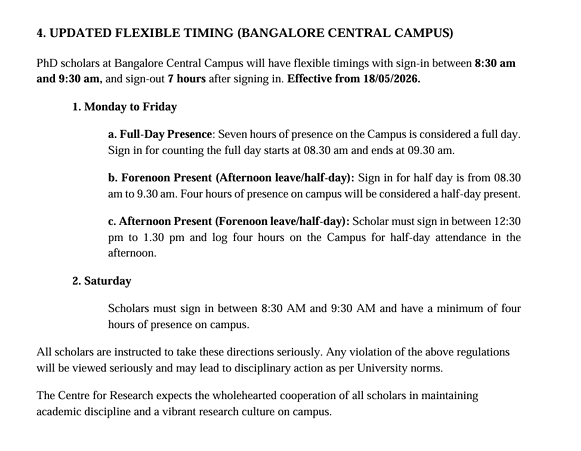
The next issue is the regulations on the movement of research scholars. Research scholars are expected to log-in anywhere between 8:30 am to 9:30 am and be on campus for 7 hours and leave the campus only after logging-out at 4:30 pm in the evening. Anytime, during a day, if you go out of the campus, you have to make entries in the register at the gate where time (exit and re-entry) and reason for the same had to be mentioned. This was made stricter recently by adding more sadism to it that scholars are not allowed to go out of the campus till 12.30 pm, once they enter the campus and have to go through Head of the Department (HoD)/Supervisor, write a letter and get signatures and show the same at the entry and exit of university gates. Have you heard of any university which makes a written guideline that PhD scholars cannot use exit gates of the university, once they enter the gates in the morning, with an exemption of an hour for lunch whose timings are specified. Does a university have a right to regulate physical movement of PhD scholars? To worsen this rule, they turn more sadistic by deducting the stipend of scholars when they get late to sign in. The scholars are on campus but there is no provision to count their presence because they could not sign in by 9:30 am. Additionally a sign out of even 30 seconds before completion of 7 hours on campus is considered an absent for the day and the scholar loses the pay. These are not university norms, more of a prison rules. The rules that not only restrict your movement but also tell you, you need to finish your breakfast by 9:30 am and be present on campus, or eat on campus and add to our economy. They get to decide where and what one should eat, how to live one’s life, where one should go or not go. There are married scholars with children who drop their kids to creche/daycare in the morning after signing in and get back to campus. One of the scholars mentioned that she cannot take permission from HoD every single day as she has to drop off her kid to a creche and come to college. Creche only opens by 10 am. These are genuine issues; the university does not care about. Indirectly a scholar’s mundane life is expected to proceed while getting adapted to the changes university makes so frequently, that it is hard for scholars to keep up with. University rules are updated showcasing heights of undemocratic ways, sadism and hyper-regulation enforcing dictatorship. No rules are made consulting the scholars. Decision making is one way and exploitative. Acts of oppressive micro-management are capitalistic and sadistic leading to exploitation of scholars who enrol into research institutions with a hope to learn and contribute through their studies. This, CU believes, helps them maintain academic discipline and builds vibrant research culture on campus! Do these prison rules and panopticism built research culture? It’s a classic example of a research mis-culture.
At CU, Scholars don’t need supervisors to help them in their work; they don’t need university to facilitate the required for the scholars; they don’t need the supervisor to go through the research papers, the scholars are writing; we don’t need more than 2 months to conduct an ethnography for research; and the list goes on, but the presence of scholar on campus happens to be the pre-requisite for vibrant research environment!! The enforcement of this is by restricting their physical movement through exit gates, which has come to be strictly monitored. Let the other elements see the bin.
Multiple scholars from several departments narrated how they were not allowed to go for data collection during exam invigilation or otherwise they had to request and provide reasons to go for data collection for their own PhD, which happens to be the major part of the programme. Scholars were told to complete ethnographies in 2 months whereas historically ethnographies have taken years for scholars and researchers aiding to production of knowledge and that is how ethnographies are supposed to be conducted. Scholars working on field are expected to provide everyday report to the supervisor. Is this how data collection works? Revisions of/Extension of leave for data collection is allowed after 2 months of taking duty leave/out of campus leave. However, scholars had to go through a whole Q&A session with the director of Centre for Research to get the approval for the second or further round of leaves for data collection. This not only demotivates scholars but ultimately reduces the quality of research and knowledge scholars are willing to produce, which is an ultimate aim of PhD. But in this university, scholars’ presence is the only criteria to maintain vibrant research culture, without any other significant elements which are prerequisites for quality research. While the scholars go through all this, labour of invigilation during exams is put forcefully on scholars. Scholars are not allowed to even take official duty leave (for their research purpose- data collection, field visit) during the time period when exam is running in the university, because invigilation is compulsory. Scholars are expected to prioritise university work over their own PhD work.
Quality research culture is a myth at CU. It all starts from student enrolling into university where they are made to sign certain documents where they agree to pay fees, work as per rules of the university and publish two research papers in Scopus indexed or Web of Science journals. Mostly students are expected to publish with supervisors, otherwise is allowed, if the supervisor and department is okay with it. So basically, publish with the guide is what is agreed upon by most. First, this is not a UGC guideline. UGC cancelled this as a mandate to receive degree in 2022. However, Christ retains it because they need it to increase their rankings in NAAC etc. and additionally because they’ve some professors who cannot publish two papers per year, which is university guidelines laid down for professors. Most scholars write articles all by themselves. Some supervisors make an effort to read and help, while most get the publications for free. A university where some faculties are surviving and claiming credits of scholars’ hard work and research. Scholars who publish in Q1 and Q2 (top quartiles) Scopus indexed journals are treated differently from the ones who publish in Q3 and Q4 journals. The ranking points the university earns with every quartile differs. So, this is percolated down to scholars as well. The ones publishing in Q1 and Q2 are incentivised (apparently an encouragement) for the publications, only if they publish with the guide as a second author on the paper, where the guide receives 50% of the incentive, regardless of what the contribution of the guide is. The incentive is not given to the scholars who don’t publish with the guide and the ones who publish in Q3 and Q4. Of course, they don’t need encouragement! Because they don’t contribute by including the faculty in their publications. Most faculties sitting on scholars’ publications bother them only to write papers and include their names. One scholar told us how their guide just discusses about publication and pressurises them to write more articles, while the requirement is only of two articles. The ones in academia definitely know of the pain of procedure one goes through to write articles in Scopus-indexed journals. Its ends up as a gambling process as well in many cases. It gets even worse for the beginners who have no support or help coming from their supervisors, but only demands and expectations. This culture of describing to research scholars about publications and Quartile rankings in the very beginning of the coursework, pulls their attention towards only these factors and panic keeps luring that they have to crack. Some scholars are heard asking other scholars, faculties asking scholars on the campus when they mention of publication, what quartile is it! It is capitalistic and discriminatory. The intellect of scholars has been reduced to the number of publications in Scopus-indexed journals, worsening it to attaching the same to quartiles as well. Quality is not a concern in this whole process of racing after quantity of publications to project it with pride. This is the vibrant research culture CU promotes.
Another significant authoritarianism that is to be pointed out is enforcing participation of research scholars in random conferences, colloquiums, seminars, annual scholars meet etc. in the university, though unrelated to the scholar’s areas of research/interest. Attendance is marked and scholars are asked for explanations, if they remain absent. Annually they are expected to attend meeting called by Centre for Research where the director speaks random things and praises the scholars who have published in Scopus-indexed journals and asks scholars to target Q1 and Q2 journals.
Apart from this there are issues with leave and cruel rules which have forced women scholars to physically come and complete their PhD synopsis defense in few days of delivery (postpregnancy), one of the scholars lost her consciousness after the presentation of her thesis on the day of synopsis/ defense. This was forced upon by Centre for Research. Similarly, one of the scholars who was getting married approached Centre for Research for leave of few days, and she was asked to submit marriage invitation as a proof to obtain leaves, she was harassed to grant the same. Students with health ailments are asked to submit medical certificate, which is a valid concern. However, they are also asked to bring all the test reports, discharge summary, scan reports like ultrasound, MRI etc to prove their sickness. While scholars have right to leave, they are made to beg for the same while suffering health ailments. The list of such cases are endless. Since it is a private university and they call themselves an apolitical campus, additionally a threat on degree, students don’t make moves to oppose or protest against such undemocratic and dehumanising methods of control and surveillance, and the dictatorship of CU continues, rather upgrades every other day.
By acing in toxic rule making, CU can be conveniently classified as a total institution. It could rather be put under the category of ‘corporate workspace’, which have been flourishing in the hands of private managements making lives of people difficult with their autocratic rules. This panopticism here is legitimised and looks like is unquestionable, therefore oppression and injustice will continue. For those in power, everything is a disciplinary measure and may be a little thing to follow, but it is complicated and problematic as it intervenes into one’s rights to free speech and expression, whose throats are choked in institutions like CU, where scholars, staff and others are left with nothing but adhere to it. People who come here with passion, either leave the institution or lose it, in case they’re in difficult situation and are forced to continue with the institution. Intellect is quantified, learning is chained and regulations and restrictions rule the research in CU. Questioning anything can risk it for scholars as their degrees are underway, the requirement of hundred signatures on various documents required for any facility that is to be availed via paperwork and dealing with fragile egos of people you meet during the procedures.
University’s vision and mission list out every perceived noble value present on earth. However, PhD scholars at CU do not agree on university being true to them. Instead, if they have the audacity, they should openly come out and admit to their core values of Dictatorship, Undemocratic ideals, Dehumanisation and Hypocrisy. CU, own up to your real face!