
The seed of the Naxalbari struggle sprouted on March 3, 1967 when a plot of land was surrounded by the peasants in Naxalbari village in West Bengal. They marked its boundaries with red flags and started harvest. Scared of the revolutionary peasantry, the United Front government of Bengal, consisting of Bangla Congress and Communist Party of India (Marxist), announced some token land reforms, but the peasantry responded by setting up committees to take over the land of the landlords. Their slogan “March forward along the path of armed peasant revolution” struck in the hearts of the landlords like a thunderstorm. Jyoti Basu, the then Home Minister of Bengal, ordered the police in. The peasantry retaliated and a police personnel was killed. Two days later, the police killed 11 villagers, including 7 women and 2 children. The struggle intensified even more, and tea garden workers also carried out strikes in support. In this region, the government deployed a large number of paramilitary forces, beating hundreds and jailing thousands.
Though the Naxalbari uprising was crushed, the ‘spark’ had already spread like a prairie fire. To the call of Com. Charu Majumdar, many students and youth started joining the movement, sacrificing everything like families, studies, and career, in order to serve the oppressed masses. After the killings in Naxalbari, students of Kolkata plastered the College Street walls with posters declaring “Murderer Ajoy Mukherjee [the Chief Minister] must resign.” Many responded to the call of Charu Majumdar by going to villages to organise the peasantry, while spontaneous student uprisings also began taking place in educational institutions. The colleges increasingly became bastions of revolutionary politics.
An iconoclastic campaign was started by the students and youth of Bengal, who broke and destroyed statues and portraits of popular icons like Gandhi, viewing them as representatives of comprador and feudal culture. Though this was done in haste and without sufficient ideological debate, it still shook the roots of comprador-feudal culture and struck a blow to pro-establishment historians. Portraits of Com. Mao, along with his quotes and slogans, were plastered across Kolkata. There were also incidents of young students, even teenagers, snatching guns from police and running away in broad daylight. Two-thirds to three-quarters of the college unions came under the influence of AICCCR, which in less than a year became the Communist Party of India (Marxist-Leninist). The police grew increasingly anxious and were instructed not to move alone and to keep their weapons close at all times.
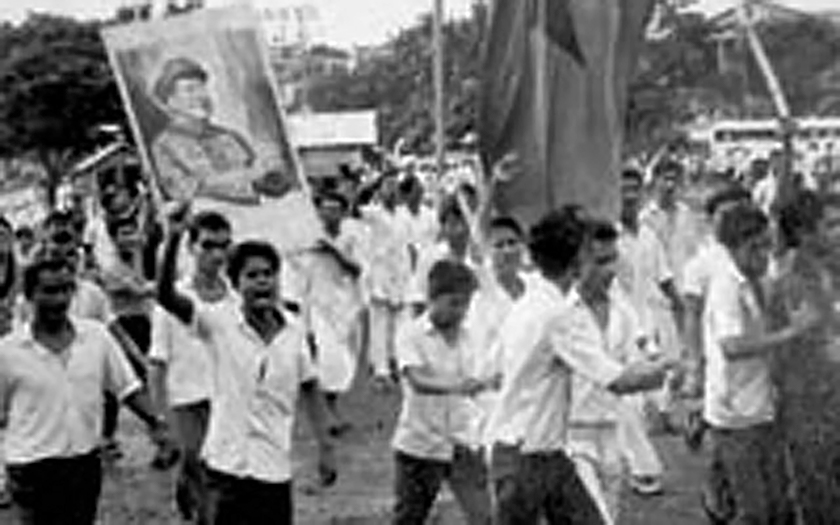
This revolt by the students was met with severe repression. Despite knowing the risks, many continued their activities and were shot when found. Many precious lives were lost. The local police proved ineffective, leading to the deployment of BSF and CRP forces in the city, with CRP camps even set up inside colleges. At one stage, the Army was also deployed. The police also used gangsters and hired killers to target revolutionaries, while the CPIM and Congress mobilised lumpen elements to attack students involved in pro-people activities. The Baranagar-Cossipore massacre stands as a haunting example of this brutality, where more than 150 youth were killed in cold blood within two days, many of whom were not even activists. There were countless instances of torture, including an old man being burnt alive for not giving information about his ‘naxalite’ nephew, and a teenage girl having her arm chopped off because she did not know where her brother was.
More than a thousand students were martyred and several thousand imprisoned, yet they displayed death-defying courage. Even after inhuman torture and facing enemy bullets, students and youth integrated themselves with landless and poor peasants and continued to arouse them for revolution. The conditions inside prisons were extremely harsh. Fifteen to sixteen prisoners were kept in cells meant for four to five. CPI-ML members and sympathisers were often confined in solitary cells for months or even years, or in very small spaces. They had to use a single bucket for urinating and defecating. Hundreds were beaten to death. Many broke out of prison and rejoined the movement, while many were martyred in the process.
Even within prisons, they turned incarceration into centres of resistance, carrying the revolutionary spirit despite severe physical and mental torture. At the Party’s call, they did not classify themselves as political prisoners, as such classification could grant privileges unavailable to comrades from worker and peasant backgrounds. Many rejected better facilities when offered. Mary Tyler, in her book ‘My Years in an Indian Prison’, described their condition, “their yard is as dreary and desolate as one could imagine… a cemented yard, a water tap and a row of dark little cells… five or six to a cell, in fetters, twenty four hours a day… Yet they laugh, joke and make light of it all… Physically all are affected… thin, pale, dry, attacked by ailments diagnosed and undiagnosed.” Despite such conditions, their morale remained strong.
The revolutionaries also had massive people’s support. People provided shelter, food, and information about police movements, and organised protests against state repression. In August 1970, when Samir Bhattacharya, a young revolutionary, was tortured to death in a police station in north Kolkata, the entire city observed a hartal and north Kolkata remained paralysed for three days. Huge crowds gathered outside hospital gates and defied Section 144. At times, it seemed that direct clashes would occur between the military and the masses. This demonstrated that when revolutionaries fight for the masses, the masses in turn stand firmly in their support.
The condition of students at that time was also dire. Poverty and unemployment were widespread and the education system after the ‘transfer of power’ remained largely unchanged from the British period. It aimed to produce lackeys of imperialism, but instead created individuals who turned against it. Youth across the country: from Punjab, Kerala, Bihar, Uttar Pradesh, Tamil Nadu, and Andhra Pradesh, found in Naxalbari politics an alternative to corruption, injustice, exploitation, and inhumanity. They were drawn to the dream of a new society.
They dreamed of a world where no one would remain hungry, where selfishness would be replaced by cooperation, and where justice would prevail. This dream, though still unfulfilled, became a driving force for thousands of students and youth. It remains a task for the future generations to strive towards making that vision a reality.