
We must demand the nationalisation of all the land, i.e., that all the land in the state should become the property of the central state power. This power must fix the size, etc., of the resettlement land fund, pass legislation for the conservation of forests, for land improvement, etc.
– V.I. Lenin (The Tasks of the Proletariat in Our Revolution)
The grand success of the Five-Year Plans and the socialist industrialisation that followed created clear discontent among the Western imperialist powers, whose own model of blood-sucking capitalist development stood in stark contrast. To defame the Soviet model, leading bourgeois historians seized upon the environmental degradation of Russia in the late 1980s and blamed it on the socialist industrialisation carried out under Stalin. However, a careful reading of history shows that it was during the Stalin era that environmental conservation was actively championed, and that the real ecological decline began only after the capitalist restoration in the Soviet Union post 50’s.
The October Revolution and the Birth of Socialist Environmental Policy
Russia experienced massive deforestation during the Tsar’s rule, which intensified during World War I. Immediately after the October Revolution (1917), Lenin and Stalin advocated for the nationalization and conservation of forests, as well as aggressive afforestation to repair the damage caused to the forests, in Party conferences in the 1920s (from 1917 to 1920, 268 decrees on nature protection were adopted). In the early years of the Soviet Union, there were two lines of thought regarding development, one of which focused solely on the urgent need for rapid industrialisation to overcome the destruction and poverty caused by the war, while the other considered the sustainable development and conservation of forests a necessity for society. Since the Soviet Union was fundamentally a scientifically oriented society, it adopted the second line (despite the famine, poverty, and economic ruin caused by World War I and the Russian Civil War), becoming the first nation to do so. From then on, the USSR witnessed unprecedented efforts in afforestation and the introduction of environmental protection laws on a scale never seen before in history. (Note that before the 1960s, in the capitalist world, there was no concept of environmental protection, and environmental law did not exist anywhere in the world except the USSR. For example, the US Environmental Protection Agency was founded in 1970.)
Planning–the–Forests:–Stalin–and–Environmental-onservation
During Stalin’s government, environmentalist policies were strongly supported, establishing levels of protection unparalleled anywhere in the world. The Soviets understood–that humanity is not separate from nature, but is a product of nature, and deeply connected with nature. The Soviet Union–developed a comprehensive and effective environmental program,which encompassed more than just conserving natural resources. Millions of hectares of forest were left untouched, considering that wild forests are best suited to regulate water flows. They even made meaningful economic and political sacrifices in the interests of environmentalism. The concept of nature being fragile and susceptible to harm from human actions was researched and pioneered by Dokuchaev, and further developed during the Soviet period. The concept of the biosphere, and ecology as the science of the biosphere, was developed by V.I. Vernadsky. Environmental Education was added to the school curricula in the 1920s, and a comprehensive study of local nature was started in schools, combining extra-curricular theoretical and practical classes and labour environmental education (Forest Subbotniks, Green and Blue patrols, etc.). Propaganda work began in popular science magazines, newspapers, and children’s literature to promote understanding and protection of nature. These efforts contributed to the formation of useful environmental skills and a reasonable attitude towards environmental protection in schoolchildren and citizens. The All-Russian Society for the Protection of Nature (VOOP) was created in 1924.
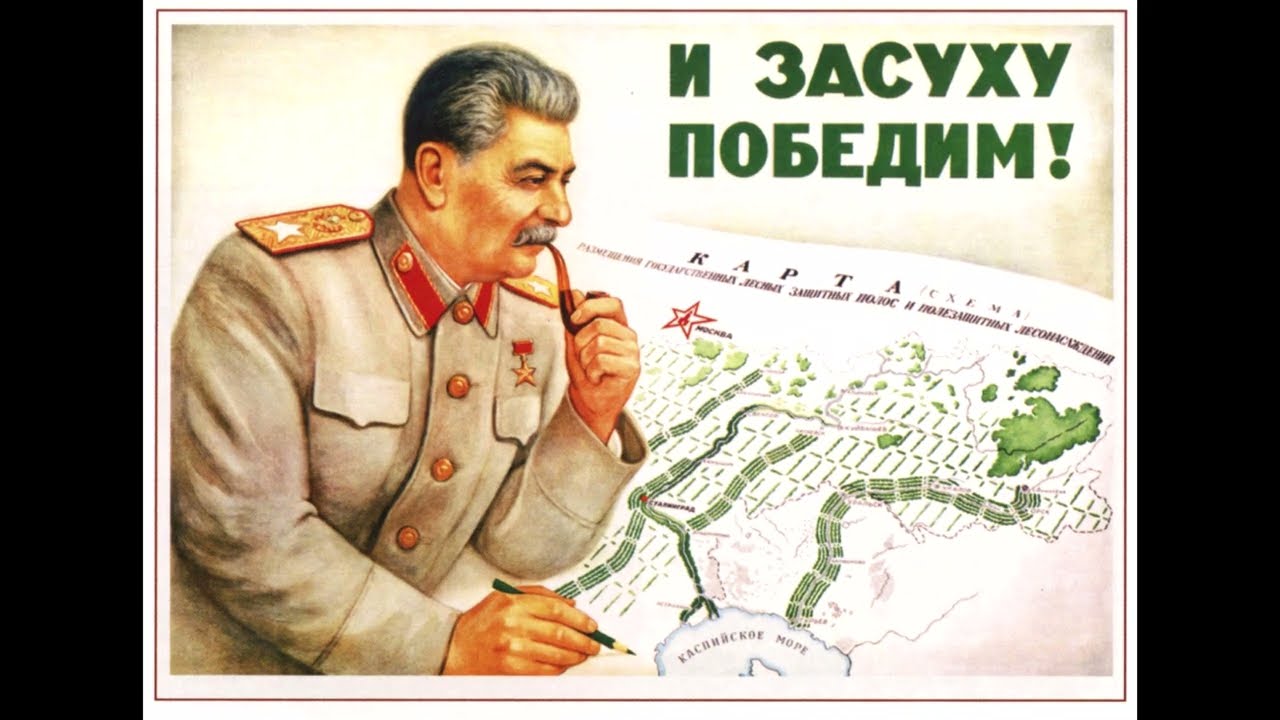
The period of 1947 to 1953 was the Zenith of environmentalism and Soviet forest management. In 1947, the Ministry of Forest Management (Minleskhoz) was established with significant authority over the nation’s administration. Minleskhoz introduced many radical reforms. The ministry set up around 200 forest protection stations to oversee industrial projects and ensure they did not cause environmental harm. Forest cutting areas were reduced, and the amount of sowing and planting of new groves was sharply expanded. The annual
volume of forest sowing and planting increased sevenfold.
According to a Pravda report: “Shelter forest belts have already been planted on more than 800,000 hectares, 306,800 hectares in this spring alone. An irrigation system for 122,000 hectares has been completed, requiring the construction of 8,000 irrigation pools and water tanks. The tasks for this year include planting 700,000 hectares of forest and building 7,587 irrigation pools.” (Kommunisti, no. 6, 1950, p. 387). The Soviet Union also undertook numerous hydrological projects to conserve its prominent rivers.
Capitalist Restoration and Environmental Decline
As the revisionists captured power after Stalin’s death, all the achievements in forest protection and environmental conservation were undone, and forest conservation fell into deep decline. Notably, Minleskhoz was dissolved on March 15, 1953, just six days after Stalin’s funeral, and forest protection bureaus were demoted or eliminated entirely. Within 6 months, the number of workers assigned to forest matters in Moscow decreased from 927 to 342 (a drop of 63.1 %) and then to 120 (a drop of 87 %) after a year. From the regional administration, 701 workers out of 1458 were removed. Revisionists promoted capitalism, and the environment was neglected after Stalin’s death.
Today, when India is facing a decline in natural forests and ecological health for capitalists’ profit, we can learn from the Soviet experience in environmental planning. The USSR’s model of centralized ecological policy, scientific forestry, strict legal protections, and state-managed land use planning is the only way to protect the environment.