
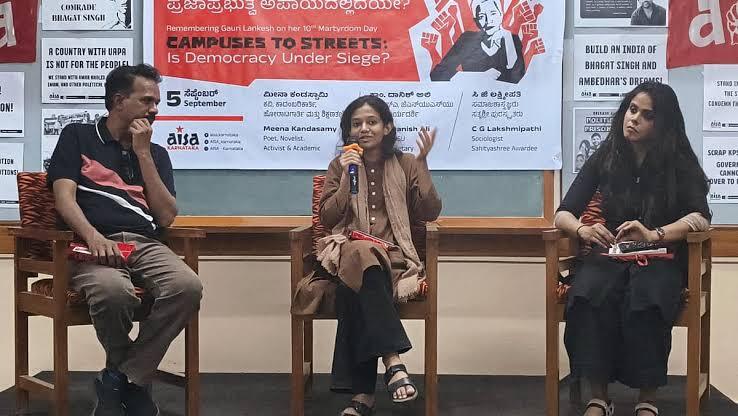
On 5th September 2026, on the martyrdom day of journalist Gauri Lankesh, All India Student Association (AISA) organised a discussion on “Is Democracy Under Siege?”. The event brought together Comrade Danish Ali, Prof. C.G. Lakshmipathi and writer-activist Meena Kandasamy. It focused on the growing attacks on democratic spaces in universities, the saffronisation and privatisation of education, and the need to defend students’ right to question and dissent. Gauri Lankesh’s assassination is not an isolated incident, but is connected with attacks on students, farmers, workers, Adivasis, writers and other dissenting voices.
The discussion began from a simple but urgent question: what happens to democracy when the right to question power itself becomes dangerous?
Danish Ali remembers Gauri Lankesh as a fearless voice against the fascist regime and the various evils in our society. Her assassination, alongside the killings of Narendra Dabholkar and Govind Pansare, reflects a wider pattern of silencing voices that challenge power and dissent.
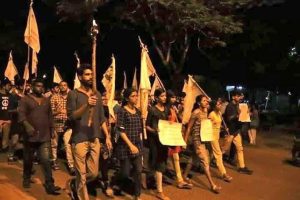
The Jantar Mantar protests broke the fear surrounding the protest, but the resignation of Dharmendra Pradhan was only the first step. The anger at Jantar Mantar was not confined to the NEET paper leak issue, it carried years of accumulated anger over corruption, privatisation, unemployment, poor governance, the criminalisation of dissent and denial of accountability. The closure of more than 94,000 government schools in Uttar Pradesh restricts access to education, particularly for children of farmers, workers and marginalised communities who depend on public education.
Education must create people who think, question and challenge biases of their own and the society’s, not merely seek employment. Amidst growing attacks on dissent, those defending equality, democracy and the right to dissent must collectively resist and refuse intimidation. Speaking up and raising voice against injustices must be a responsibility for students.
Lakshmipathi located the roots of fascism within the family, where caste values are reproduced through everyday socialisation and gradually carried into institutions and classrooms. The classroom itself becomes “caste room” or “communal room”, where Muslims are reduced to references with Pakistan. The structure of the current education system also reflects a wider shift towards liberalisation and privatisation, particularly through MoUs that bring private universities. Against this, defending government institutions and strengthening quality public education is essential to ensure that access to education is not determined by caste, class or the ability to pay.
For Meena Kandasamy, Gauri Lankesh’s assassination represented a ruthless attempt by the right wing to silence dissent. It is connected to a pattern of suppressing dissent through imprisonment, censorship, witch-hunts and targeted violence. The violence was not limited to eliminating one outspoken journalist, it sought to create an atmosphere in which others would be afraid to speak, write or challenge power. In cases of university crisis, she spoke of eight student suicides at IIT Delhi in less than two years, alongside students being punished, jailed and subjected to institutional trauma. When campuses become spaces of punishment and harassment rather than learning, the pressure placed on students becomes devastating.
Fascism cannot be separated from casteism: even access to education and knowledge is shaped by caste. We are seeing the growing influence of Sangh Parivar’s Brahminical Hindu ideology within campuses, where control over education also becomes control over who gets access to knowledge, whose histories are taught and whose voices are allowed to question the current social order. IIT Kanpur, with only two Dalit faculty members out of 400, is an example of the absence of Dalit, Adivasi and other marginalised communities representation in educational institutions. The same control over knowledge appears in the commodification of women under “Hindu-corporate fascism”, as in the rewriting of textbooks and removal of histories that do not fit the RSS-BJP’s dominant narrative. It means deciding what students get to know and more importantly, what they are made to forget.
The discussion made clear that the defence of democracy cannot be separated from the defence of dissent, equality and public education. From campuses under surveillance to classrooms shaped by caste and communalism, repression operates not only through direct violence but also through silence, exclusion and fear. Gauri Lankesh’s assassination stands as a devastating reminder of where the suppression of dissent can lead. Her voice was rooted in the refusal to be silenced. The struggle extends beyond remembering one journalist, it lies in defending the right to question power, resist injustice and organise collectively. All those confronting repression cannot fight these battles in isolation. The response to fear must be solidarity: agitate, educate and organise.