
From dawn on Monday, July 20, students, young people with precarious employment, and families arrived in New Delhi from several Indian states to participate in the march called by the Cockroach Janta Party (CJP) and left student organisations to the Parliament, on the first day of the monsoon session. The simmering anger generated by the Delhi police’s direct attack on the protest site on 18th July and the abduction of Sonam Wangchuk, assumed greater proportions by 20th July. Thousands spontaneously joined the call to march to parliament demanding justice from the proclaimed representatives of the people.
By morning, the area was already heavily surrounded by security. Despite the restrictions, the crowd began moving directly toward the parliament complex. Metal barriers, some welded, had been erected along the route to prevent access to the ‘red zone’ around the parliament. Several metro stations in the city centre, including Rajiv Chowk and Patel Chowk, were closed for several hours. Internet shutdown also caused breakage of communication among protesters stranded in various parts of the stretch.
Over the course of the day, the total number of participants reached at least one lakh, according to estimates circulating among organisers and the media, with lines of protesters filling the streets and intersections of central Delhi. Authorities had called in reinforcements from all districts of the capital, in addition to the paramilitary units already deployed in recent weeks. Evidently, the outpour was a consequence of people’s anger against more than a decade of the oppressive BJP governance.
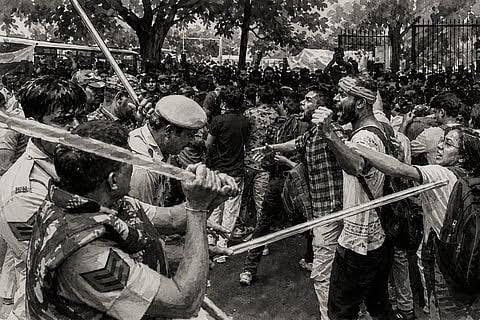
The first moment of intense tension occurred when groups of protesters reached the barriers closest to the parliamentary area. The crowd pushed against the barriers, and the police responded with batons and tear gas to disperse the groups closest to the cordon. Some protesters were detained and loaded into police vehicles, while others remained seated on the ground, chanting slogans and holding signs about ‘paper leaks’. Water cannons and pellet guns were also used liberally on the protesters leading to hearing and eyesight losses in some cases. There were incidents of stone-pelting committed by hired goons of the Delhi police in plainclothes on the protesting masses. Women were beaten up in a humiliating manner by the Delhi police as evidenced by recordings. A truck loaded with stones was discovered near the protest site that was later traced to a police seizure list. Godi media too jumped in trying to discredit the protesters vehemently. Nothing could deter the protest from continuing in Jantar Mantar. Inside the parliament, the opening of the monsoon session was marked by strong opposition protests over the NEET issue and the demonstrations underway just a few kilometres from the assembly.
The same week, the fire of the protest spread across different cities in India, most prominently in Patna, Kolkata, Mumbai, and Ahmedabad. In Patna, police abducted many student activists including AISA and CPIML Liberation activists. In Mumbai and Kolkata, multiple FIRs were filed against the protestors. In West Bengal, the current BJP CM targeted the protesters using communal language while the police disproportionately targeted Muslim youth leaders through FIRs. In the background, Sonam Wangchuk ended his hunger strike inside a hospital in Gurugram on 23rd July in the presence of Union Ministers JP Nadda and Jitendra Singh. The movement by that time had already surpassed the CJP leadership and Sonam Wangchuk, becoming synonymous with the untamed rage of the Gen-Z in India. Despite deploying all its resources, the battle of narratives as well as the battle on the ground were lost by the BJP-RSS juggernaut. Ultimately, Dharmendra Pradhan had to bow to people’s pressure and resign on the 25th of July, marking a historic victory of the power of Gen-Z over this fascist regime. The issues surrounding centralisation of exams through NTA and the privatisation of education through the NEP 2020 persist and the fight must continue. In Chennai particularly, protests demanding the banning of NEET continues.
Despite initial promises, the BJP-led state governments and the union government continued to hound the leaders of the movement. With mounting public pressure, the Supreme Court had to intervene and order for immediate withdrawal of FIRs against all protesters. Interestingly, in the Congres–ruled Karnataka, an FIR invoking section 192 of the BNS (intent to cause riot) was lodged against an unidentified protester for holding a poster on Umar Khalid and Sharjeel Imam in Freedom park. This incident poses a question mark on the verbal support extended by the Congress towards the movement.
While Pradhan has been replaced by an equally competent RSS strongman Prahlad Joshi, the spark of the movement continues to ignite spontaneous protests, this time led by the Gen-alpha in different parts of the country. In many places, school students have won the fight for basic facilities through demonstrations outside their schools. This shows the far-reaching impact even a movement on economic demands can have on the general psyche of the masses. For the first time in more than a decade, BJP’s communal rhetoric has failed, the police stand discredited, and the yellow journalists have been silenced by the people united.
(Based on a ground report published on 21st July, 2026)