
The experience of the war has shown that the Soviet system is not only the best system for organising the country’s economic and cultural development in times of peace, but it is also the best system in times of war – for resisting the enemy and for mobilising the entire strength of the people. The socialist system born out of the October Revolution has given strength to our people and our army, making them great and invincible.
-Com. Joseph Stalin
Hitler’s Attack on the USSR
On 22 June, 1941, without any warning, Hitler broke the non-aggression pact and attacked the Soviet Union, achieving some initial success through this sudden attack. The Soviet armies, while resisting, began to retreat. They intended to inflict significant losses on the fascist forces and slow down their advance. Eight days after the attack (30 June, 1941), the State Defense Committee was established, and all power was entrusted to it. Stalin became the chairman of this committee. On 3 July 1941, Stalin addressed the Soviet people and the army about the critical situation of the country. Explaining the objectives of the Soviet Union in the war against fascist Germany, Stalin said it was a great war of the entire Soviet people against the German fascist army. The aim of this war was not only to protect the socialist state, but also to help liberate all the European nations suffering under the yoke of German fascism. He also stated that in this war of liberation, the Soviet people would not stand alone: “This war for the liberation of our motherland will merge with the struggle of the peoples of Europe and America for their own freedom and democratic liberation. It will be a united front of nations standing for freedom and against enslavement, against the danger of becoming slaves of Hitler’s fascist armies.” Despite clearly seeing the danger of fascism, the Western powers had greatly hesitated to unite with the Soviet Union and confront it. Taking advantage of the then favourable international situation, Stalin called upon the Soviet people to organize their entire lives for the war. He emphasized that all the needs of the army must be fulfilled first in order to defeat the enemy. Not only the Red Army and the Red Navy, but all Soviet citizens would have to fight for every inch of Soviet land, every village and every city, with every drop of their blood. Because of the Five-Year Plans, Soviet workers and specialists had already become accustomed to accomplishing large tasks in a short time. As a result, factories that would normally take three years to build were dismantled, moved, and reassembled at new locations within six to eight months.
On 6 December, 1941, the moment arrived when the exhausted German forces, having suffered immense losses, reached the outskirts of Moscow, and at that very moment, the reserve army, already prepared, struck them like lightning. The victory of Moscow forced even the skeptics to admit that Hitler’s army was not invincible. On 23 February, 1942, Stalin said: “The advantage that the German fascist army gained from sudden and surprise attacks has now ended. From now on, the outcome of the war will not depend on the convenience of surprise attacks, but on sustained military operations, on the firmness of the rear, the morale of the army, the strength and capability of military divisions, the weapons and resources of the army, and the organizational ability of its commanders.” In the Second World War, Stalin proved himself to be an outstanding military commander and a man of great military genius.
Battle of Stalingrad
In 1942, the German armies were advancing to capture the great oil fields of Baku and Grozny. Their next objective, it was said, was to reach India through Iran and link up with the Japanese. However, Stalin understood that having failed to encircle the capital from the west and south, the fascists were now trying to extend their encirclement and achieve the same objective from the east. Their intention was to deprive the Soviet Union of the industrial regions of the Volga and the Urals, then attack Moscow. By mid-July, the Germans indeed abandoned the route toward Iran and India and turned toward the Volga, launching an attack on Stalingrad. However, forces had already been stationed there. On 5 October, 1942, Stalin, who had earlier defended Tsaritsyn (the former name of Stalingrad) against counter-revolutionaries, ordered the commander there, “I demand that you take all measures for the defense of Stalingrad. Stalingrad must not surrender to the enemy.” Thus began the historic Battle of Stalingrad, one of the greatest and most significant victories in history. Stalin said, “I believe that no other country or army could have defended itself against the invasion of the German fascist plunderers and their barbaric accomplices. Only our Soviet country and only our Red Army could withstand such blows – not only withstand them, but also crush the enemy.” On 19 November, 1942, in the outer sectors of Stalingrad, the Red Army abandoned the strategy of defense and adopted an offensive policy, launching attacks on both flanks of the enemy. The attack was so powerful that, like a thread of silk burning in fire, the enemy forces shrank, became disorganized, and began to retreat. The Red Army not only encircled them but destroyed large parts of the 300,000 fascist troops and captured the rest, achieving a decisive victory at Stalingrad. After the victory at Stalingrad, the Nazi army fell into disorder, driven out rapidly by the Red Army.
Liberation of the Motherland and Reconstruction (1943)
In the winter of 1942-43, the Red Army’s campaign succeeded in recapturing those Soviet territories from the Germans that had been seized at the very beginning of the war. Even then, Churchill and his associates were not willing to open a second front, despite having witnessed the severe defeats of Hitler’s army. After this, the Red Army abandoned the defensive stance and adopted an offensive policy across the entire front. The Red Army continued to advance, destroying and driving back the enemy. By November 1943, two-thirds of Soviet territory had been liberated from German control. On the one hand, the Red Army continued to liberate territories, and on the other, the people engaged in rehabilitation and reconstruction work according to a planned program. The enemy was retreating, but to prevent them from regrouping, the guerrilla army was striking them fiercely at various locations, causing heavy losses. Intensified guerrilla warfare made the fascist army confused and disoriented.
The successes of the Red Army removed one fear from the minds of Western imperialists, but at the same time raised another, that Bolshevism might spread across all of Eurasia. In November 1943, in Tehran, Stalin, Roosevelt, and Churchill met, discussed, and reached an agreement among the three powers on the war against Germany and post-war cooperation. In the final years of the war, the Soviet state was not only fighting battles and achieving victories but also continuously repairing and restarting factories, iron furnaces, and hydroelectric power stations destroyed by the fascists. During this very period, new steel plants were established in Chelyabinsk and Uzbekistan, and new blast furnaces were set up in Tagil, Magnitogorsk, and other places to increase iron production. A new aluminium factory began operating in Stalinsk. New hydroelectric power stations started functioning in Stalinsk, Chelyabinsk, and other locations. Stalin paid special attention to the economic reconstruction of the liberated territories. In his leadership, the Party’s Central Committee and the Council of People’s Commissars decided in August 1943 to adopt necessary measures for the economic rehabilitation of the areas freed from German occupation. In the Soviet Union, the collective interest of the people was not separate from individual interest. As a result, reconstruction and rehabilitation work progressed rapidly.
“Onward to Berlin!”
By 1944, the countries allied with the fascists – Romania, Finland, and Bulgaria – not only surrendered to the Soviet Union but also turned their guns against Hitler’s armies. The Soviet army became fully capable of defeating Germany in a single blow. On 6 November 1944, when the Soviet people were celebrating the 27th anniversary of their great Revolution, Stalin stated in his speech that all Soviet territory had been liberated from German fascists. Not only that, but the Soviet army had now entered Germany and its allied countries, clearing out the enemy. The Red Army advanced rapidly toward Berlin. In just 40 days (January-February), through lightning offensives, the Soviet army liberated all of Poland, most of Czechoslovakia, and large parts of East Prussia and Silesia. Hungary, Hitler’s last European ally, had also surrendered. The Red Army captured Vienna, destroying Germany’s southern stronghold. Crossing the Oder River, it advanced toward Berlin, liberating concentration camps all the while. In April, Stalin signed the Soviet-Polish friendship treaty. The hope of Western imperialists to use Poland as a puppet in their hands and as a base for anti-Soviet activities was shattered. For the Soviet Union, this treaty was a major and decisive political victory.
The Great Victory and the End of Hitler
The great day of victory over Germany has arrived. Forced by the blows of the Red Army and our allied forces, fascist Germany has fallen to its knees and surrendered unconditionally. Now there is every reason to say that the historic day of Germany’s final defeat has arrived – the day of our people’s great victory over German imperialism. My dear countrymen and countrywomen! Congratulations on the victory!” – Com. Joseph Stalin
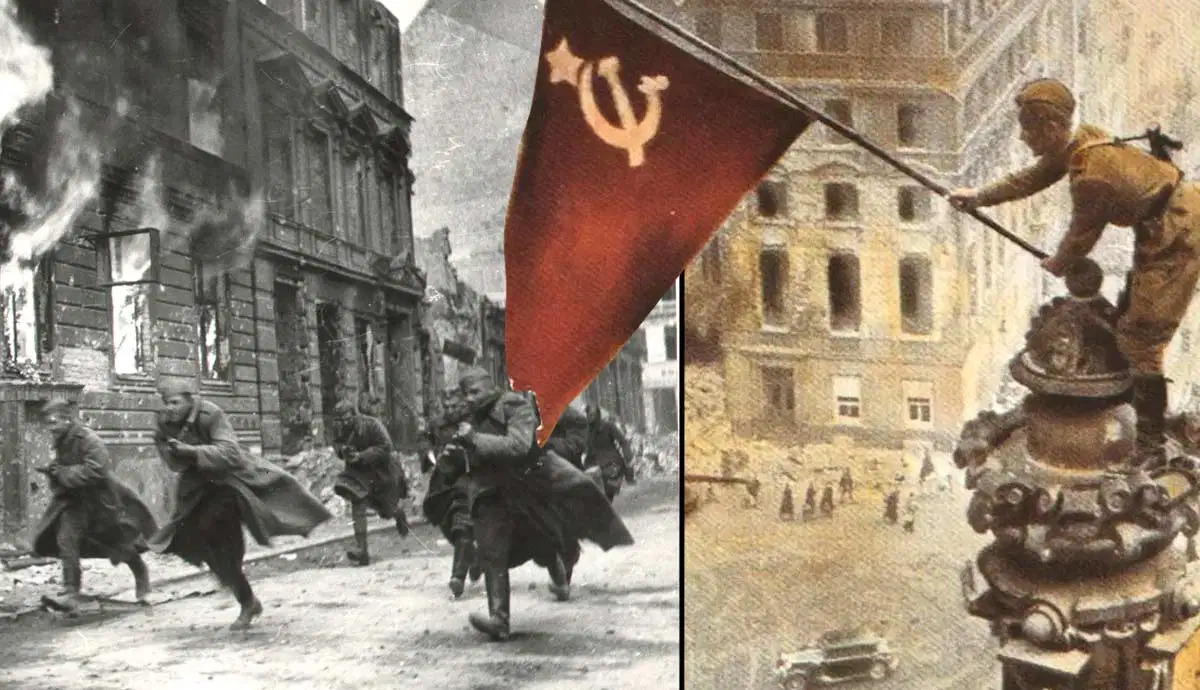
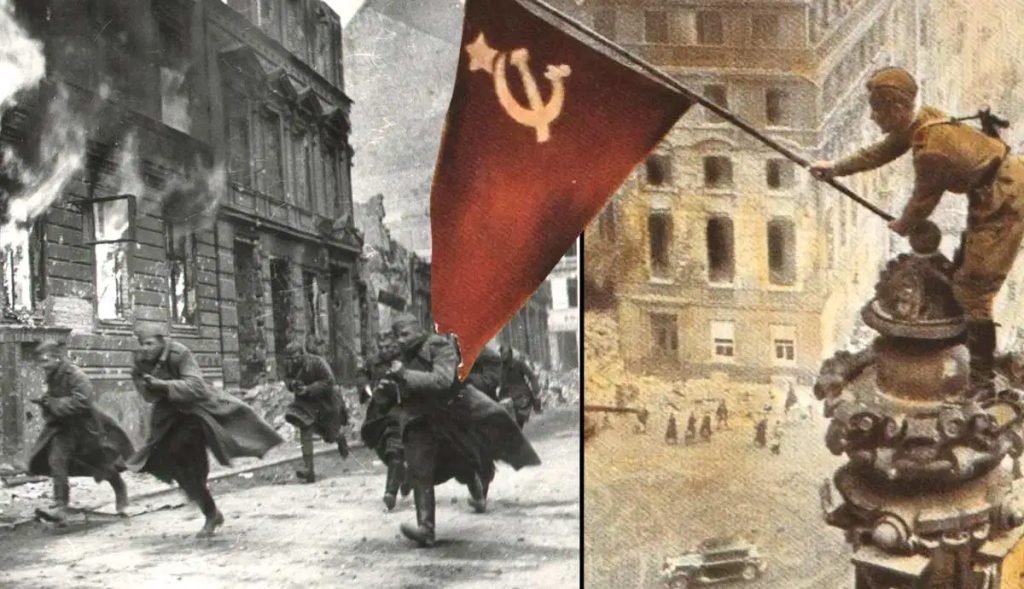
On May 2, 1945, Moscow Radio announced that the Soviet army had taken control of Berlin. The Red Army raised its victory flag over Berlin. Adolf Hitler, along with a few of his close associates, had already died by suicide in his bunker. On May 8, 1945, the high representatives of the German army signed an unconditional surrender. May 9th was declared Victory Day by Stalin. By 1945, Japan’s Kwantung Army in Manchuria met the same fate as Hitler’s forces. The Soviet army drove the Japanese forces out of Manchuria, southern Sakhalin, northern Korea, and the Kuril Islands. For Japan, no option remained except unconditional surrender.
During the war, the Soviet socialist system and planned economy proved itself far superior to the capitalist system. It proved itself superior again during the reconstruction period. Despite millions of Soviets being killed in the war, collective farming and collective labour soon cultivated millions of acres of land that had been left barren, and rebuilt the devastated villages. As the needs of war gradually declined, the factories that had been producing war materials began to shift toward producing goods for peacetime use. It was proven in practice that only socialism can counter fascism.