

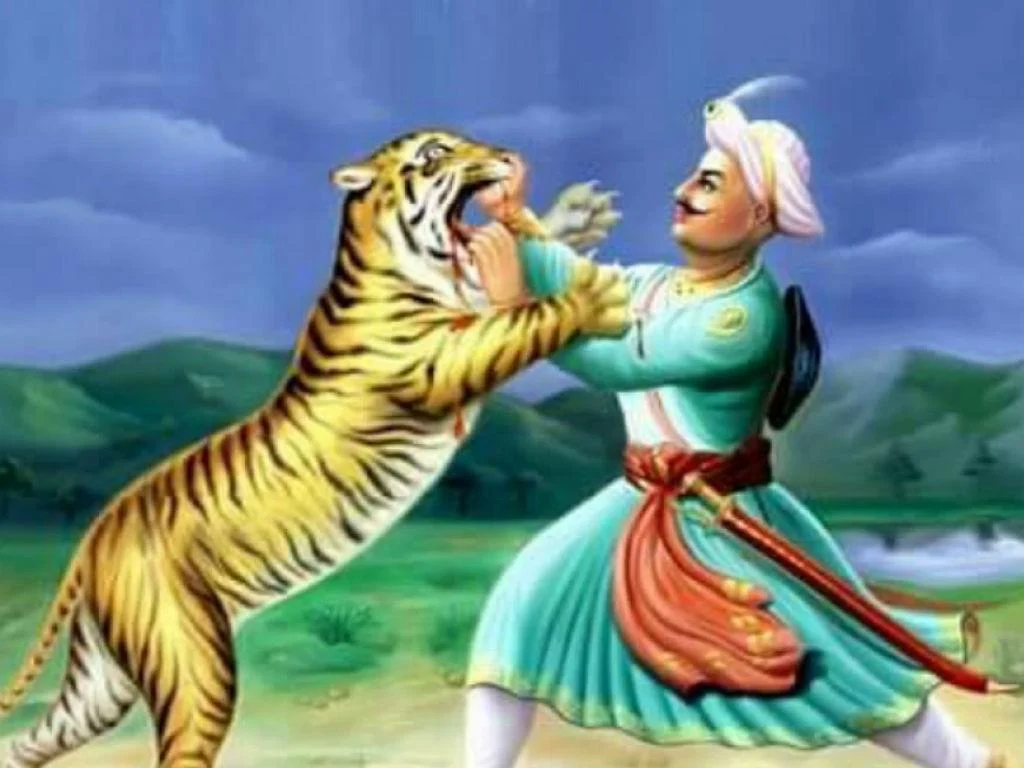
“This place was the base for NASA’s sounding rocket programme. Here, I saw a painting prominently displayed in the reception lobby… It turned out to be Tipu Sultan’s army fighting the British. The painting depicted a fact forgotten in Tipu’s own country but commemorated here on the other side of the planet. I was happy to see an Indian glorified by NASA as a hero of warfare rocketry.”
-A.P.J. Abdul Kalam (Wings of Fire)
“It is better to die before you bend your knees before your enemy”
– Tipu Sultan
From the middle of the 18th century, the East India Company made rapid military gains until they encountered Hyder Ali in Mysore. Unlike previous successes, the East India Company registered its first defeat at the first Anglo-Mysore War (1767 – 1769). After Hyder Ali’s death, in the second Anglo-Mysore War, his son and heir, Tipu Sultan, succeeded him to the throne. Four Anglo-Mysore wars (1767–99), lasting 32 years, made Tipu Sultan famous as an anti-colonial hero who impeded British colonialism. The courage of Tipu Sultan on the battlefields earned him the title of ‘Sher-e-Mysore’ (the Tiger of Mysore). By the end of the 18th century, the Mughal empire was dying, and most of the regional powers like, Rajputana, Ranjit Singh of Punjab, Marathas, and the Nizam of Hyderabad – had compromised with the British. None of them foresaw the long-term threat of a takeover by a colonial power. Tipu Sultan was the only one among his contemporaries who anticipated British imperialism. However, Tipu Sultan did not simply fight on the battlefront. He planned and prepared a strategy. He wanted to create a grand alliance of forces against theBritish, both inside and outside India. He sent his ambassadors to France and Turkey asking for help for Indians in their battle against the British. He also sent his special agents to Pune, Hyderabad, Delhi, Rajputana, Nepal, Kabul, Mauritius etc. He urged all the regional powers in India to rise against British colonialism. Unfortunately, Tipu’s plans of a grand alliance never came to reality. The concept of nationalism was not developed in 18th-century India. Still, Tipu Sultan was much ahead of his time to understand that all Indians had a common enemy in British colonialism. When the Marathas, the Nizam, and the British came together against Tipu, he allied with the French to battle the British. Young Tipu continued the work of his father and stood firmly against the rising power of the East India Company. Tipu Sultan died on May 4th, 1799, on the battlefield fighting the British in the fourth Anglo-Mysore war (1798-1799). His death ended most possibilities of stopping British colonialism.
Tipu Sultan was not only a great warrior but also a visionary ruler and a keen administrator. He initiated a series of progressive socio-economic reforms to promote the economic welfare of his subjects. He wanted Mysore to be an economic, industrial, and military power, to match with the European leading forces in technology and industry. He paid special attention to agriculture, industries, banking and finance, revenue, judiciary, army, navy, social customs, and cultural affairs. He wanted to develop the economy of Mysore State and make the citizens economically self-reliant and politically sovereign. He introduced several new laws, including new coinage, a new lunisolar calendar, and a new land revenue system. He had adopted healthy measures to increase production and productivity in the fields of agriculture and industry. He laid the foundation of an irrigation dam near Mysore on the river Cauvery. He initiated land reforms, a coordinated banking system, a loan scheme for farmers, and initiatives in horticulture, animal husbandry, sericulture, and commerce and manufacturing. He invited experts from Turkey, China, France, and Iran to set up industries in Channapatna, Bidnur, Chitradurga, Bangalore, Srirangapatna, etc. for the development of trade and commerce. Mangalore, Bhatkal, Coondapur, Tadadi, etc. became important naval centres of his times. He advanced rocketry beyond what existed anywhere at that time. He encouraged pearl culture on the Malabar coast. He established widely distributed centres for government-regulated silkworm breeding and rearing in Mysore state that continues to be a huge industry. He attempted to build up a standard system of laws and created civil services to strengthen the administration and perform the responsibilities of the government to the people. He was perhaps the first Indian to recognize theglobal significance of the French Revolution. Following the Revolution, he began referring to himself as “Citizen Tipu”. He also got a special tree planted in his palace, called the ‘Tree of Liberty’.
In recent years Hindutva fascist forces have used British propaganda and portrayed Tipu Sultan as a fanatic who invaded Malabar, Kodagu, and Cochin and committed untold atrocities against the local feudal forces. After being defeated by the Mysore ruler for many years, to salvage their pride, the British made a villain out of Tipu in plays, cartoons and other popular media, representing him as a fanatical Muslim tyrant bent on persecuting Christians and driving Europeans out of the Indian subcontinent. In 2019, the BJP-led Karnataka government banned Tipu’s birthday celebration and eventually removed Tipu from the school curriculum. Even Tipu Express was renamed Wodeyar Express by the BJP. Just a year ago, the BJP cooked up the story of Tipu being killed by Uri Gowda and Nanje Gowda, two imaginary Vokkaliga warriors to sow communal disharmony between the Muslims and Vokkaligas. This project royally backfired on the BJP with even seers speaking out against it.
Research clearly shows that he was a patron of both mosques and temples. Even to this day, there are numerous Hindu temples in the Deccan which are enjoying the benefits of jagirs granted by Tipu Sultan. He also built a church, the first in Mysore. In 1791, Marathas invaded Sringeri and destroyed a temple. The Sankaracharya then appealed to Tipu who immediately sent money and other help for the re-building of the temple. The excesses committed by him were not communal rather political assertions in keeping with the times. Tipu Sultan was a fierce opponent of British colonialism; a proto-nationalist; and a visionary administrator. His legacy can best be understood in the context of the times he lived in. He was the biggest obstacle to the colonial takeover of India by the British. At a time when many Indian kings were eager to seek British alliance and accept “British Residents”, Tipu banned Europeans from entering his territory uninvited. He remains a symbol of resistance to colonialism.